
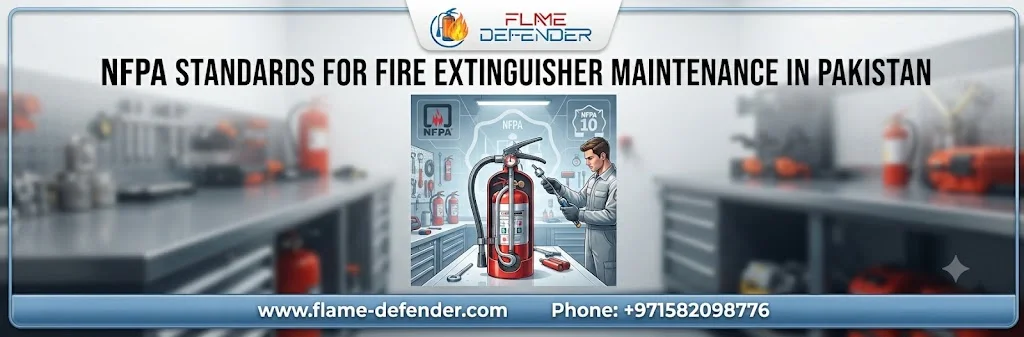
Fire safety is not something any home, office, or factory in Pakistan can afford to ignore. A fire extinguisher sitting quietly in a corner might look ready to work, but without proper care it can fail exactly when it is needed the most. This is why understanding NFPA standards for fire extinguisher maintenance matters and why fire extinguisher refilling in Pakistan has become such an important service for businesses, schools, hospitals, and residential buildings.
In this guide, we’ll break down what NFPA standards actually require, why regular maintenance and refilling keep your extinguishers reliable, and how you can get your equipment serviced correctly by trusted providers such as Flame Defender.
What Is NFPA and Why Does It Matter?
NFPA stands for the National Fire Protection Association, a US-based organization that sets globally recognized codes for fire safety equipment. While Pakistan has its own local fire safety authorities, many companies, multinational offices, and industrial facilities in Pakistan follow NFPA guidelines because they are considered the international benchmark for fire protection.
The most relevant standard here is NFPA 10 Standard for Portable Fire Extinguishers. It lays out exactly how extinguishers should be selected, installed, inspected, maintained, and refilled to keep them functional in an emergency.
Why Fire Extinguisher Maintenance Is So Important in Pakistan
Pakistan’s climate hot summers, humid coastal areas, and dusty industrial zones puts extra strain on fire safety equipment. Extinguishers exposed to heat, moisture, or corrosion can lose pressure or develop internal damage without any visible warning signs. Add to this the fact that many buildings in cities like Karachi, Lahore, Islamabad, and Faisalabad go years without proper fire safety audits, and the risk becomes serious.
Regular maintenance based on NFPA 10 guidelines ensures:
- The extinguisher has the correct pressure to discharge properly
- The extinguishing agent (powder, CO2, foam, etc.) has not degraded
- Hoses, nozzles, and pins are free from blockage or damage
- The unit is legally compliant for insurance and safety inspections
- Lives and property are actually protected when a fire breaks out
Key NFPA 10 Maintenance Requirements
According to NFPA 10, fire extinguisher care is broken into a few clear categories:
1. Monthly Visual Inspection
A quick visual check should be done every month to confirm the extinguisher is in its designated place, the pressure gauge is in the operable range, the pin and tamper seal are intact, and there is no visible damage or corrosion.
2. Annual Maintenance Check
Once a year, a certified technician should perform a more thorough inspection checking the internal condition, verifying weight, and confirming the extinguishing agent is still effective.
3. Recharging / Refilling
Whenever an extinguisher is used, even partially, or when it fails inspection, it must be recharged. NFPA 10 also recommends refilling dry chemical extinguishers roughly every 6 years as part of routine maintenance, even if unused.
4. Hydrostatic Testing
Extinguisher cylinders must undergo hydrostatic testing periodically (commonly every 5 to 12 years depending on the type) to check whether the tank can safely hold pressure.
Fire Extinguisher Refilling in Pakistan: What You Need to Know
Fire extinguisher refilling in Pakistan is the process of replacing the depleted or expired extinguishing agent with a fresh charge, followed by repressurizing the cylinder and testing the discharge mechanism. It’s a specialized job that should never be attempted at home.
A proper refilling service typically involves:
- Inspection – checking the cylinder body, valve, hose, and gauge for damage
- Depressurizing – safely releasing any remaining pressure
- Emptying and cleaning – removing old agent residue from the cylinder
- Refilling – adding the correct type and quantity of extinguishing agent (ABC powder, CO2, foam, or clean agent)
- Repressurizing – restoring the extinguisher to its rated pressure
- Testing and tagging – verifying function and attaching a service tag with the refill date
Skipping any of these steps can leave you with an extinguisher that looks fine but won’t actually work when needed.
Signs Your Fire Extinguisher Needs Refilling
You don’t need to wait for a scheduled inspection to notice trouble. Watch out for:
- The pressure gauge needle pointing to the red zone
- Visible rust, dents, or corrosion on the cylinder
- A broken or missing tamper seal
- Powder clumping (you can sometimes hear this if you gently shake a dry powder extinguisher)
- The extinguisher was used, even briefly, during an incident
- The last service tag is more than a year old
If any of these apply, it’s time to book a professional refill instead of waiting for it to fail during an actual emergency.
How Often Should You Refill Fire Extinguishers in Pakistan?
While the exact interval depends on the type of extinguisher, most commercial and residential properties in Pakistan should follow this general schedule:
- Monthly – visual self-check
- Annually – professional inspection and service
- Every 5–6 years – full refill and recharge (even if unused)
- Every 5–12 years – hydrostatic pressure testing (depending on cylinder type)
Following this schedule keeps your building compliant with fire safety regulations and insurance requirements while genuinely reducing fire risk.
Choosing a Reliable Fire Extinguisher Refilling Service
Given how important correct refilling is, choosing the right service provider matters as much as the schedule itself. A good provider should offer trained technicians, use genuine extinguishing agents, follow NFPA 10 guidelines, and provide proper documentation after every service.
Companies like Flame Defender specialize in fire extinguisher refilling across Pakistan, offering doorstep pickup, certified refilling, and maintenance services for homes, offices, factories, and commercial buildings — helping ensure your fire safety equipment is always ready when it matters most.
Final Thoughts
Fire extinguishers are one of those safety tools people install once and forget about — until it’s too late. Following NFPA standards for inspection, maintenance, and refilling isn’t just a compliance checkbox; it’s what actually determines whether your extinguisher works during a real fire. Whether you manage a small shop or a large industrial facility, scheduling regular fire extinguisher refilling in Pakistan with a trusted, certified provider is one of the simplest ways to protect your property and the people in it.
Frequently Asked Questions (FAQs)
1. What is NFPA 10 and why is it important for fire extinguishers? NFPA 10 is the international standard that defines how fire extinguishers should be selected, inspected, maintained, and refilled. It’s important because it ensures extinguishers actually function correctly during an emergency, rather than failing due to poor maintenance.
2. How often should fire extinguishers be refilled in Pakistan? Most extinguishers should be professionally inspected every year and fully refilled every 5 to 6 years, or immediately after any use, even partial.
3. Can I refill a fire extinguisher myself? No. Refilling requires specialized equipment, the correct extinguishing agent, and trained technicians to safely depressurize, clean, refill, and test the cylinder. DIY refilling can be dangerous and may result in equipment that doesn’t work properly.
4. How do I know if my fire extinguisher needs refilling? Check the pressure gauge — if the needle is outside the green zone, or if there’s visible damage, an expired service tag, or the unit was previously used, it needs refilling.
5. What types of fire extinguishers can be refilled? Most rechargeable types can be refilled, including ABC dry chemical, CO2, foam, and clean agent extinguishers. Disposable (single-use) extinguishers cannot be refilled and must be replaced.
6. Is fire extinguisher refilling mandatory by law in Pakistan? While enforcement varies by region, most commercial buildings, factories, and public spaces are required to maintain functional, regularly serviced fire extinguishers under local fire safety regulations and building codes, and many insurance policies require proof of servicing.
7. How much does fire extinguisher refilling cost in Pakistan? Cost depends on the extinguisher’s size, type, and the extinguishing agent used. CO2 and clean agent refills typically cost more than standard dry powder refills. It’s best to request a quote directly from a certified provider.
8. What happens during a fire extinguisher service visit? A technician inspects the cylinder, hose, and valve, checks the pressure and agent condition, refills or recharges if needed, tests the unit, and attaches a new service tag with the date.
9. How long does a fire extinguisher last before it needs hydrostatic testing? This depends on the cylinder material and type, but most extinguishers require hydrostatic testing somewhere between every 5 and 12 years to confirm the cylinder can still safely hold pressure.
10. Who provides certified fire extinguisher refilling services in Pakistan? Several fire safety companies across Pakistan offer certified refilling and maintenance services. Providers such as Flame Defender offer NFPA-aligned refilling, inspection, and maintenance for homes, offices, and industrial facilities nationwide.