
Fire extinguishers are often the first line of defense when a small fire breaks out. Whether it’s in a home kitchen, an office building, a factory, or a warehouse, having a working extinguisher nearby can mean the difference between a minor incident and a major disaster. But many people forget that an extinguisher is not a “set it and forget it” device. It needs regular care, and one of the most important parts of that care is fire extinguisher refilling.
In this article, we’ll explain what refilling actually means, why it’s so important, how often it should be done, and what the process looks like — especially for homes and businesses across Pakistan.
What Does Fire Extinguisher Refilling Mean?
Fire extinguisher refilling is the process of replacing the used or expired extinguishing agent inside a fire extinguisher with a fresh, properly pressurized charge. Every extinguisher — whether it’s a dry powder (ABC), CO2, foam, or water-based unit — has a limited amount of extinguishing agent and a specific pressure level that must be maintained for it to work correctly.
Over time, extinguishers lose pressure, the chemical agent can settle or degrade, and seals can wear out. If an extinguisher is used even briefly, it usually loses enough pressure that it won’t fire again properly, even if it looks mostly full. Refilling restores the unit to full working condition, so it’s ready the next time it’s needed.
Refilling is different from simply buying a new extinguisher. It’s a maintenance service that extends the life of your existing equipment, checks the internal and external condition of the cylinder, and ensures the extinguisher meets safety standards — all at a fraction of the cost of replacement.
Why Fire Extinguisher Refilling Matters
1. A Half-Charged Extinguisher Can Fail When You Need It Most
An extinguisher that has lost pressure or has a partially used agent may not discharge with enough force to put out a fire. In an emergency, this delay or failure can allow a small fire to spread rapidly. Regular refilling ensures your extinguisher performs at full capacity exactly when it’s required.
2. It’s a Legal and Safety Compliance Requirement
In Pakistan, commercial buildings, factories, schools, hospitals, and offices are generally required to maintain functional fire safety equipment as part of building and workplace safety regulations. Fire departments and safety inspectors often check extinguisher tags or service records during inspections. Keeping extinguishers refilled and serviced helps businesses stay compliant and avoid penalties.
3. It Protects Lives and Property
At the end of the day, the real purpose of fire extinguisher refilling is protecting people. A functioning extinguisher can stop a fire before it spreads to furniture, wiring, gas lines, or an entire building. In many cases, quick action with a properly charged extinguisher prevents what could otherwise become a life-threatening emergency.
4. It’s More Cost-Effective Than Replacement
Buying a brand-new extinguisher every time one is used or expires can be expensive, especially for businesses that maintain multiple units across a building or site. Refilling is typically much cheaper and allows the same cylinder to be reused for years, as long as it passes pressure and safety checks.
5. It Extends Equipment Lifespan
Extinguisher cylinders are built to last many years if properly maintained. Regular refilling, combined with visual inspections and pressure testing, helps extend the working life of the equipment rather than forcing early replacement.
How Often Should a Fire Extinguisher Be Refilled?
There’s no single rule for every extinguisher, but general guidelines include:
- After any use — even a partial discharge — the extinguisher should be refilled immediately.
- Annually — most extinguishers should be professionally inspected once a year, even if never used, to check pressure and condition.
- Every 5 years — many types require a more thorough internal inspection or hydrostatic testing.
- Based on manufacturer guidance — some extinguishers, especially CO2 and dry powder types, have specific service intervals stated by the manufacturer.
Signs that your extinguisher needs refilling include a pressure gauge needle outside the “green zone,” a dented or corroded cylinder, a broken seal or pin, or simply reaching its due service date on the inspection tag.
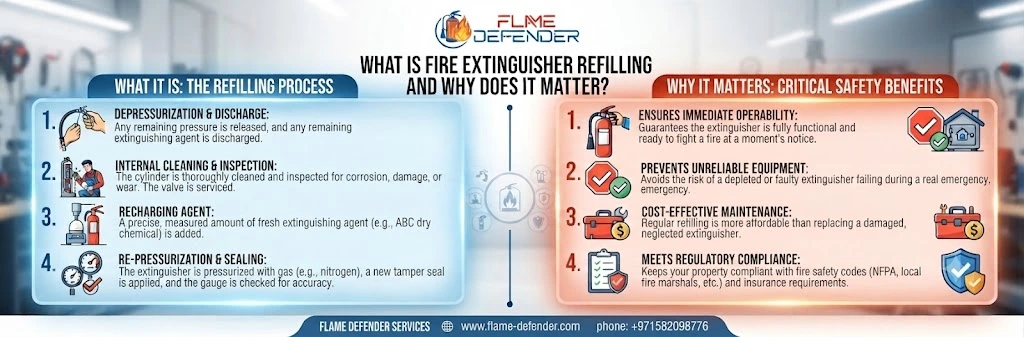
The Fire Extinguisher Refilling Process
While the exact steps vary slightly depending on the extinguisher type, the general process includes:
- Inspection – The technician checks the cylinder body, hose, nozzle, pressure gauge, and pin for damage or wear.
- Discharge and Emptying – Any remaining agent and pressure is safely released from the cylinder.
- Cleaning – The internal chamber is cleaned to remove old residue, especially important for dry chemical extinguishers.
- Refilling the Agent – Fresh extinguishing agent (powder, CO2, foam, or water additive) is added in the correct quantity.
- Pressurizing – The cylinder is recharged with the correct pressure using nitrogen or CO2, depending on the extinguisher type.
- Sealing and Tagging – A new tamper seal and service tag are attached, showing the refill date and next due date.
- Final Testing – The extinguisher is checked for leaks and proper gauge reading before being returned to service.
This process should always be handled by trained professionals using proper equipment, since incorrect pressurization or a poor seal can make an extinguisher unsafe or unreliable.
Fire Extinguisher Refilling in Pakistan
As industrial activity, commercial construction, and residential safety awareness grow across Pakistan, the demand for reliable fire safety maintenance services — including extinguisher refilling — has increased significantly. Cities like Karachi, Lahore, Islamabad, Rawalpindi, and Faisalabad host thousands of businesses, factories, and residential complexes that rely on properly maintained fire extinguishers to meet safety standards and protect occupants.
Choosing a trusted local provider for fire extinguisher refilling in Pakistan ensures that your equipment is serviced using genuine agents, correct pressure standards, and proper safety checks — not just a quick refill that looks fine on the outside but fails when actually needed. Professional providers, such as Flame Defender, offer refilling and maintenance services designed to keep homes, offices, and industrial sites compliant and genuinely fire-ready throughout the year.
Final Thoughts
Fire extinguisher refilling isn’t just a maintenance formality — it’s a critical part of keeping any building genuinely prepared for a fire emergency. An extinguisher that looks fine on the outside can still be empty, under-pressurized, or expired on the inside. Routine refilling, inspection, and servicing ensure that when a fire starts, your extinguisher is ready to respond immediately and effectively.
Whether you manage a home, an office, a factory, or a commercial property in Pakistan, scheduling regular fire extinguisher refilling should be a non-negotiable part of your safety routine.
Frequently Asked Questions (FAQs)
1. What is fire extinguisher refilling? Fire extinguisher refilling is the process of replacing the used, expired, or depressurized extinguishing agent inside a fire extinguisher with a fresh charge, restoring it to full working condition.
2. How often should a fire extinguisher be refilled? Most extinguishers should be inspected annually and refilled immediately after any use. Depending on the type, a full recharge or hydrostatic test may be needed every 5 years.
3. How do I know if my fire extinguisher needs refilling? Check the pressure gauge — if the needle isn’t in the green zone, the extinguisher needs attention. Other signs include a broken seal, missing pin, corrosion, or an expired service tag.
4. Is it cheaper to refill or replace a fire extinguisher? Refilling is usually far more cost-effective than buying a new extinguisher, as long as the cylinder passes inspection and pressure testing.
5. Can I refill a fire extinguisher myself? No. Refilling requires specialized equipment, correct pressurization, and trained handling of extinguishing agents, so it should always be done by a certified fire safety professional.
6. How long does fire extinguisher refilling take? A standard refill typically takes anywhere from a few minutes to a couple of hours per unit, depending on the extinguisher type and service provider’s workload.
7. What types of fire extinguishers can be refilled? Most types can be refilled, including dry chemical (ABC), CO2, foam, and water-based extinguishers, as long as the cylinder itself passes a safety inspection.
8. Is fire extinguisher refilling mandatory for businesses in Pakistan? Yes, commercial buildings, factories, and workplaces are generally expected to maintain functional, regularly serviced fire extinguishers to meet safety and fire code requirements.
9. What happens if I don’t refill an expired fire extinguisher? An expired or under-pressurized extinguisher may fail to discharge properly during a fire, putting lives and property at serious risk, and may also result in non-compliance during safety inspections.
10. Where can I get fire extinguisher refilling services in Pakistan? Many fire safety companies across Pakistan’s major cities offer professional refilling services. Providers like Flame Defender offer reliable, standard-compliant refilling and maintenance for homes and businesses.