
Fire safety is an essential part of running a responsible business. Whether a company operates a small retail shop, an office, a warehouse, a restaurant, a factory, or a commercial building, fire hazards can threaten employees, customers, equipment, inventory, and business continuity.
A fire can begin with an electrical fault, unattended cooking equipment, overheated machinery, improper storage of combustible materials, or a poorly maintained appliance. Without appropriate precautions, a small incident can quickly become a serious emergency.
For businesses in Pakistan, fire prevention deserves particular attention because commercial properties may contain electrical equipment, generators, air-conditioning systems, fuel supplies, packaging materials, and other potential sources of ignition or combustible materials. Effective prevention requires more than placing fire extinguishers around a building. It involves identifying hazards, maintaining equipment, training employees, and preparing for emergencies.
A properly selected fire alarm system in Pakistan can also support a comprehensive fire protection strategy by warning occupants when a fire is detected. However, detection equipment works best alongside safe working practices, suitable firefighting arrangements, clear escape routes, and regular maintenance.
This guide explains why every business needs fire prevention tips, which hazards deserve attention, and how organizations can develop a practical workplace fire safety plan.
1. Understanding the Importance of Fire Prevention
Fire prevention means identifying and reducing the conditions that could cause a fire before an emergency occurs. It includes everyday practices such as maintaining electrical installations, storing materials safely, controlling ignition sources, and ensuring that employees understand workplace hazards.
Prevention is important because a commercial fire can affect several aspects of an organization simultaneously.
Employee safety: Workers and visitors may be exposed to smoke, heat, and dangerous evacuation conditions. Prevention and early warning help support a safer workplace.
Protection of assets: Computers, machinery, stock, documents, furniture, and production equipment can be damaged or destroyed by fire.
Business continuity: Even a fire that does not destroy an entire building may interrupt operations, delay deliveries, and affect customers.
Financial stability: Fire incidents can lead to repair expenses, lost inventory, operational downtime, and insurance complications.
Regulatory responsibilities: Businesses may need to meet applicable building, workplace, fire protection, and local authority requirements.
Fire prevention is therefore not simply an equipment-related expense. It is an important part of protecting people, maintaining operations, and managing business risks.
2. Identify Common Fire Hazards in Commercial Buildings
A business cannot manage fire risks effectively without understanding where they may arise. Every workplace has a different risk profile, so inspections should consider the building’s activities, equipment, materials, and occupancy.
Electrical faults
Damaged wiring, overloaded sockets, defective appliances, loose connections, and poorly maintained electrical equipment can create fire hazards.
Businesses should arrange appropriate inspections and repairs through qualified electrical professionals. Employees should report damaged cables, unusual heating, burning smells, or repeated circuit interruptions rather than attempting unauthorized repairs.
Avoid using extension leads as permanent substitutes for suitable electrical installations. Equipment should be used according to its ratings and manufacturer instructions.
Cooking equipment
Restaurants, cafés, hotels, canteens, and workplace kitchens face additional hazards from cooking appliances, hot surfaces, and combustible grease deposits.
Kitchen staff should follow safe operating procedures, keep cooking areas clean, and ensure that suitable fire protection equipment is available. Equipment should be maintained regularly, and employees should understand how to respond to a cooking-related fire without putting themselves at risk.
Combustible materials
Paper, cardboard, textiles, plastics, packaging, and certain chemicals can contribute to fire growth.
Storage areas should be organized so that materials do not obstruct exits, electrical equipment, or firefighting equipment. Hazardous materials require storage arrangements appropriate to their properties and applicable safety requirements.
Machinery and generators
Factories, workshops, warehouses, and businesses using backup generators may have hazards associated with moving machinery, hot components, fuel, and electrical connections.
Routine maintenance, suitable ventilation, housekeeping, and adherence to manufacturer instructions help reduce these risks.
Smoking and open flames
Smoking materials, candles, welding operations, and other ignition sources require appropriate controls. Businesses should establish clear rules for smoking and hot work, including designated areas or permit procedures where necessary.
Recognizing these hazards early allows managers to take preventive action before they develop into emergencies.
3. Develop a Workplace Fire Prevention Plan
A written fire prevention plan gives employees and managers a consistent approach to identifying hazards and responding to problems.
The plan should reflect the size, layout, activities, and risks of the business. A small office may need a simpler arrangement than a factory handling combustible materials or a multistorey commercial building.
A practical plan should include:
- Identification of likely ignition sources and combustible materials.
- Procedures for reporting fire hazards and equipment faults.
- Responsibilities for inspections and maintenance.
- Safe storage and housekeeping requirements.
- Emergency communication arrangements.
- Evacuation routes and assembly points.
- Staff training and evacuation drills.
- Inspection records and corrective actions.
Assign responsibility for keeping the plan current. Managers should review it when the business changes its layout, introduces new machinery, increases storage, or changes the number of people working in the building.
A plan is only useful when employees understand it and managers act on identified problems.
4. Install Suitable Fire Detection and Alarm Equipment
Early warning is an important part of workplace fire protection. Employees may not immediately notice a fire, particularly when it begins in a storeroom, electrical room, ceiling space, or an area that is not regularly occupied.
A suitable fire alarm system can alert occupants so they can begin the established emergency response.
In Pakistan, businesses should assess their detection and alarm requirements against the applicable building code, local regulations, occupancy type, and recommendations from qualified fire safety professionals.
The Pakistan Engineering Council’s Building Code of Pakistan: Fire Safety Provisions 2016 provides a national reference for building fire safety. Punjab Civil Defence also identifies fire detection and alarm systems among the fire safety measures considered during inspections of industrial, commercial, and high-rise premises. <Cite refs={[“turn889549search33″,”turn889549search0”]}/>
Depending on the building and its risk profile, a system may include:
Smoke detectors: These detect smoke and can provide early warning in suitable locations.
Heat detectors: These respond to temperature conditions and may be appropriate in certain areas where smoke detectors are unsuitable.
Manual call points: These allow occupants to activate an alarm when they discover a fire, where such devices are part of the system design.
Audible and visual notification devices: These help communicate the warning to occupants, including in areas where background noise may make an audible alarm difficult to hear.
Control panels and backup power: Larger installations may use a control panel to monitor detection devices and manage alarms. Appropriate backup power can help maintain system operation during a power interruption.
The precise design should be determined by the building’s needs and applicable requirements. Installing equipment is not enough; it must also be tested, maintained, and kept operational.
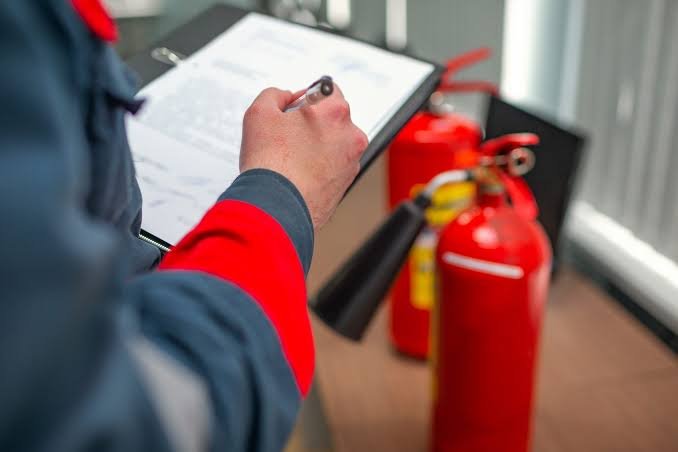
5. Keep Fire Extinguishers and Firefighting Equipment Ready
Fire extinguishers and other firefighting equipment may help control certain fires when the equipment is suitable, the incident is still manageable, and trained people can act without unnecessary risk.
Businesses should not choose equipment solely on price or appearance. The type, capacity, number, and placement of extinguishers should reflect the hazards present and applicable requirements.
For example, electrical equipment, cooking oils, ordinary combustible materials, and flammable liquids may require different approaches to fire control. Using an unsuitable extinguisher can create additional hazards.
A workplace fire safety inspection should confirm that:
- Equipment is appropriate for the identified risks.
- Extinguishers are visible and accessible.
- Inspection and servicing requirements are followed.
- Employees know where equipment is located.
- Relevant staff receive appropriate training.
- Hydrants, hose reels, and sprinkler systems are maintained where installed.
Never allow stock, furniture, or deliveries to block firefighting equipment.
Employees should only attempt to tackle a small fire if they are trained, the correct equipment is available, the alarm has been raised, and a safe escape route remains open. If the fire grows, smoke spreads, or conditions become unsafe, they should evacuate immediately.
6. Maintain Clear Emergency Exits and Escape Routes
A fire prevention strategy must include safe evacuation. Even a well-maintained alarm system cannot protect occupants effectively if exits are blocked or employees do not know how to leave.
Businesses should ensure that escape routes are clearly identified, accessible, and maintained according to applicable requirements.
Common problems include stock placed in corridors, locked exit doors, blocked stairways, damaged emergency lights, and signs that are difficult to see.
Managers should inspect escape routes regularly and correct problems promptly.
An effective evacuation arrangement should identify:
- Primary and alternative escape routes.
- Emergency exits and stairways.
- Assembly points outside the building.
- Procedures for assisting people who need additional support.
- Responsibilities for communicating with emergency services.
- Methods for accounting for employees and visitors after evacuation.
Employees should never be instructed to return to a building to collect belongings or investigate whether a fire has been extinguished.
Escape plans should be displayed where appropriate, explained to staff, and reviewed whenever the building layout changes.
7. Train Employees to Recognize and Prevent Fire Hazards
Employees are often the first people to notice an unsafe condition. Training helps them recognize hazards and understand the correct reporting and response procedures.
Fire safety training should be suitable for the workplace and the tasks employees perform.
Topics may include:
- Identifying common fire hazards.
- Safe use of electrical equipment.
- Correct storage of combustible materials.
- Reporting faults and unsafe conditions.
- Raising the alarm when a fire is discovered.
- Understanding evacuation routes and assembly points.
- Knowing when not to attempt firefighting.
- Following instructions from designated safety personnel.
Training should not be limited to new employees. Refresher sessions are useful when procedures change, new equipment is introduced, or inspections reveal recurring problems.
Punjab Civil Defence lists fire safety, firefighting, first aid, and evacuation drills among its training and awareness activities. Businesses can investigate relevant training options through the appropriate local authority. <Cite refs={[“turn889549search5″,”turn889549search4”]}/>
A workplace where employees feel comfortable reporting hazards is more likely to identify problems before they become serious.
8. Schedule Regular Inspections and Preventive Maintenance
Fire safety equipment can become unreliable when it is neglected. Regular inspections help businesses identify faults, damage, obstructions, and maintenance needs.
A preventive maintenance schedule should cover equipment and building features relevant to the workplace.
For example, inspections may include:
- Electrical installations and connected equipment.
- Fire alarms and detection devices.
- Fire extinguishers and firefighting systems.
- Emergency lighting and exit signs.
- Fire doors and escape routes.
- Kitchen extraction systems where applicable.
- Generators and associated fuel arrangements.
- Storage areas containing combustible materials.
The frequency of checks depends on the equipment, manufacturer’s instructions, relevant standards, and applicable regulations. Some checks may be performed by designated staff, while technical inspection and servicing must be completed by qualified professionals.
Keep records of inspection dates, identified defects, repairs, and outstanding actions. Records help managers track recurring problems and demonstrate that safety responsibilities are being addressed.
If a critical safety system fails, arrange prompt assessment and repair. Do not assume that equipment is functional simply because it appears undamaged.
9. Improve Housekeeping and Safe Material Storage
Poor housekeeping can increase fire risk and make evacuation more difficult. Accumulated waste, obstructed corridors, and careless storage practices can create unnecessary hazards.
Businesses should introduce straightforward housekeeping rules that employees can follow every day.
Remove waste regularly, keep work areas organized, and prevent combustible materials from accumulating near ignition sources. Maintain suitable clearance around electrical panels and machinery according to applicable requirements.
In warehouses, materials should be stored in stable arrangements that do not obstruct exits, detection devices, or firefighting equipment.
Chemicals and flammable liquids should be stored in appropriate containers and designated areas, following safety data sheets and relevant requirements. They should not be stored casually beside heat sources or incompatible substances.
Supervisors should include housekeeping in routine workplace inspections rather than waiting for a major safety review.
10. Control Hot Work and High-Risk Activities
Some business activities create temporary fire hazards even when the workplace is normally safe.
Welding, cutting, grinding, soldering, and similar hot work can produce sparks or heat capable of igniting combustible materials.
Where appropriate, businesses should establish a hot-work permit procedure. This process may include authorizing the task, checking the surrounding area, removing or protecting combustible materials, confirming suitable firefighting arrangements, and monitoring the area after work finishes.
Only trained and authorized personnel should carry out tasks requiring specialized precautions.
Contractors should be informed about workplace fire safety procedures before beginning work. Managers should verify that temporary work does not block exits, disable detection equipment without authorization, or introduce unassessed hazards.
Where a fire protection system must temporarily be isolated for legitimate maintenance, the business should use an approved impairment procedure and arrange appropriate compensating measures.
11. Prepare for Power Failures and Electrical Emergencies
Power interruptions can complicate an emergency, particularly in multistorey buildings, warehouses, and workplaces that rely on powered equipment.
Businesses should confirm that essential fire safety systems have appropriate backup arrangements where required. Emergency lighting, alarm notification, and other life-safety equipment should be assessed as part of the building’s overall safety design.
Generators should be installed, operated, and maintained according to manufacturer instructions and relevant safety requirements. Fuel storage, exhaust ventilation, and electrical connections require particular attention.
Never use unsafe temporary wiring to restore power to critical systems. Qualified professionals should assess electrical faults and complete necessary repairs.
Staff should understand what to do if normal lighting fails, an alarm activates during a power interruption, or electrical equipment begins showing signs of overheating.
12. Conduct Fire Drills and Review Emergency Procedures
A written emergency plan should be tested through suitable drills. Drills help employees become familiar with exits, assembly points, warning signals, and their responsibilities.
After a drill, managers should evaluate whether people understood the instructions, whether routes were accessible, and whether communication worked as intended.
Identify problems and assign corrective actions. For example, a drill may reveal that an assembly point is poorly located, employees cannot hear the alarm in a noisy area, or visitors need clearer instructions.
Drills should be designed around the workplace and conducted at appropriate intervals. They should not create unnecessary danger or interfere with genuine emergency response.
For larger or higher-risk premises, qualified fire safety professionals can help assess the plan and identify improvements.
13. Understand Fire Safety Responsibilities in Pakistan
Businesses in Pakistan should not assume that a single checklist applies identically to every property. Requirements can depend on the province, municipality, building classification, occupancy, height, size, and activities carried out on the premises.
The Pakistan Engineering Council publishes the Building Code of Pakistan: Fire Safety Provisions 2016. Punjab Civil Defence identifies fire detection and alarm systems, firefighting arrangements, fire safety plans, emergency control facilities, and evacuation planning among the measures considered in relevant inspections. <Cite refs={[“turn889549search33″,”turn889549search0”]}/>
Business owners and facility managers should consult the relevant building-control authority, Civil Defence department, fire service, and qualified fire safety professionals to establish which provisions apply.
Do not rely on informal advice or the presence of equipment alone as proof of compliance. Documentation, installation quality, inspection records, maintenance, and actual operational readiness may all matter.
A professional assessment can help identify gaps between the existing arrangements and the requirements applicable to the property.
14. Build a Long-Term Fire Safety Culture
Fire prevention is most effective when it becomes part of normal business operations rather than an occasional task.
Management should communicate clear expectations, provide suitable training, maintain safety equipment, and respond promptly when employees report hazards.
Businesses can support this approach by assigning a responsible person to coordinate inspections, keeping maintenance records, reviewing incident reports, and tracking corrective actions.
Safety performance should not be measured only by whether a fire has occurred. Near misses, defective equipment, blocked exits, and repeated unsafe practices can reveal weaknesses that need attention.
Small, consistent improvements can make workplace safety more dependable over time.
Conclusion
Every business needs fire prevention measures because a fire can threaten people, property, operations, and long-term financial stability. Identifying hazards, maintaining equipment, organizing storage, training employees, and keeping escape routes clear are practical steps that businesses can take to reduce avoidable risks.
A suitable fire alarm system in Pakistan can strengthen a workplace’s ability to detect a fire and warn occupants, provided that it is properly designed, installed, tested, and maintained. It should form part of a wider strategy that includes suitable firefighting arrangements, emergency planning, staff training, and compliance with applicable requirements.
The best time to address fire hazards is before an emergency occurs. By making fire prevention a shared responsibility, businesses can create safer workplaces and become better prepared to protect employees, customers, and essential assets.
Frequently Asked Questions (FAQs)
1. Why is fire prevention important for every business?
Fire prevention helps protect employees, customers, buildings, stock, machinery, and business operations. It also helps organizations identify hazards early, reduce avoidable damage, and prepare for emergencies.
2. What are the most common fire hazards in businesses?
Common hazards include faulty electrical equipment, overloaded sockets, unsafe cooking practices, combustible waste, improper material storage, poorly maintained machinery, and uncontrolled hot work. The risks vary depending on the type of business.
3. Does every business need a fire alarm system in Pakistan?
Fire detection and alarm requirements depend on the building, occupancy, applicable codes, and local regulations. Businesses should consult the relevant authority and a qualified fire safety professional to determine the appropriate system for their premises.
4. How often should a business inspect its fire safety equipment?
Inspection frequency depends on the equipment, manufacturer’s instructions, applicable standards, and local requirements. Businesses should establish a documented schedule, carry out appropriate routine checks, and arrange professional servicing when required.
5. What should employees do when a fire breaks out at work?
Employees should raise the alarm, follow the established evacuation procedure, use designated escape routes, and move to the assembly point. They should contact emergency services according to workplace procedures and never re-enter the building until authorized. Firefighting should only be attempted by trained people when it is safe to do so.