
Fire extinguishers are one of the most important safety tools in any home, office, factory, or shop. But once a fire extinguisher is used, or once it crosses its expiry date, it needs to be refilled. In Pakistan, many people try to save money by refilling their fire extinguishers themselves or by taking help from an untrained local mechanic. This might sound like a smart, budget-friendly idea, but in reality, it can put your life, your property, and everyone around you at serious risk.
In this article, we will explain in simple words why DIY fire extinguisher refilling is dangerous, what can go wrong, and why professional fire extinguisher refilling in Pakistan is always the safer and smarter choice.
What Does “Refilling a Fire Extinguisher” Actually Mean?
A fire extinguisher is a pressurized cylinder. Inside it, there is a firefighting agent (like dry chemical powder, CO2, or foam) along with a propellant that pushes this agent out when you press the lever. Over time, or after use, the pressure drops and the agent gets used up. Refilling means:
- Removing the old or used agent
- Cleaning and inspecting the cylinder
- Adding the correct type and quantity of firefighting agent
- Re-pressurizing the cylinder to the exact required level
- Testing the valve, hose, and seals for leaks
- Sealing and tagging the extinguisher with a new expiry date
This sounds simple on paper, but every single step requires technical knowledge, calibrated equipment, and safety training. This is exactly where DIY attempts go wrong.
The Real Dangers of DIY Fire Extinguisher Refilling
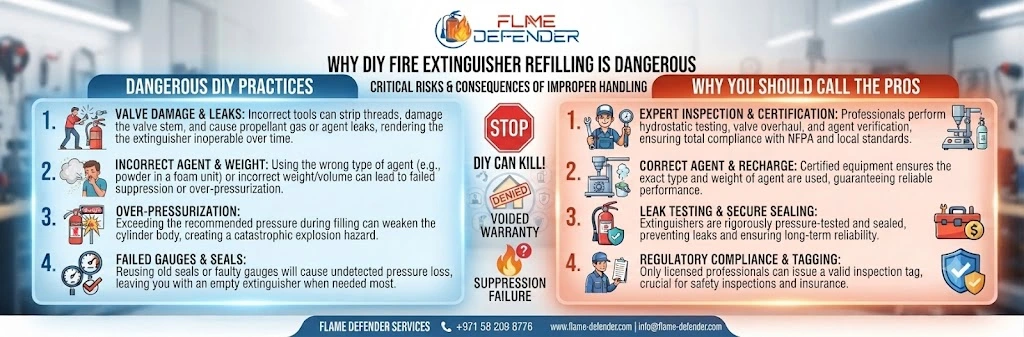
1. Risk of Cylinder Explosion
Fire extinguisher cylinders are pressure vessels. If they are overfilled, under-tested, or pressurized with the wrong equipment, they can rupture or explode. A person refilling an extinguisher at home usually does not have a pressure gauge calibrated for this exact purpose, which means they are literally guessing the pressure level. An over-pressurized cylinder can burst violently, causing serious injury or even death.
2. Wrong Agent-to-Cylinder Match
Not every extinguisher accepts the same agent. ABC powder, CO2, foam, and clean agent extinguishers all have different chemical compositions and different cylinder designs. Using the wrong agent or mixing chemicals incorrectly can cause a chemical reaction inside the cylinder, corrode the internal walls, or make the extinguisher completely ineffective during an actual fire.
3. Corroded or Weak Cylinders Go Unnoticed
Professional refilling always includes hydrostatic testing, which checks whether the cylinder body is still strong enough to hold pressure safely. DIY refilling skips this step entirely. A cylinder that looks fine from the outside may be corroded or weakened from the inside, and refilling it without testing is like reusing a cracked gas cylinder — the danger is invisible until it’s too late.
4. Faulty Valves and Seals
The valve assembly, O-rings, and seals of a fire extinguisher are precision components. If they are not replaced or fitted correctly, the extinguisher may leak slowly over time, or worse, it may fail to build pressure at all. This means that when you actually need it during a fire, it simply won’t work.
5. The Extinguisher May Fail When You Need It Most
This is the biggest danger of all. A fire extinguisher exists for one reason: to work instantly and reliably during an emergency. A poorly refilled extinguisher may look normal, show a full pressure gauge, and still fail to discharge properly, or discharge with very low pressure, giving you no real chance to control the fire.
6. No Compliance With Safety Standards
In Pakistan, fire safety equipment used in offices, factories, schools, and commercial buildings is often subject to inspection by fire departments, insurance companies, or safety auditors. DIY-refilled extinguishers usually do not carry proper certification, tags, or documentation, which can lead to compliance issues, failed audits, or even invalidated insurance claims after a fire incident.
7. Health Risks From Chemical Exposure
Handling dry chemical powder, CO2 under pressure, or foam concentrate without proper protective equipment and ventilation can cause skin irritation, respiratory issues, or eye damage. Professionals working in controlled environments use protective gear and proper handling procedures that most people don’t have access to at home.
Why Professional Refilling Is Always Worth It
Getting your fire extinguisher refilled by a certified professional service ensures:
- Correct agent type and exact quantity for your cylinder
- Accurate pressure testing with calibrated equipment
- Hydrostatic testing to check cylinder strength
- Genuine valve, hose, and seal replacement when needed
- A certified tag with refill date and next due date
- Peace of mind that the extinguisher will actually work when needed
Professional fire extinguisher refilling costs only a small amount compared to the value of the property and lives it protects. It is one of those safety investments that should never be compromised for the sake of saving a little money.
If you are located in Pakistan and want your fire extinguishers refilled safely and correctly, it’s best to rely on a trusted, certified provider rather than attempting it yourself or using an unverified local mechanic. You can learn more about proper refilling services here: Fire Extinguisher Refilling in Pakistan.
Signs That Your Fire Extinguisher Needs Refilling
- The pressure gauge needle is in the red zone (not green)
- The extinguisher was used, even partially
- The extinguisher is past its expiry/service date (usually annually)
- You notice rust, dents, or damage on the cylinder body
- The pin or tamper seal is broken
- There is visible powder leakage or clumping inside (for powder types)
If you notice any of these signs, don’t wait — get it checked and refilled by a professional as soon as possible.
Final Thoughts
DIY fire extinguisher refilling might seem like an easy way to save a few rupees. Still, the hidden risks — cylinder explosion, chemical mismatch, faulty valves, and complete extinguisher failure during a real fire — are simply not worth it. Fire safety equipment is meant to protect lives, and that protection only works if it’s done right.
Always choose certified, professional fire extinguisher refilling in Pakistan to make sure your extinguisher is ready, reliable, and safe whenever you need it most.
Frequently Asked Questions (FAQs)
1. Is it safe to refill a fire extinguisher at home? No, refilling a fire extinguisher at home is not safe. It involves pressurized equipment, specific chemical agents, and testing procedures that require professional training and calibrated tools.
2. How often should a fire extinguisher be refilled in Pakistan? Most fire extinguishers should be inspected annually and refilled either after use or when the pressure gauge shows low pressure, typically every 1 to 5 years, depending on the type and usage.
3. What happens if I use an expired fire extinguisher? An expired fire extinguisher may have reduced pressure, degraded chemical agent, or a weakened cylinder, which means it may not discharge properly or work at all during a fire emergency.
4. Can any mechanic refill a fire extinguisher? No, only trained and certified technicians with proper equipment, correct firefighting agents, and testing tools should refill fire extinguishers. An untrained mechanic can make critical mistakes.
5. What is hydrostatic testing, and why is it important? Hydrostatic testing checks whether a fire extinguisher cylinder can still safely hold pressure. It detects internal corrosion or weakness that isn’t visible from the outside, preventing dangerous cylinder failures.
6. How much does fire extinguisher refilling cost in Pakistan? The cost varies depending on the extinguisher type and size (CO2, ABC powder, foam, etc.). Still, it is generally affordable and far less expensive than the potential cost of fire damage or injury.
7. Can a fire extinguisher explode if refilled incorrectly? Yes, incorrect refilling — especially overfilling or over-pressurizing — can cause the cylinder to rupture or explode, posing a serious safety risk to anyone nearby.
8. What types of fire extinguishers need professional refilling? All types, including ABC dry powder, CO2, foam, and clean agent extinguishers, require professional refilling since each uses different agents, pressures, and cylinder specifications.
9. How do I know if my fire extinguisher needs refilling? Check the pressure gauge (it should be in the green zone), look for a broken tamper seal, visible damage, rust, or an expired service date on the tag.
10. Where can I get professional fire extinguisher refilling in Pakistan? You can get certified and reliable fire extinguisher refilling services through trusted providers like Flame Defender, which ensures safe handling, proper testing, and compliance with fire safety standards.