
Fire safety is not something you think about — until the moment you need it. A fire extinguisher sitting quietly in the corner of your office, kitchen, warehouse, or car is one of the most important safety tools you’ll ever own. But here’s the catch: an extinguisher is only useful if it actually works when you need it. That’s where regular fire extinguisher refilling in Pakistan becomes essential.
In this guide, we’ll break down the different types of fire extinguishers, what kind of fire each one is designed for, and how often they need to be refilled or serviced. Whether you’re a homeowner, a business manager, or someone responsible for safety compliance, this article will help you understand exactly what your building needs.
Why Understanding Fire Extinguisher Types Matters
Not all fires are the same, and not all extinguishers work on every fire. Using the wrong type of extinguisher can make a fire worse instead of putting it out. That’s why fire safety codes classify extinguishers based on the type of fuel they’re designed to fight.
Choosing the right extinguisher — and keeping it properly maintained — is a legal and practical requirement for homes, offices, factories, and commercial buildings across Pakistan. Local fire departments and safety consultants strongly recommend that every property owner know which extinguishers they have and when they’re due for a refill.
The Main Types of Fire Extinguishers
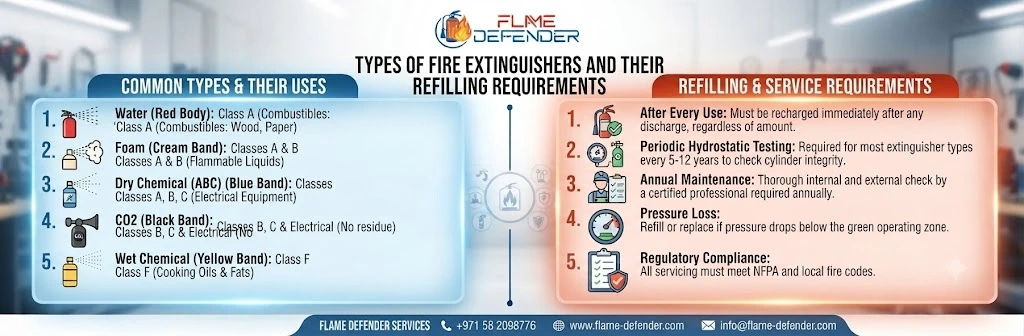
1. Water Fire Extinguishers (Class A)
Water extinguishers are the most basic type and are used for fires involving ordinary combustible materials like wood, paper, cloth, and cardboard. They work by cooling the fire and removing the heat element needed for combustion.
Best for: Offices, schools, libraries, and homes with a lot of paper or wood-based materials.
Not suitable for: Electrical fires or flammable liquid fires, since water can spread the flames or cause electric shock.
2. Foam Fire Extinguishers (Class A & B)
Foam extinguishers are versatile and can handle both ordinary combustible fires and flammable liquid fires such as petrol, oil, or paint. The foam creates a blanket over the fire, cutting off its oxygen supply.
Best for: Garages, workshops, warehouses, and industrial areas where flammable liquids are stored.
3. Dry Powder (ABC) Fire Extinguishers
This is the most common type found across Pakistan because it’s a multi-purpose extinguisher. It can be used on Class A, B, and C fires — meaning solids, liquids, and gases. The powder interrupts the chemical reaction of the fire.
Best for: Homes, offices, vehicles, factories, and virtually any general-purpose setting.
Note: Dry powder can leave residue and reduce visibility, so it’s not ideal for confined spaces with sensitive electronics.
4. CO2 (Carbon Dioxide) Fire Extinguishers
CO2 extinguishers are designed specifically for electrical fires and flammable liquids. They don’t leave any residue, which makes them perfect for areas with computers, servers, and electrical panels.
Best for: Server rooms, electrical substations, laboratories, and IT offices.
5. Wet Chemical Fire Extinguishers (Class F/K)
These are specialized extinguishers designed for kitchen fires involving cooking oils and fats. They cool the fire quickly and form a soap-like layer that prevents re-ignition.
Best for: Commercial kitchens, restaurants, and hotel kitchens.
Why Fire Extinguisher Refilling Is Necessary
A fire extinguisher isn’t a “buy it once and forget it” device. Over time, the pressure inside the cylinder drops, the extinguishing agent can degrade, and seals can wear out. If not maintained, an extinguisher may fail during an actual emergency, which defeats its entire purpose.
Here’s why refilling matters so much:
- Pressure loss: Extinguishers rely on internal pressure to discharge their contents. Even a small leak can render them useless.
- Agent degradation: Dry powder can clump, foam can separate, and chemical agents can lose effectiveness over time.
- Legal compliance: Businesses in Pakistan are required to maintain functional fire safety equipment as part of building safety codes and insurance requirements.
- Reliability during emergencies: A poorly maintained extinguisher may not discharge properly, wasting critical seconds during a fire.
How Often Should Fire Extinguishers Be Refilled?
Refilling schedules depend on the type of extinguisher, how it’s used, and manufacturer guidelines. As a general rule followed across Pakistan:
Extinguisher Type: Recommended Refilling Interval
Water (Class A) Every 1 year
Foam (Class A & B) Every 1 year
Dry Powder (ABC) Every 1 year (or after any use)
CO2 Every 5 years (with annual inspection)
Wet Chemical Every 1 year
In addition to scheduled refilling, an extinguisher must be refilled immediately after any use, even a partial discharge, since the pressure and content level will no longer be at full capacity.
Signs Your Fire Extinguisher Needs Refilling
You don’t always have to wait for the annual schedule. Watch out for these warning signs:
- The pressure gauge needle is in the red zone (not the green “operational” zone)
- Visible corrosion or rust on the cylinder
- Dents or damage to the extinguisher body
- The pin or tamper seal is broken.
- It’s been used, even briefly.
- The inspection tag shows an expired date.
If you notice any of these signs, it’s time to book a professional fire extinguisher refilling service rather than risk relying on faulty equipment.
Fire Extinguisher Refilling in Pakistan: What to Expect
Across major cities in Pakistan — including Lahore, Karachi, Islamabad, and Rawalpindi — professional fire safety companies offer refilling, servicing, and inspection for all extinguisher types. A proper refilling service typically includes:
- Inspection of the cylinder body, valve, and hose for damage
- Discharge testing of the current pressure and agent condition
- Refilling with fresh extinguishing agent (powder, foam, water, or CO2)
- Pressure testing to confirm the cylinder holds correctly
- Tagging and documentation with the refill date for compliance records
Choosing a reliable service provider matters because improperly refilled extinguishers can be just as dangerous as expired ones. Working with a certified provider like Flame Defender ensures your extinguishers are refilled to proper safety standards, tested for pressure accuracy, and ready for real emergencies.
Who Needs Regular Fire Extinguisher Refilling?
- Homeowners — for kitchen and general household safety
- Offices and corporate buildings — for compliance and employee safety
- Factories and warehouses — where flammable materials are common
- Restaurants and hotels — for kitchen fire risks
- Schools and hospitals — where public safety regulations are strict
- Vehicle owners — as extinguishers are often required in commercial transport
Final Thoughts
Fire extinguishers are a small investment that can prevent massive property damage and save lives. But an extinguisher is only as reliable as its last service date. Understanding the different types — water, foam, dry powder, CO2, and wet Chemical — helps you choose the right protection for your space, while regular refilling ensures that protection actually works when it matters most.
If your fire extinguishers haven’t been checked recently, don’t wait for an emergency to find out they’re empty. Schedule a professional fire extinguisher refilling service today to keep your home, office, or business safe and compliant.
Frequently Asked Questions (FAQs)
1. How often should a fire extinguisher be refilled in Pakistan? Most extinguishers, including water, foam, and dry powder types, should be refilled once a year. CO2 extinguishers can typically go up to 5 years between refills, but need annual inspection.
2. What happens if I don’t refill my fire extinguisher on time? An expired or under-pressurized extinguisher may fail to discharge properly during a fire, putting lives and property at serious risk. It may also violate local safety and insurance regulations.
3. Can I refill a fire extinguisher myself? No. Refilling requires specialized equipment, proper extinguishing agents, and pressure-testing tools. A certified fire safety company should always do it.
4. How do I know if my fire extinguisher needs refilling? Check the pressure gauge — if the needle is outside the green zone, or if the inspection tag has expired, it’s time for a refill or service check.
5. Is it necessary to refill an extinguisher even if it hasn’t been used? Yes. Extinguishing agents and internal pressure degrade naturally over time, even without use, so scheduled refilling is still required.
6. What type of fire extinguisher is best for a home in Pakistan? A dry powder (ABC) extinguisher is usually recommended for homes since it covers multiple fire types, including electrical and general combustibles.
7. How much does fire extinguisher refilling cost in Pakistan? Costs vary depending on the extinguisher type, size, and service provider. It’s best to request a quote directly from a professional refilling company for accurate pricing.
8. Do commercial buildings in Pakistan require certified fire extinguisher servicing? Yes, most commercial properties, including offices, factories, and restaurants, are required to maintain serviced and certified fire extinguishers as part of safety compliance.
9. Can an expired fire extinguisher be dangerous? Yes. An expired or poorly maintained extinguisher may leak, lose pressure, or fail to discharge, which can be dangerous both during storage and in an emergency.
10. Where can I get fire extinguisher refilling services near me in Pakistan? Certified fire safety providers such as Flame Defender offer professional refilling, inspection, and servicing across major cities in Pakistan.