
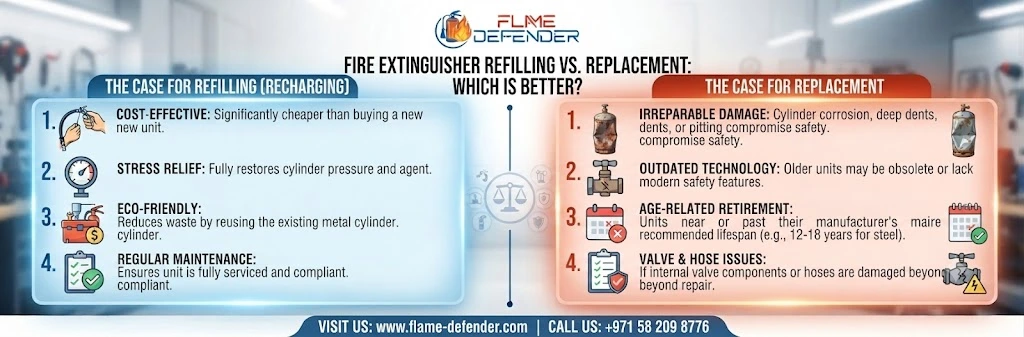
Fire extinguishers save lives, but only when they actually work. If yours has been sitting in the corner of your shop, office, or home for years, you’ve probably asked yourself: should I get it refilled, or should I just buy a new one? This is one of the most common questions people search for, especially when looking into fire extinguisher refilling in Pakistan, where both options are widely available but not always well understood.
In this guide, we’ll break down the real differences between refilling and replacing a fire extinguisher, when each option makes sense, what it costs, and how to keep your fire safety equipment fully compliant and functional all year round.
Why This Decision Matters
A fire extinguisher isn’t a decorative item. It’s emergency equipment that needs to be ready to perform at full pressure and full capacity the moment it’s needed. An extinguisher that looks fine on the outside can be completely useless on the inside if the pressure has dropped, the powder has clumped, or the seal has degraded.
Choosing between refilling and replacing isn’t just about saving money. It’s about making sure that when a fire breaks out, your extinguisher actually does its job.
What Does Fire Extinguisher Refilling Mean?
Refilling means emptying out the old extinguishing agent (dry powder, CO2, foam, or water) and recharging the cylinder with a fresh charge, along with a full pressure check, valve inspection, and seal replacement. A properly refilled extinguisher should perform just as well as a new one, provided the cylinder itself is still in good structural condition.
Most extinguishers are refilled after use, or as part of routine annual maintenance, since the pressure inside naturally drops over time even without being discharged.
What Does Fire Extinguisher Replacement Mean?
Replacement means retiring the old unit completely and installing a brand-new extinguisher. This is usually necessary when the cylinder has physical damage, corrosion, rust, dents, or has simply reached the end of its safe service life, which is typically around 10 to 15 years depending on the type and manufacturer.
Fire Extinguisher Refilling vs. Replacement: Key Differences
| Factor | Refilling | Replacement |
|---|---|---|
| Cost | Lower, usually a fraction of a new unit | Higher, full unit cost |
| Turnaround time | Quick, often same day | Depends on stock availability |
| Environmental impact | Lower, reuses existing cylinder | Higher, discards old unit |
| Best for | Cylinders in good physical condition | Damaged, corroded, or expired cylinders |
| Compliance | Requires inspection and hydrostatic testing at intervals | New unit comes pre-certified |
| Long-term value | Excellent if maintained regularly | Better when old unit is beyond repair |
When Should You Refill Instead of Replace?
Refilling is almost always the smarter choice when:
- The extinguisher was recently used to put out a small fire and the cylinder itself is undamaged.
- The pressure gauge shows a drop below the recommended level during a routine check.
- The extinguisher is less than 10 years old and has no visible rust, dents, or corrosion.
- You’re doing scheduled annual maintenance and the unit passes a visual and pressure inspection.
- You want to reduce costs while keeping your fire safety equipment fully compliant.
For businesses in Pakistan managing multiple extinguishers across offices, factories, or warehouses, refilling is usually the most cost-effective way to stay compliant with fire safety regulations without repeatedly buying new units.
When Should You Replace Instead of Refill?
Replacement becomes necessary when:
- The cylinder shows visible rust, dents, or corrosion that could compromise its strength under pressure.
- The extinguisher has failed a hydrostatic pressure test.
- It’s older than the manufacturer’s recommended service life, generally 10 to 15 years.
- The valve or handle mechanism is cracked, broken, or doesn’t seal properly.
- It’s a cheap or unbranded unit where the cylinder quality itself is questionable.
Trying to refill a damaged or aging cylinder isn’t just wasteful, it can be dangerous, since a compromised cylinder under pressure is a safety risk in itself.
Cost Comparison in Pakistan
One of the biggest reasons people search for fire extinguisher refilling in Pakistan is cost. Refilling is typically far cheaper than buying a new extinguisher, since you’re only paying for the extinguishing agent, labor, and inspection rather than the full manufacturing cost of a new cylinder, valve, and hose assembly. For homes, shops, and small businesses working with a limited budget, refilling existing units on schedule is usually the most practical route, as long as the cylinders remain in safe condition.
That said, prices vary depending on the type of extinguisher (ABC powder, CO2, foam, or water), the size of the cylinder, and the service provider. It’s worth getting a quote before assuming which option is cheaper for your specific situation.
How Often Should Extinguishers Be Refilled?
As a general rule:
- After any use, even partial, an extinguisher should be refilled immediately.
- Annually, extinguishers should be inspected for pressure, physical damage, and expiry of components like seals and gauges.
- Every 5 years, many types require more thorough maintenance, including internal examination.
- Every 10 to 12 years, hydrostatic testing is typically required to confirm the cylinder can still safely hold pressure.
Skipping these intervals is one of the most common reasons extinguishers fail exactly when they’re needed most.
Signs Your Fire Extinguisher Needs Attention
Watch out for:
- The pressure gauge needle sitting outside the green “normal” zone.
- Visible rust, dents, or corrosion on the cylinder body.
- A damaged, cracked, or missing pin and tamper seal.
- Powder that feels clumped or hardened when the extinguisher is tipped or shaken.
- An expired inspection tag or no tag at all.
If you notice any of these signs, don’t wait. Get it checked by a certified fire safety provider right away.
Refilling and Replacement: What Makes Sense for Most People?
For the vast majority of homes and businesses, a mix of both approaches works best. Extinguishers that are structurally sound and within their service life should be refilled on a regular maintenance schedule. Units that are old, damaged, or have failed inspection should be replaced rather than risked.
This balanced approach keeps your fire safety costs manageable while making sure every extinguisher on your property is genuinely reliable, not just present for show.
Getting Professional Help
Whether you need a refill, a replacement, or simply aren’t sure which one your extinguisher needs, it’s worth having a professional inspect it rather than guessing. A quick inspection can tell you the exact condition of the cylinder, valve, and extinguishing agent, and whether refilling will restore full function or whether it’s genuinely time for a new unit.
If you’re looking for reliable fire extinguisher refilling in Pakistan, you can learn more about the process and get your extinguisher serviced through Flame Defender’s fire extinguisher refilling service.
Frequently Asked Questions
1. Is it cheaper to refill or replace a fire extinguisher? Refilling is almost always cheaper than replacing, as long as the cylinder itself is undamaged and within its safe service life. Replacement only becomes cost-effective when the old unit is too damaged or old to safely refill.
2. How long does a fire extinguisher last before it needs refilling? Most extinguishers lose pressure gradually and should be checked annually, with a full refill typically needed every 1 to 5 years depending on usage, storage conditions, and the type of extinguishing agent.
3. Can any fire extinguisher be refilled? Not always. Extinguishers with rust, dents, corrosion, or cracked valves usually cannot be safely refilled and should be replaced instead.
4. How do I know if my fire extinguisher needs to be refilled? Check the pressure gauge. If the needle has moved outside the green zone, or if the extinguisher has been used even partially, it needs a refill.
5. What is the average lifespan of a fire extinguisher? Most fire extinguishers have a safe service life of 10 to 15 years, after which replacement is generally recommended regardless of how well maintained they’ve been.
6. Do fire extinguishers expire even if never used? Yes. The pressure and chemical composition inside can degrade over time even without use, which is why annual inspections and periodic refills are necessary.
7. Where can I get fire extinguisher refilling in Pakistan? Certified fire safety companies across major cities in Pakistan offer refilling services, including pickup, inspection, recharge, and delivery. Flame Defender is one option offering this service.
8. How often should fire extinguishers be inspected? At minimum, once a year. Businesses with high fire risk, such as factories or kitchens, often benefit from more frequent checks.
9. Can I refill a fire extinguisher myself at home? No. Refilling requires specialized equipment to safely recharge the cylinder with the correct pressure and extinguishing agent. It should only be done by trained professionals.
10. What happens if I use an expired or unrefilled fire extinguisher during a fire? It may fail to discharge properly, run out too quickly, or not build enough pressure to reach the fire effectively, putting lives and property at greater risk.
Final Thoughts
The choice between refilling and replacing a fire extinguisher comes down to the condition of the cylinder and how well it’s been maintained. In most cases, refilling is the more affordable and practical solution, while replacement should be reserved for units that are damaged, expired, or beyond safe repair.
Regular inspection is the key to making the right call every time. Don’t wait for an emergency to find out your extinguisher isn’t ready. Schedule a professional check today and make sure your fire safety equipment is fully functional when it matters most.