
Fire safety is not something any business owner in Pakistan can afford to ignore. Whether you run a small shop in Lahore, a factory in Faisalabad, or an office in Karachi, a properly maintained fire extinguisher can be the difference between a small incident and a devastating loss. Among the most common types used across the country is the DCP (Dry Chemical Powder) fire extinguisher, valued for its ability to fight multiple classes of fire. But owning one is not enough — it must be refilled and serviced regularly to actually work when needed.
This guide walks Pakistani business owners through everything they need to know about fire extinguisher refilling in Pakistan, including why it matters, how often it should be done, what the process involves, and how to choose a trustworthy service provider.
What Is a DCP Fire Extinguisher and Why Is It So Popular in Pakistan?
DCP extinguishers use a fine chemical powder — typically monoammonium phosphate or sodium bicarbonate based — to smother fires by interrupting the chemical reaction that keeps them burning. They are rated for Class A (ordinary combustibles like wood and paper), Class B (flammable liquids like oil and petrol), and Class C (electrical fires), which makes them a practical, all-purpose choice for offices, warehouses, retail stores, restaurants, and factories.
Their versatility, relatively low cost, and long shelf life have made DCP extinguishers the go-to option for commercial buildings across Punjab, Sindh, KPK, and beyond. However, this popularity also means that thousands of businesses need refilling services every year, and not all providers offer the same quality of service.
Why Refilling Matters More Than Buying New
Many business owners mistakenly believe that once a fire extinguisher is purchased, it’s a lifetime investment. In reality, the powder inside settles, loses pressure, or becomes contaminated over time. An extinguisher that looks fine on the outside may be completely useless in an actual fire.
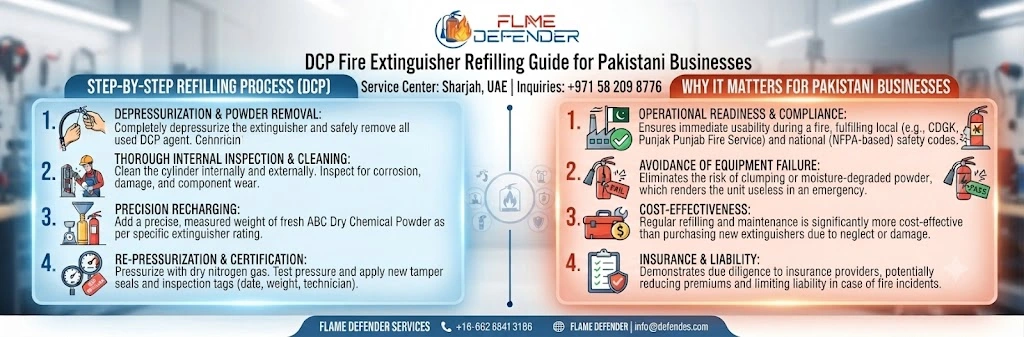
Refilling is also far more cost-effective than replacing units entirely. A cylinder in good physical condition can typically be refilled multiple times over its service life, saving businesses significant money while keeping them compliant with local fire safety expectations.
How Often Should You Refill a DCP Fire Extinguisher in Pakistan?
As a general rule, DCP fire extinguishers should be:
- Inspected visually every month — checking the pressure gauge, pin, seal, and hose for damage.
- Professionally serviced annually, even if the extinguisher was never used.
- Refilled immediately after any use, even partial discharge, since the pressure and powder quantity will no longer be at required levels.
- Fully refilled every 3–5 years depending on manufacturer guidelines and usage environment (industrial settings with dust or humidity may need more frequent servicing).
Businesses operating in high-risk environments — such as fuel stations, textile mills, or commercial kitchens — should consider more frequent checks, since these settings increase the likelihood of both fire incidents and equipment degradation.
Signs Your Fire Extinguisher Needs Refilling
You don’t always have to wait for the annual service date. Watch out for these warning signs:
- The pressure gauge needle is outside the green zone.
- Visible corrosion, dents, or rust on the cylinder body.
- A damaged or missing safety pin and tamper seal.
- Clumping or hardened powder (you may hear a rattling sound when the cylinder is shaken, which usually indicates the powder has caked together).
- The extinguisher has been used, even briefly.
If any of these apply, it’s time to contact a professional refilling service rather than waiting.
The DCP Refilling Process, Step by Step
A proper refilling service typically includes:
- Inspection — checking the cylinder body, valve, hose, and pressure gauge for damage or wear.
- Depressurizing and emptying — safely releasing any remaining pressure and removing leftover powder.
- Cylinder testing — in some cases, hydrostatic testing is performed to confirm the cylinder can safely hold pressure again.
- Refilling with correct-grade DCP powder — using the manufacturer-recommended type and quantity.
- Repressurizing with nitrogen or dry air to the correct PSI level.
- Sealing and tagging — a new tamper seal and service tag with the refill date are added for compliance and traceability.
Skipping steps like hydrostatic testing or using substandard powder is a common shortcut taken by unreliable vendors — and it’s exactly why choosing an experienced provider matters.
Legal and Safety Compliance for Pakistani Businesses
Fire safety compliance in Pakistan is increasingly being enforced, particularly for commercial buildings, factories, and high-occupancy spaces like malls and hotels. Insurance providers, civil defense authorities, and local building regulations often require documented proof of regular fire extinguisher servicing. Keeping refilling records isn’t just good practice — it can protect your business legally and reduce insurance disputes in the event of a fire.
Choosing a Reliable Fire Extinguisher Refilling Service in Pakistan
With refilling services available from countless vendors, quality varies widely. Here’s what to look for:
- Certified technicians who follow standard refilling and testing procedures.
- Genuine DCP powder rather than diluted or low-grade substitutes.
- Transparent pricing with no hidden charges.
- Nationwide or citywide service coverage, especially useful for businesses with multiple branches.
- Proper documentation including service tags and refill certificates.
- Quick turnaround times, since businesses can’t operate safely without functional fire equipment.
Providers like Flame Defender specialize in professional fire extinguisher refilling services tailored to the needs of Pakistani businesses, offering trained technicians and proper documentation to keep your workplace compliant and genuinely fire-ready.
Common Mistakes Businesses Make
- Assuming a full-looking cylinder means it’s still pressurized correctly.
- Refilling extinguishers with mismatched or low-quality powder.
- Ignoring minor discharge, thinking a small use doesn’t require servicing.
- Choosing the cheapest vendor without checking their certification or reputation.
- Not maintaining a service record, which can cause problems during safety audits or insurance claims.
Avoiding these mistakes is often as simple as building a relationship with one dependable refilling service rather than switching providers based on price alone.
Frequently Asked Questions
1. How often should a DCP fire extinguisher be refilled in Pakistan? Generally every 3–5 years, or immediately after any use, with annual professional inspections in between regardless of use.
2. How much does fire extinguisher refilling cost in Pakistan? Costs vary by cylinder size, powder type, and service provider, typically ranging from a few hundred to a few thousand rupees per unit. It’s best to request a quote directly from a provider for accurate pricing.
3. Can a fire extinguisher be refilled at home or by non-professionals? No. Refilling involves depressurizing, cylinder testing, and repressurizing, which requires trained technicians and proper equipment to be done safely and effectively.
4. What happens if a fire extinguisher is not refilled on time? It may lose pressure or have degraded powder, meaning it could fail completely during an actual fire emergency, putting people and property at serious risk.
5. How do I know if my DCP extinguisher needs refilling? Check the pressure gauge, look for a tamper seal or expired service tag, and shake the cylinder gently — a rattling sound often indicates caked or settled powder.
6. Is DCP powder the same for all extinguisher brands? Not always. Powder formulations can differ slightly, so it’s important that refilling is done with the correct grade recommended for your specific extinguisher type.
7. Do businesses in Pakistan legally need to service fire extinguishers regularly? Many local regulations, insurance policies, and civil defense requirements mandate regular servicing, especially for commercial and industrial properties, though specific rules can vary by city and building type.
8. How long does the refilling process usually take? A standard refill can often be completed within a day, though larger batches or hydrostatic testing may take slightly longer depending on the service provider.
9. Can a fire extinguisher be refilled multiple times? Yes, as long as the cylinder passes inspection and hydrostatic testing where applicable. Most cylinders can be refilled several times before they need to be replaced.
10. Where can businesses get professional fire extinguisher refilling in Pakistan? Businesses can get certified DCP fire extinguisher refilling services from providers such as Flame Defender, which offers trained technicians and reliable service for commercial clients across Pakistan.
Keeping your DCP fire extinguishers properly refilled isn’t just a regulatory checkbox — it’s a core part of protecting your employees, customers, and property. By staying on top of inspection schedules, recognizing warning signs early, and partnering with a certified refilling service, Pakistani businesses can ensure their fire safety equipment is ready to perform when it matters most.