
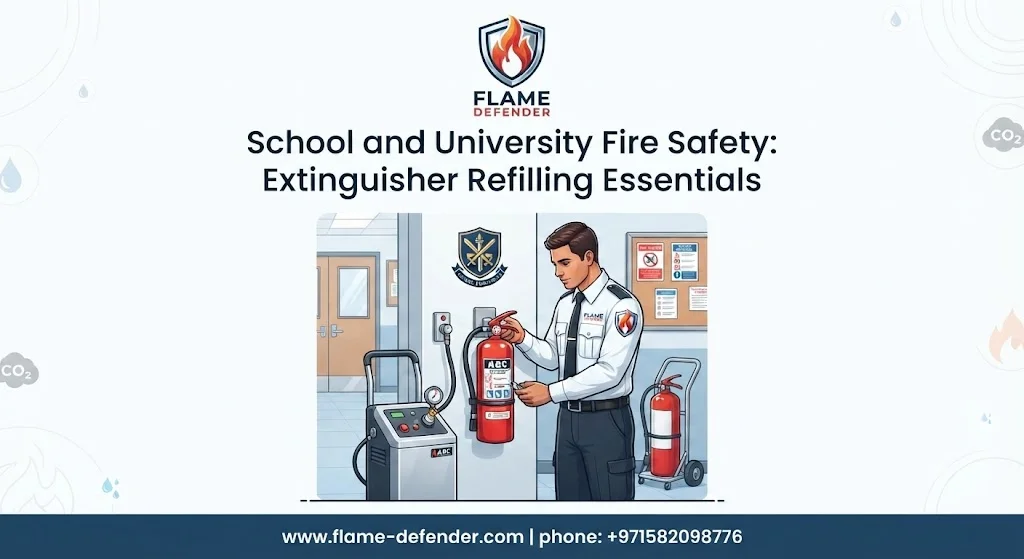
Fire safety is one of the most overlooked aspects of campus management in Pakistan. Schools, colleges, and universities are full of electrical equipment, laboratories, libraries, hostels, and crowded classrooms — all of which carry some level of fire risk. Yet many institutions only think about fire extinguishers when a safety inspection is scheduled, or worse, after an incident has already happened.
One of the biggest gaps in campus fire safety is not the absence of extinguishers, but their poor maintenance. An extinguisher that hasn’t been serviced or refilled on time is almost as dangerous as having no extinguisher at all, because staff and students believe they are protected when they are not. This is why regular fire extinguisher refilling in Pakistan has become such an important part of institutional safety planning.
In this article, we’ll look at why extinguisher refilling matters specifically for educational institutions, how often it should be done, what the refilling process involves, and how schools and universities can build a dependable fire safety routine.
Why Fire Safety Matters More in Educational Institutions
Schools and universities are unique environments. Unlike offices or factories, they house large numbers of children, teenagers, and young adults who may not know how to react calmly during an emergency. A few factors make fire safety especially critical on campuses:
- High occupancy — Classrooms, lecture halls, and hostels are often packed, making quick evacuation harder if smoke or fire spreads.
- Diverse fire risks — Chemistry and physics labs, computer labs, kitchens in hostels and cafeterias, and electrical wiring in older buildings all present different fire hazards.
- Limited fire safety awareness — Many students and even staff members have never been trained on how to use a fire extinguisher.
- Older infrastructure — A lot of educational buildings in Pakistan were constructed decades ago, with electrical systems that were never upgraded for modern loads.
Given these risks, having functional, properly maintained fire extinguishers isn’t optional — it’s a basic responsibility that school and university administrations owe to their students and staff.
The Problem with Neglected Extinguishers
A fire extinguisher is not a “buy it once and forget it” item. Over time, the pressure inside the cylinder drops, the extinguishing agent can settle or degrade, and seals can wear out. If an extinguisher isn’t refilled and inspected on schedule, it may:
- Fail to discharge when needed
- Discharge with reduced pressure, covering a much smaller area than expected
- Have expired or ineffective extinguishing agent
- Leak or malfunction due to rusted or damaged components
In a school setting, this becomes even more dangerous because the people relying on the extinguisher in an emergency — teachers, lab assistants, security guards — may have little to no firefighting experience. They need equipment they can trust to work the first time.
How Often Should Extinguishers Be Refilled?
For most educational institutions in Pakistan, a general guideline looks like this:
- Monthly visual checks — Staff or safety officers should confirm the pressure gauge is in the green zone, the pin and seal are intact, and there’s no visible damage.
- Annual professional inspection — A certified technician should inspect every extinguisher once a year, even if it looks fine.
- Refilling after use — Any extinguisher that has been discharged, even partially, must be refilled immediately.
- Refilling based on type — Dry chemical powder extinguishers typically need refilling every 1–2 years, while CO2 extinguishers may last longer between refills but still require regular pressure testing.
Because campuses often have extinguishers spread across multiple buildings, hostels, labs, and administrative blocks, keeping a simple maintenance log (with dates and locations) helps ensure nothing gets missed.
What Happens During Fire Extinguisher Refilling
Many school administrators assume refilling is as simple as “adding more powder.” In reality, professional refilling involves several careful steps:
- Depressurizing the cylinder safely to remove any remaining pressure.
- Inspecting the cylinder body for rust, dents, or corrosion that could make it unsafe to reuse.
- Cleaning the valve and nozzle to remove old residue or blockages.
- Replacing the extinguishing agent — whether it’s dry chemical powder, CO2, foam, or water-based — with a fresh, correctly measured charge.
- Re-pressurizing the cylinder to the manufacturer’s specified level.
- Testing the seal and pressure gauge to confirm everything is functioning correctly.
- Tagging the cylinder with the refill date, technician details, and next due date.
This is why refilling should always be handled by a trained, professional service rather than attempted in-house. Incorrectly pressurized cylinders can be hazardous themselves.
Building a Fire Safety Routine for Your Institution
A one-time fire safety audit isn’t enough. Schools and universities benefit from treating fire safety as an ongoing responsibility, built into the academic calendar. A few practical steps:
- Create a fire safety register listing every extinguisher, its location, type, last service date, and next due date.
- Assign responsibility to a specific safety officer or facilities team member, rather than leaving it to chance.
- Schedule refilling and inspections before the start of each academic year, when buildings are being prepared for students to return.
- Train staff and senior students on basic extinguisher use — the standard PASS method (Pull, Aim, Squeeze, Sweep) takes only a few minutes to teach.
- Conduct fire drills at least twice a year so both staff and students know evacuation routes and assembly points.
- Partner with a reliable local refilling service that can handle multiple locations and provide proper documentation for compliance and insurance purposes.
For institutions looking for a dependable partner to manage this process, professional providers like Flame Defender’s fire extinguisher refilling service offer scheduled maintenance, refilling, and inspection support tailored to the needs of schools, colleges, and universities across Pakistan.
Common Mistakes Schools and Universities Make
Even well-meaning institutions fall into a few recurring traps:
- Assuming a full-looking cylinder means it’s working — pressure and agent condition matter more than appearance.
- Storing extinguishers in inaccessible places — locked cabinets or high shelves defeat the purpose during an emergency.
- Not labeling extinguisher types — using the wrong extinguisher on an electrical or chemical fire can make things worse.
- Ignoring hostel and cafeteria kitchens — these areas have some of the highest fire risks on campus but are often the most neglected during safety checks.
- No documentation — without service records, it’s impossible to know which extinguishers are overdue.
Avoiding these mistakes usually just takes a proper checklist and a consistent refilling schedule.
Final Thoughts
Fire safety in schools and universities isn’t just about having extinguishers mounted on the wall — it’s about making sure they actually work when someone needs them. Regular fire extinguisher refilling, paired with staff training and routine inspections, can be the difference between a small, controlled incident and a serious tragedy.
For institutions across Pakistan, investing in a proper fire safety maintenance schedule is a small, manageable cost compared to the risk of an unprotected campus. Taking this seriously protects not just property, but the lives of students, teachers, and staff.
Frequently Asked Questions
1. How often should fire extinguishers be refilled in schools and universities? Most extinguishers should be inspected annually and refilled every 1–2 years depending on type, or immediately after any use, even partial.
2. What is the cost of fire extinguisher refilling in Pakistan? Costs vary depending on the extinguisher type, size, and service provider, but refilling is generally much cheaper than replacing an entire unit. It’s best to get a quote based on the number and type of extinguishers on campus.
3. Can schools refill fire extinguishers themselves? No, refilling should always be done by a trained professional, since it involves handling pressurized cylinders and specific extinguishing agents that require proper equipment and expertise.
4. How do I know if a fire extinguisher needs refilling? Check the pressure gauge — if the needle isn’t in the green zone, or if the seal is broken, the pin is missing, or the extinguisher has visible damage, it needs servicing.
5. What type of fire extinguisher is best for school labs? CO2 extinguishers are usually recommended for labs and areas with electrical or chemical equipment, since they don’t leave residue and are safe on live electrical fires.
6. How many fire extinguishers should a school have? This depends on building size and layout, but a general rule is at least one extinguisher per floor or per 500 square feet, plus additional units near labs, kitchens, and electrical rooms.
7. Do fire extinguishers expire? The cylinder itself can last many years with proper maintenance, but the extinguishing agent inside loses effectiveness over time and needs to be replaced through refilling.
8. Who is responsible for fire safety compliance in Pakistani schools? Institutional administration is generally responsible for ensuring compliance with local fire safety regulations, including maintaining functional extinguishers and conducting regular fire drills.
9. What should be included in a school fire safety checklist? A good checklist includes extinguisher inspection dates, clear signage, unobstructed access to extinguishers, staff training records, evacuation route maps, and scheduled fire drills.
10. Where can schools and universities get professional extinguisher refilling in Pakistan? Institutions can work with certified fire safety service providers such as Flame Defender, which offers extinguisher refilling and maintenance services designed for schools, colleges, and universities.