
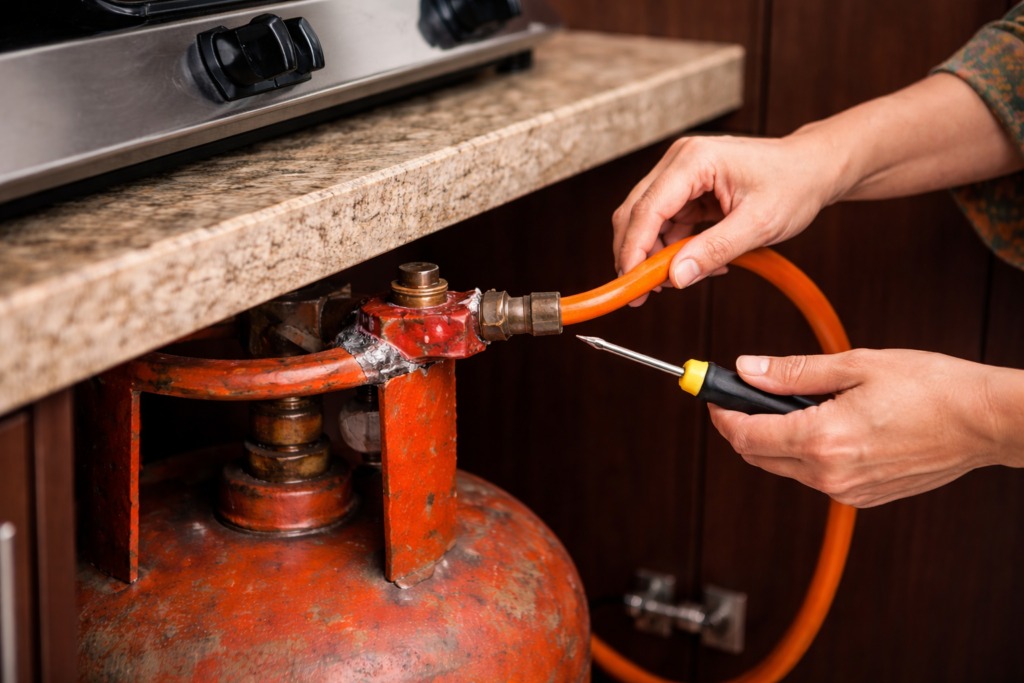
Gas cylinders are commonly used in homes, restaurants, shops, and workplaces across Pakistan. They can provide an important source of cooking and heating energy, but they also require responsible handling and proper safety planning. LPG is highly flammable, and a leak or other gas-related problem can create a serious fire hazard if it is not addressed safely. Pakistan’s Oil and Gas Regulatory Authority (OGRA) publishes safety requirements and public-awareness material related to LPG use and storage.
A good safety plan should therefore cover more than fire extinguishers and emergency exits. Gas cylinder safety should be part of the overall fire-safety system, along with electrical safety, safe cooking practices, smoke detection, alarms, evacuation planning, and regular maintenance.
For homes and businesses, a properly planned fire alarm system in Pakistan can provide an important layer of early warning. However, an alarm does not replace safe gas-cylinder practices. Prevention and early detection need to work together.
Why Gas Cylinder Safety Matters
LPG can become dangerous when there is a leak, poor ventilation, an unsuitable installation, damaged equipment, or an ignition source nearby. OGRA describes LPG as highly inflammable and highlights the importance of proper handling because incorrect use can create serious safety hazards.
The risk is not limited to the cylinder itself. Connections, regulators, hoses, appliances, and surrounding materials can also contribute to a fire or gas-related emergency.
This is why gas-cylinder safety should be treated as part of a complete fire-safety plan rather than as a separate household task.
A strong plan considers three basic areas:
- Prevent gas leaks and unsafe conditions.
- Detect problems as early as possible.
- Make sure people can respond and evacuate safely.
Choose Safe and Appropriate Equipment
One of the first steps in gas-cylinder safety is making sure the equipment being used is appropriate for its intended purpose.
Cylinders, regulators, hoses, valves, and gas appliances should be suitable for LPG service and maintained according to the manufacturer’s requirements. Damaged, visibly deteriorated, or questionable equipment should not simply be ignored.
For commercial or specialized installations, qualified professionals should assess the system and applicable requirements. Pakistan Engineering Council materials recognize specialized engineering work covering the installation, commissioning, and maintenance of fire detection, alarm, and suppression systems.
The same principle applies to gas-related safety: complicated installations should not be treated as ordinary do-it-yourself projects.
Keep the Area Around the Cylinder Safe
The area surrounding a gas cylinder is just as important as the cylinder itself.
Avoid allowing unnecessary combustible materials to accumulate around gas equipment. Paper, cardboard, cloth, packaging, chemicals, and other easily ignited materials can make a small fire more difficult to control.
Good housekeeping also makes it easier to notice problems. If an area is crowded or poorly maintained, damaged equipment or unusual conditions may go unnoticed.
For licensed LPG distributor premises, OGRA’s safety requirements address issues such as ignition sources, ventilation, electrical wiring, combustible construction, and portable fire extinguishers. While those requirements are specifically directed at distributor premises, they demonstrate the importance of controlling ignition sources and maintaining suitable ventilation around LPG facilities.
Ventilation Is an Important Safety Consideration
Ventilation is an important part of gas safety because a leaked gas supply should not be allowed to accumulate in an enclosed area.
OGRA’s requirements for LPG distributor premises specifically call for ventilation arrangements that allow air movement to the outside.
For homes and other buildings, ventilation requirements can depend on the type of appliance, installation, building, and applicable local requirements. Any permanent or specialized installation should be assessed by an appropriately qualified professional.
Never assume that simply opening a window is enough to make an unsafe gas installation safe.
Keep Ignition Sources Under Control
A gas leak and an ignition source can create a dangerous combination.
Potential ignition sources include flames, smoking materials, sparks, and unsuitable electrical equipment. This is one reason OGRA’s safety requirements for LPG distributor premises prohibit open flames and other ignition sources within those premises.
The broader lesson for homes and workplaces is simple: gas equipment should be kept away from unnecessary sources of ignition, and people should never treat a suspected gas leak as a normal situation.
If you suspect a gas leak, avoid creating additional ignition sources and move people away from the area. Contact the appropriate emergency or gas-service authority from a safe location.
Do Not Ignore Signs of a Gas Problem
Unusual smells, damaged connections, unexpected appliance behavior, or other warning signs should never be dismissed.
If people notice a suspected gas leak, the priority should be safety rather than trying to investigate the problem personally.
Do not attempt risky repairs or experiment with gas equipment. Move to a safe location and contact qualified professionals or the appropriate emergency service.
Children should never be asked to investigate, repair, move, or operate gas-cylinder equipment.
Gas Cylinder Safety and Fire Alarms
A fire alarm is an important part of an overall fire-protection strategy, but it is important to understand what an alarm can and cannot do.
The Building Code of Pakistan Fire Safety Provisions 2016 states that fire alarm systems should be provided where necessary to warn occupants of a fire, depending on the building’s size, arrangement, or occupancy. The code also emphasizes appropriate design, installation, approval, maintenance, inspection, and testing of fire-protection systems.
A fire alarm system in Pakistan can help provide early warning when a fire occurs, giving occupants valuable time to respond according to their emergency plan.
However, a standard fire alarm should not be assumed to be a substitute for a dedicated gas-detection system. Gas detection and fire detection address different hazards, and the appropriate protection depends on the building and installation.
Why Early Warning Matters
Fire can spread quickly, especially when combustible materials are nearby.
An alarm can alert occupants who may be asleep, working in another room, or otherwise unaware that a fire has started. This is particularly important in larger buildings where people may be far away from the source of a fire.
The Building Code of Pakistan recognizes occupant notification as an important part of fire safety.
For this reason, an alarm system should be considered one layer of a broader safety strategy that includes prevention, emergency exits, evacuation procedures, and appropriate firefighting equipment.
Never Block Emergency Exits
Gas-cylinder safety is only one part of emergency preparedness.
If a gas-related incident develops into a fire, people need a clear way out of the building. Furniture, boxes, equipment, or stored materials should not block escape routes.
Pakistan’s Building Code of Pakistan Fire Safety Provisions addresses means of egress and requires routes to a place of safety to be clearly arranged or marked.
Every household or workplace should know its available exits and have a simple emergency plan.
Prepare a Family or Workplace Emergency Plan
A safety plan should answer basic questions before an emergency occurs:
- What should everyone do if a fire alarm sounds?
- Which exits should be used?
- Where should people gather after leaving?
- Who will call emergency services?
- How will children, older people, or anyone needing assistance be supported?
- Who is responsible for checking that everyone has left?
Practicing the plan can help people respond more calmly during an actual emergency.
Fire drills and emergency planning are also recognized as elements of fire-safety management in Pakistan’s fire-safety provisions.
Keep Children Away From Gas Equipment
Children should be taught that gas cylinders, regulators, valves, hoses, and cooking appliances are not toys.
They should not be asked to turn gas equipment on or off, investigate unusual smells, or attempt repairs.
Adults should explain what to do if they smell gas or hear a fire alarm: alert a responsible adult, move away from danger, and follow the household emergency plan.
Simple education can prevent unsafe curiosity from becoming an emergency.
Avoid Improvised Repairs
One common mistake is trying to solve a gas-equipment problem with temporary or improvised repairs.
Gas systems are not an appropriate place for experimentation. A damaged component may require professional inspection or replacement.
If a cylinder, regulator, hose, valve, or appliance appears damaged, stop treating the equipment as normal household equipment and seek appropriate professional assistance.
The goal should always be to restore the system safely rather than finding a quick temporary solution.
Maintenance Should Be Part of the Safety Plan
Safety equipment cannot be useful if it is neglected.
Regularly check the condition of relevant fire-safety equipment and make sure alarms and other protective systems receive appropriate inspection and testing.
Pakistan’s Building Code of Pakistan Fire Safety Provisions includes requirements concerning maintenance, inspection, and testing of fire-protection systems.
For businesses, keeping maintenance and inspection records can also help demonstrate that safety systems are being actively managed.
Do Not Depend on One Safety Measure
A fire extinguisher alone is not a complete fire-safety plan.
A fire alarm alone is not a complete fire-safety plan.
Gas-cylinder precautions alone are not a complete fire-safety plan.
The strongest approach combines several layers:
- Safe gas-cylinder practices.
- Suitable ventilation and controlled ignition sources.
- Electrical and cooking safety.
- Appropriate fire detection and alarm systems.
- Suitable firefighting equipment.
- Clear emergency exits.
- An evacuation plan.
- Regular inspection and maintenance.
- Fire-safety education.
- Professional assistance for specialized systems.
This layered approach helps reduce the chance that one failure will leave people without protection.
Gas Cylinder Safety for Businesses
Restaurants, hotels, workshops, factories, shops, and other commercial properties may have greater fire-safety considerations because of the number of people, equipment, fuel sources, and building arrangements involved.
Businesses should identify gas-related hazards during their fire-risk assessment and make sure employees understand emergency procedures.
Specialized LPG facilities have additional requirements. OGRA maintains information covering LPG standards, licensing, authorized equipment manufacturers, storage and filling plants, and safety requirements for LPG distributor premises.
Businesses should consult the applicable authority and qualified professionals rather than assuming that household practices automatically meet commercial requirements.
What to Do During a Fire Emergency
If a fire occurs, people should prioritize getting away from danger and following the established emergency plan.
Do not stay behind to collect belongings.
Do not allow children to return inside.
Do not take unnecessary risks attempting to fight a growing fire.
Once outside, move to the designated safe location and contact the appropriate emergency services.
The exact response can depend on the type of incident, building, and available emergency procedures. Professional responders should handle situations that are beyond the capabilities of occupants.
The Role of a Fire Alarm System in Pakistan
A properly designed fire alarm system can form an important part of a building’s emergency-warning strategy.
Its purpose is not to prevent every fire. Instead, it can help provide timely warning so occupants can begin their emergency response.
For buildings where fire alarms are required, Pakistan’s Building Code of Pakistan Fire Safety Provisions calls for systems to be designed, installed, and approved in accordance with applicable codes and standards.
Professional installation and maintenance are therefore important. PEC also identifies fire detection, alarm, and suppression systems as a specialized engineering field.
For reliable fire protection solutions and professional guidance, businesses and property owners can explore Flame Defender.
A Simple Gas Cylinder Safety Checklist
Before considering your safety plan complete, review these points:
- Is the gas equipment appropriate for its intended use?
- Is the cylinder and associated equipment in good condition?
- Is the surrounding area clean and free from unnecessary combustible materials?
- Are ignition sources properly controlled?
- Is the installation appropriately ventilated?
- Do children know to stay away from gas equipment?
- Are emergency exits clear?
- Does the building have appropriate fire detection and alarm arrangements?
- Are fire-safety systems inspected and maintained?
- Does everyone know what to do during an emergency?
- Is professional help available for specialized gas or fire-protection work?
If several answers are uncertain, the safety plan deserves another review.
Conclusion
Gas-cylinder safety should never be treated as an afterthought. Whether LPG is used at home or in a workplace, responsible equipment selection, proper maintenance, ventilation, ignition-source control, emergency planning, and fire detection all contribute to a safer environment.
A fire alarm system in Pakistan can provide an important layer of early warning, but it works best when combined with prevention and a clear evacuation plan.
The most effective safety plan is not based on one product or one precaution. It is built around several layers that work together: prevent hazards where possible, detect emergencies early, warn occupants, and provide a clear path to safety.
When gas-cylinder safety becomes part of everyday fire-safety planning, families and businesses are better prepared to respond to an emergency.
FAQs
1. Why is gas cylinder safety important in Pakistan?
Gas cylinders containing LPG require careful handling because LPG is highly flammable. Safe equipment, appropriate ventilation, controlled ignition sources, regular maintenance, and emergency planning can help reduce fire-related risks. OGRA provides safety information and regulatory material related to LPG in Pakistan.
2. Can a fire alarm detect a gas leak?
A standard fire alarm system is primarily designed to detect and warn occupants about fire-related conditions. It should not automatically be considered a dedicated gas-leak detection system. The appropriate detection equipment depends on the building, fuel, appliances, and applicable safety requirements.
3. Should children handle gas cylinders?
No. Children should not operate, move, inspect, or repair gas cylinders or related equipment. They should instead be taught to stay away from gas equipment and immediately tell a responsible adult if they notice an unusual smell or other warning sign.
4. How often should fire-safety equipment be checked?
Inspection and testing requirements depend on the type of equipment, building, system, and applicable standards. Pakistan’s Building Code of Pakistan Fire Safety Provisions includes provisions concerning maintenance, inspection, and testing of fire-protection systems.
5. Is gas-cylinder safety enough to protect a building from fire?
No. Gas-cylinder safety is one part of a complete fire-safety strategy. A comprehensive plan can also include electrical safety, cooking safety, suitable fire detection and alarms, firefighting equipment, clear exits, emergency procedures, training, and regular maintenance.