
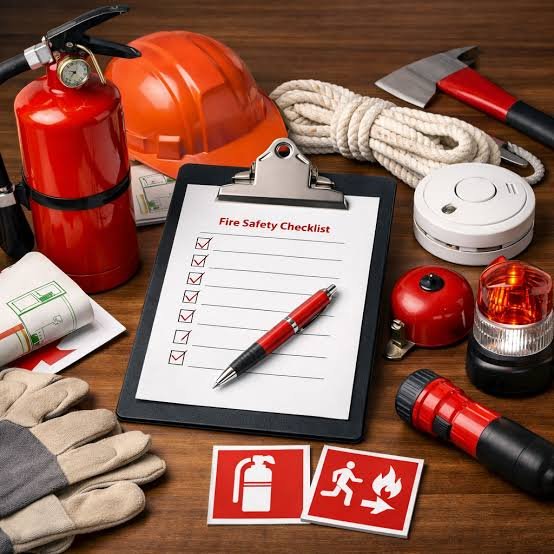
Office fire safety is an important responsibility for every business, regardless of its size. Offices may appear safer than factories or warehouses, but they still contain potential fire hazards, including electrical equipment, power outlets, kitchen appliances, paper documents, furniture, and storage materials.
A small safety problem can become a serious concern if it goes unnoticed. Blocked emergency exits, poorly maintained electrical equipment, missing safety signs, and outdated evacuation plans can make an emergency more difficult to manage.
The good news is that office fire safety does not have to be complicated. A simple, organised checklist can help employees and managers review important safety arrangements, identify problems, and make sure corrective action is taken.
In Pakistan, offices should consider their building design, number of occupants, equipment, and applicable fire safety requirements. The Building Code of Pakistan – Fire Safety Provisions 2016 provides an important national reference, while provincial and local authorities may have additional inspection requirements.
This beginner’s guide explains the essential areas to review and provides a practical office fire safety checklist.
Why Is Office Fire Safety Important?
An office may contain several potential sources of ignition and combustible materials. Electrical equipment, printers, computers, chargers, kitchen appliances, paper records, and furniture are common examples.
The risk can increase when equipment is poorly maintained, storage areas become overcrowded, or employees are unfamiliar with emergency procedures.
A well-organised fire safety programme helps an office:
- Identify potential fire hazards.
- Maintain suitable fire detection and warning arrangements.
- Keep emergency exits accessible.
- Improve employee awareness.
- Organise evacuation procedures.
- Maintain safety equipment.
- Record inspections and corrective actions.
Fire safety is not only the responsibility of the building owner. Office managers, supervisors, maintenance personnel, and employees all have a role in maintaining a safer working environment.
1. Check Electrical Equipment and Power Arrangements
Electrical equipment is common in almost every office. Computers, printers, photocopiers, air conditioners, chargers, and other devices operate throughout the working day.
Poor maintenance or damaged equipment can create electrical safety concerns.
What should office managers review?
Include these points in the checklist:
- [ ] Electrical cables and plugs appear undamaged.
- [ ] Damaged equipment is reported and taken out of service by authorised personnel.
- [ ] Electrical outlets are not visibly overloaded.
- [ ] Unauthorised electrical modifications are avoided.
- [ ] Office equipment is used according to manufacturer guidance.
- [ ] Electrical distribution areas are kept accessible to authorised maintenance personnel.
- [ ] Electrical concerns are reported promptly.
- [ ] Maintenance work is handled by qualified personnel.
Employees should not attempt to repair electrical installations themselves. Any suspected electrical fault should be reported to the responsible maintenance team.
Review office equipment arrangements
Office equipment should be installed and maintained appropriately. Management should also consider whether equipment is being used in suitable locations and whether changes to the office layout have affected electrical safety.
A regular review helps identify problems before they become more serious.
2. Review the Fire Alarm and Detection System
A fire alarm system provides an important warning when a potential fire emergency is detected. It helps alert occupants so they can follow the building’s emergency procedures.
However, simply having an alarm installed does not guarantee that the complete system is suitable or properly maintained.
Office fire alarm checklist
Review the following points:
- [ ] An appropriate fire detection and alarm arrangement is provided.
- [ ] Alarm warning devices are not obstructed.
- [ ] Employees understand what the alarm signal means.
- [ ] Reported faults are communicated to the responsible personnel.
- [ ] Inspection and maintenance records are available.
- [ ] Required backup power arrangements are maintained.
- [ ] Changes to the office layout are considered when reviewing detection coverage.
- [ ] Technical servicing is arranged through qualified professionals.
Choosing a fire alarm system in Pakistan
When considering a fire alarm system in Pakistan, office owners should evaluate the building’s size, layout, occupancy, and applicable requirements.
A small office may have different needs from a multi-storey corporate building. The number of occupants, room arrangements, and building design can all affect the appropriate detection and warning arrangements.
Installation, inspection, testing, and maintenance should be handled by qualified professionals.
Employees should receive basic information about recognising the alarm and following the evacuation plan. They should not interfere with control panels, detectors, or other technical components.
3. Keep Emergency Exits and Escape Routes Clear
Emergency exits are among the most important parts of an office fire safety arrangement.
Employees and visitors need accessible routes to leave the building if an emergency occurs. These routes should remain clear during normal working hours and outside regular office schedules.
What should be checked?
- [ ] Emergency exits are clearly identified.
- [ ] Corridors and stairways are free from unnecessary storage.
- [ ] Exit doors are accessible.
- [ ] Emergency routes are suitable for the building’s occupancy.
- [ ] Exit signs are visible.
- [ ] Emergency lighting is maintained where required.
- [ ] Fire doors are not obstructed or improperly altered.
- [ ] Employees know the designated evacuation routes.
Why clear routes matter
Office furniture, delivery boxes, unused equipment, and temporary storage can gradually occupy corridors and access areas.
These items may seem harmless during normal operations, but they can make evacuation more difficult.
Management should assign responsibility for checking common areas and ensure that employees understand why emergency routes must remain accessible.
Consider visitors and people needing assistance
An office may contain clients, contractors, delivery personnel, and visitors who are unfamiliar with the building.
The evacuation plan should also consider people with disabilities, temporary mobility limitations, or other needs that may affect evacuation.
Clear instructions and suitable assistance arrangements should be established before an emergency occurs.
4. Check Fire Extinguishers and Other Safety Equipment
Fire protection equipment should be appropriate for the building and maintained according to applicable requirements and manufacturer guidance.
The presence of equipment alone does not prove that it is suitable or ready for use.
Fire extinguisher checklist
- [ ] Suitable extinguishers are provided where required.
- [ ] Equipment is accessible and clearly identified.
- [ ] Inspection information is available.
- [ ] Damaged or missing equipment is reported.
- [ ] Maintenance is completed by appropriate personnel.
- [ ] Employees know how to report equipment problems.
The type and location of firefighting equipment should be determined through an appropriate assessment of the building.
General employees should understand that different extinguishers are designed for different fire types. They should not be expected to operate equipment unless they have received suitable instruction and the situation is safe.
Evacuation and contacting emergency services should take priority.
Other installed fire protection equipment
Depending on the building, the checklist may also cover:
- Smoke detectors
- Sprinkler systems
- Fire hydrants
- Hose reels
- Fire doors
- Emergency lighting
- Fire safety signs
- Fire pumps and water supplies
Not every office requires the same equipment. Requirements depend on the building’s characteristics and applicable regulations.
5. Review Office Housekeeping and Storage
Good housekeeping is an important part of fire prevention.
Offices often contain paper, cardboard packaging, furniture, cleaning materials, and other items that may contribute to fire spread if stored carelessly.
A regular housekeeping review can help keep work areas organised and reduce unnecessary hazards.
Housekeeping checklist
- [ ] Unnecessary combustible materials are removed from work areas.
- [ ] Paper and cardboard are stored appropriately.
- [ ] Waste is collected regularly.
- [ ] Storage does not obstruct exits or safety equipment.
- [ ] Electrical and maintenance areas remain accessible.
- [ ] Shared spaces are kept organised.
- [ ] Cleaning materials are stored according to their instructions.
- [ ] Kitchen and break areas are kept tidy.
Pay attention to shared spaces
Office kitchens, meeting rooms, storage cupboards, and reception areas may be used by many employees.
Because responsibility can become unclear in shared spaces, management should establish simple arrangements for housekeeping and reporting problems.
6. Review the Office Evacuation Plan
Every office should have emergency arrangements that occupants can understand.
An evacuation plan should explain how people are warned, where they should go, and how the organisation accounts for employees and visitors after evacuation.
What should an evacuation plan include?
A suitable plan should address:
- Main emergency exits.
- Alternative escape routes.
- Stairways and designated evacuation paths.
- Assembly points.
- Emergency contact arrangements.
- Responsibilities of designated personnel.
- Arrangements for visitors.
- Assistance for people who may need additional support.
Employees should be familiar with the arrangements relevant to their work areas.
Make evacuation information accessible
Emergency instructions should be easy to understand and available in appropriate locations.
Where necessary, organisations should consider language and accessibility needs so that employees and visitors can understand what action is expected.
Organise and review fire drills
Fire drills help occupants become familiar with the evacuation arrangements.
They should be organised responsibly, supervised, and conducted according to applicable requirements.
After a drill, management can review whether people understood the alarm, whether routes remained accessible, and whether everyone reached the assembly point.
Any problems should be recorded and addressed.
7. Provide Basic Fire Safety Training for Employees
Employees are more likely to respond appropriately when they understand the office’s safety procedures.
Training should be suitable for the building and the responsibilities of the people attending.
Important training topics
A basic office fire safety session can include:
- Common workplace fire hazards.
- Electrical safety awareness.
- Recognition of fire alarm signals.
- Location of emergency exits.
- Evacuation procedures.
- Assembly point arrangements.
- Reporting hazards and equipment faults.
- Responsibilities during an emergency.
New employees should receive relevant safety information when they join the organisation. Refresher sessions should be arranged when procedures change or when additional awareness is needed.
Clarify employee responsibilities
Employees should know how to report safety concerns and whom to contact.
Designated fire wardens or safety personnel may have additional responsibilities under the office emergency plan. These responsibilities should be clearly communicated and supported by suitable training.
Ordinary employees should not be expected to take unnecessary risks or attempt firefighting beyond their training.
8. Maintain Fire Safety Inspection Records
An effective checklist should do more than identify problems. It should help management track what happens after an inspection.
A record of findings makes it easier to assign responsibilities, monitor maintenance, and confirm that corrective action has been completed.
What information should be recorded?
An office inspection record can include:
- Date of inspection.
- Name of the inspector.
- Area or equipment reviewed.
- Condition observed.
- Problems identified.
- Corrective action required.
- Person responsible for follow-up.
- Target completion date.
- Date the issue was reviewed again.
For example, if an inspection identifies a damaged exit sign, the issue can be recorded and assigned to the responsible maintenance team.
The record should be updated after the problem has been addressed.
Review records regularly
Management should review inspection records to identify repeated issues.
If the same problem appears in several inspections, it may indicate that the existing corrective action is not effective.
Records also help organisations prepare for discussions with relevant authorities and qualified fire safety professionals.
A Beginner’s Office Fire Safety Checklist
The following checklist provides a simple starting point for office managers and employees. It is a general awareness tool, not a substitute for a professional risk assessment or official inspection.
Electrical safety
- [ ] Electrical equipment appears undamaged.
- [ ] Reported electrical faults are followed up.
- [ ] Unauthorised modifications are avoided.
- [ ] Equipment is used according to instructions.
Fire detection and warning
- [ ] Appropriate detection and alarm arrangements are provided.
- [ ] Alarm devices are accessible.
- [ ] Employees understand the warning signal.
- [ ] Maintenance records are available.
- [ ] Reported faults receive attention.
Exits and evacuation
- [ ] Emergency exits are accessible.
- [ ] Corridors and stairways remain clear.
- [ ] Exit signs are visible.
- [ ] Emergency lighting is maintained where required.
- [ ] Evacuation instructions are available.
- [ ] Assembly arrangements are communicated.
Fire protection equipment
- [ ] Required extinguishers are available.
- [ ] Equipment is accessible and inspected.
- [ ] Installed fire protection systems are maintained.
- [ ] Damaged equipment is reported.
Housekeeping
- [ ] Waste is managed regularly.
- [ ] Combustible materials are stored appropriately.
- [ ] Shared spaces are organised.
- [ ] Safety equipment is not blocked.
Training and records
- [ ] Employees receive relevant fire safety information.
- [ ] New employees are informed about emergency procedures.
- [ ] Fire drills are reviewed where required.
- [ ] Inspection records are maintained.
- [ ] Corrective actions are followed up.
How Often Should an Office Fire Safety Checklist Be Used?
There is no single inspection frequency that suits every office. The appropriate schedule depends on the building’s risk level, occupancy, equipment, applicable requirements, and the type of check being performed.
Some basic observations, such as checking that exits remain clear, may be part of routine office management. Formal equipment inspections and servicing should follow the applicable technical requirements and professional recommendations.
The checklist should also be reviewed whenever:
- The office layout changes.
- New equipment is introduced.
- Occupancy increases.
- A fire safety fault is reported.
- An evacuation drill identifies a problem.
- Building management changes.
- Relevant regulations or authority instructions are updated.
Regular review helps ensure that the checklist continues to reflect the actual office environment.
Office Fire Safety Requirements in Pakistan
Office owners and managers in Pakistan should consider national building guidance alongside relevant provincial and local requirements.
The Building Code of Pakistan – Fire Safety Provisions 2016 is an important reference for fire protection and life safety in buildings. It addresses subjects such as fire prevention, means of escape, fire protection systems, alarms, and maintenance.
Punjab Civil Defence identifies fire detection and alarm systems, firefighting arrangements, fire safety plans, emergency control rooms, and evacuation arrangements among the measures considered during inspections of relevant premises.
The Sindh Occupational Safety and Health Rules, 2019 also contain workplace provisions addressing fire safety, alarms, and firefighting equipment.
These examples should not be interpreted as identical requirements for every office throughout Pakistan. The applicable rules depend on the location, building type, occupancy, and responsible authority.
Office managers should consult the relevant building control authority, Civil Defence department, and qualified fire safety professionals to confirm the requirements for their premises.
Common Office Fire Safety Mistakes to Avoid
Even offices with safety equipment can have weaknesses in their arrangements.
Blocking emergency exits: Temporary storage and furniture should never be allowed to obstruct designated escape routes.
Ignoring damaged electrical equipment: Reported faults should receive timely attention from qualified personnel.
Assuming an installed alarm is always operational: Equipment needs appropriate inspection and maintenance.
Forgetting employee training: Staff should understand the alarm, evacuation route, and assembly point.
Ignoring visitors: Visitors and contractors may need clear emergency information.
Failing to record inspections: Written records help management follow up on problems.
Using one checklist for every building: A checklist should reflect the actual office layout and risks.
Conclusion
Office fire safety begins with awareness, regular inspections, and clear responsibilities. A practical checklist helps managers and employees review electrical equipment, fire alarm arrangements, emergency exits, firefighting equipment, housekeeping, evacuation procedures, and training.
For offices using a fire alarm system in Pakistan, the checklist should cover the entire emergency arrangement rather than focusing only on the alarm itself. Warning systems, accessible escape routes, maintained equipment, employee awareness, and reliable inspection records all contribute to a safer workplace.
Every office has different requirements, so its checklist should be adapted to the building and reviewed regularly. Where technical assessment, installation, or maintenance is necessary, qualified professionals should be involved.
The most effective office fire safety checklist is one that leads to real improvements, not simply completed boxes.
Frequently Asked Questions
1. What should an office fire safety checklist include?
It should cover electrical safety, fire detection and alarm systems, extinguishers, emergency exits, evacuation procedures, housekeeping, employee training, and maintenance records.
2. How often should office fire safety inspections take place?
Inspection frequency depends on the building’s risks, installed equipment, and applicable requirements. Routine observations and formal technical inspections should follow an appropriate schedule.
3. Why is a fire alarm system important in an office?
A fire alarm system provides an important warning when a potential fire emergency is detected. It alerts occupants so they can follow the building’s evacuation procedures.
4. Who is responsible for office fire safety?
Responsibility is shared among building owners, office management, supervisors, maintenance personnel, and employees. Each person should understand their assigned responsibilities.
5. Is a basic office fire safety checklist enough to meet legal requirements in Pakistan?
Not necessarily. A general checklist is useful for routine awareness but does not replace a professional fire risk assessment, technical inspection, or official compliance review. Organisations should confirm the requirements applicable to their premises.