
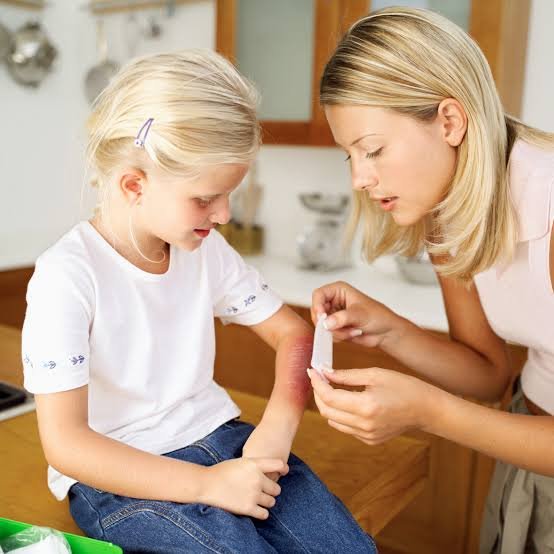
Children are naturally curious. They may want to explore the kitchen, touch household objects, play near electrical equipment, or investigate something that looks interesting. This curiosity is an important part of growing up, but it can also expose children to burn and scald hazards.
Teaching children basic burn-safety awareness can help them understand what to do when an accident happens. Children should not be expected to manage serious injuries themselves. Instead, the goal is to teach them simple safety rules, how to move away from danger, and how to quickly tell a trusted adult.
Burns can happen because of hot liquids, steam, flames, hot surfaces, electrical sources, or chemicals. Scalds from hot water and other liquids are particularly important to discuss with children. Proper first aid should be started quickly, while serious burns require professional medical assessment. The NHS advises cooling a burn with cool running water for 20 minutes and avoiding ice, butter, toothpaste, creams, and other household substances.
For families in Pakistan, burn first aid should also be considered part of a wider home fire-safety plan. Teaching children about alarms, escape routes, and safe behavior can help them respond more calmly during an emergency.
Why Children Need to Learn About Burn Safety
Children may not recognize the difference between something that is safe to touch and something that can cause an injury.
A cup of hot tea may look harmless. A cooking pan may look like an ordinary object. A heater may look interesting during winter. Electrical equipment may appear safe even when there is a hidden fault.
Teaching children basic safety awareness helps them understand that heat and fire should be treated with caution.
However, education should not encourage children to investigate dangerous situations. A simple rule is:
Move away, tell an adult, and never try to handle a dangerous source yourself.
This approach is especially important for younger children.
Common Causes of Burns in Children
Burns and scalds can happen in many different situations around the home.
Common examples include:
- Hot water
- Tea, coffee, or other hot drinks
- Cooking liquids
- Steam
- Hot cooking utensils
- Heaters
- Fireplaces or open flames
- Electrical equipment
- Hot irons
- Fireworks
- Matches and lighters
- Certain chemicals
The risk is not limited to the kitchen. Bathrooms, bedrooms, outdoor areas, workshops, and event spaces can also contain potential hazards.
Parents and caregivers should look around the home from a child’s point of view and identify anything that could cause a burn.
Teach Children One Simple Rule: Stop and Tell an Adult
Children do not need complicated medical instructions.
One of the most useful lessons is to teach them to immediately move away from a dangerous source and tell a trusted adult.
For example, if a child sees a fire, spilled hot liquid, damaged electrical equipment, or another dangerous situation, they should not try to investigate it.
Instead:
- Move away from the danger.
- Tell a parent, teacher, caregiver, or another trusted adult.
- Follow the adult’s instructions.
- Never return to the dangerous area without permission.
This keeps children from turning a small incident into a larger emergency.
What Children Should Know About a Burn
Children can learn that a burn is an injury caused by heat or another harmful source.
A scald is a type of burn caused by hot liquid or steam.
You can explain the difference using simple examples:
Burn: Contact with something hot, such as a hot surface.
Scald: Contact with hot liquid or steam.
Children do not need detailed medical information. They simply need to understand that heat can hurt skin and that an adult should be told immediately.
The First Step After a Burn
If a child experiences a burn, the first priority is to stop further exposure to the heat while keeping everyone safe.
An adult should move the child away from the source if it is safe to do so.
The child should not be encouraged to return to the source or investigate what caused the accident.
For thermal burns and scalds, established first-aid guidance recommends cooling the affected area with cool running water for around 20 minutes. The American Red Cross recommends immediate cooling for a minimum of 10 minutes and ideally 20 minutes, while NHS guidance recommends 20 minutes.
Because children can become cold more quickly, an adult should keep the rest of the child comfortably warm while the affected area is being cooled.
Why Ice Should Not Be Used
A common misconception is that ice is the best way to cool a burn.
Children may hear this idea from friends or see it in movies, but ice should not be placed directly on a burn.
Guidance from the NHS and American Red Cross advises against using ice because it can worsen tissue injury.
A simple message for children is:
“Use cool running water, not ice.”
The adult caring for the child should follow appropriate first-aid guidance and seek medical help when necessary.
Do Not Put Household Remedies on Burns
Another important lesson is that burns should not automatically be treated with household remedies.
Children may hear suggestions involving toothpaste, butter, oil, creams, or other substances. These should not be used as substitutes for proper first aid.
NHS guidance specifically advises against putting ice, butter, toothpaste, creams, gels, oils, or ointments on a burn or scald.
Teaching this early can prevent children or older siblings from accidentally making an injury worse.
Do Not Remove Material Stuck to the Skin
If clothing, jewelry, or another material is stuck to a burn, it should not be pulled away.
NHS guidance recommends removing clothing or jewelry near the affected area when possible, but not removing anything that is stuck to the skin because doing so can cause additional damage.
This is an important reason why burn first aid should be handled by a responsible adult rather than a child.
When a Child Needs Medical Help
Not every burn has the same severity.
Parents and caregivers should seek professional medical advice when they are concerned about the injury, particularly when a burn is large, deep, severe, or affects important areas such as the face, hands, feet, or major joints.
Burns involving the face or eyes, extensive burns, serious electrical injuries, chemical injuries, or burns associated with breathing problems require urgent medical attention.
For children, it is especially important not to underestimate an injury. If there is uncertainty about the severity, contacting a healthcare professional is appropriate.
First-aid education is not a replacement for professional medical care.
Teaching Children About Fire Alarms
Burn first aid should be combined with fire prevention and emergency awareness.
Children should know what a fire alarm sounds like and understand that an alarm is a signal to leave the area and tell an adult.
They should never be taught to ignore an alarm because they cannot see smoke or flames.
For homes, schools, offices, and other buildings, appropriately designed fire detection and alarm systems can provide early warning during a fire.
Pakistan’s Building Code of Pakistan Fire Safety Provisions 2016 covers fire protection systems and equipment, emergency operations, and means of egress among other fire-safety matters.
A suitable fire alarm system in Pakistan can therefore be one part of a broader fire-safety strategy, alongside evacuation planning, appropriate equipment, maintenance, and occupant education.
Make Fire Alarm Lessons Easy for Children
Children remember simple instructions better than long technical explanations.
Parents and teachers can teach three basic rules:
Hear the alarm → Leave the building → Tell an adult.
Children should know that they should not stop to collect toys, school bags, phones, or other belongings during a fire emergency.
They should also understand that elevators should not be used during a building fire unless emergency personnel specifically direct otherwise.
Regular practice can make emergency procedures easier to remember.
Teach Children About Escape Routes
Every family should know how to leave their home safely during a fire.
Parents can show children:
- Their normal exit route
- An alternative exit route
- Where to meet outside
- How to recognize an emergency
- Which adults they should contact
- Why they must not go back inside
Children should also know that emergency exits and escape routes must remain clear.
Pakistan’s Fire Safety Provisions address the arrangement and design of means of egress as part of fire and life safety.
Kitchen Safety for Children
The kitchen is one of the most important areas for burn prevention.
Children should learn to stay away from hot cooking surfaces, boiling liquids, ovens, and cooking equipment unless a responsible adult is supervising an age-appropriate activity.
Parents can reduce risks by keeping hot drinks away from the edge of tables and counters and preventing children from reaching cooking equipment.
Hot liquids can cause serious scalds even when they do not appear extremely dangerous.
Teaching children not to pull tablecloths, touch hot cookware, or play near cooking areas can prevent many accidents.
Heater and Winter Safety
During colder months, families may use heaters and other heating equipment.
Children should learn that heaters can become very hot and should not be touched or used as toys.
Furniture, curtains, bedding, clothing, paper, and other combustible items should be kept away from heat sources.
Adults should also follow the manufacturer’s safety instructions for heating equipment.
A child should never be responsible for deciding whether a heater or electrical appliance is safe to use.
Electrical Burn Awareness
Electricity can cause serious injuries.
Children should never play with electrical sockets, damaged wires, chargers, switches, or electrical appliances that appear unsafe.
A simple rule is:
If an electrical item looks damaged, do not touch it. Tell an adult.
Adults should address electrical faults safely and arrange professional assistance when appropriate.
Children should also be taught never to insert objects into electrical sockets.
Fireworks and Burn Safety
Fireworks can cause burns and other injuries, which is why children should not be allowed to handle them.
During celebrations, children should remain in designated safe areas and follow adult instructions.
Fireworks should never be treated as toys.
Parents and event organizers should also consider the wider fire risk created by crowds, decorations, combustible materials, and nearby buildings.
The Building Code of Pakistan Fire Safety Provisions 2016 specifically includes special events, outdoor events, exhibits, and temporary occupancies within its fire-safety scope.
Make Learning Practical Without Creating Fear
Teaching children about fire safety does not mean frightening them.
Lessons can be calm, simple, and age-appropriate.
Parents can use everyday examples:
- “Hot tea can burn you, so don’t touch it.”
- “If you smell smoke, tell an adult.”
- “If the alarm sounds, leave with the adults.”
- “Never touch a damaged wire.”
- “If you get burned, tell an adult immediately.”
- “Never put toothpaste or ice on a burn.”
The objective is confidence and awareness, not fear.
Practice Fire Safety at Home
Families can regularly review their fire-safety plan.
A short practice session can include identifying exits, discussing the meeting point, checking that alarms can be heard, and reminding children never to hide during a fire.
Parents should also make sure that young children know how to identify trusted adults who can help them.
The more familiar children are with simple safety procedures, the easier it may be for them to follow instructions during an emergency.
Fire Safety Education in Schools
Schools also have an important role in teaching children about burns and fire safety.
Teachers can include age-appropriate lessons covering:
- Common causes of burns
- Safe behavior around heat
- What a fire alarm means
- Emergency exits
- How to tell an adult about an injury
- Why children should never play with fire
- Basic first-aid awareness
Schools should focus on awareness and safe behavior rather than asking children to handle dangerous equipment.
The Connection Between Burn Prevention and Fire Protection
Burn first aid is only one part of a complete safety strategy.
The best outcome is to prevent injuries from happening in the first place.
For homes and buildings, this means combining:
- Fire prevention
- Safe electrical systems
- Kitchen safety
- Safe heating practices
- Smoke detection
- Fire alarms
- Clear escape routes
- Emergency planning
- Regular equipment maintenance
- Age-appropriate fire-safety education
A properly planned fire alarm system in Pakistan can support early warning, but it should work as part of a wider fire-protection plan rather than as a standalone solution.
Flame Defender provides information about fire alarm systems, including detection equipment, control panels, installation, testing, maintenance, and related fire-protection services. Flame Defender
A Simple Burn-Safety Lesson for Children
Parents can remember a simple teaching sequence:
Stay away: Move away from the heat or fire.
Tell an adult: Immediately tell a parent, teacher, caregiver, or another trusted adult.
Cool the burn: An adult should cool a thermal burn with cool running water for about 20 minutes, following appropriate first-aid guidance.
Do not use home remedies: Avoid ice, butter, toothpaste, oils, creams, and similar substances.
Get medical help when needed: Serious, extensive, deep, or concerning burns require professional assessment.
This simple framework is easier for children to understand than complicated first-aid instructions.
Conclusion
Teaching children about burn first aid is not about turning them into emergency responders. It is about giving them simple knowledge that can help them stay safe and seek help quickly.
Children should learn to move away from heat, tell a trusted adult about an injury, and never experiment with fire, fireworks, electrical equipment, or dangerous household materials.
Adults remain responsible for providing first aid, deciding when medical attention is needed, and maintaining a safe home or event environment.
Fire prevention should also be supported by reliable detection and alarm systems, clear escape routes, emergency planning, and regular maintenance. A properly designed fire alarm system in Pakistan can provide an important early warning layer, while education helps children understand how to respond when an alarm sounds.
Most importantly, fire-safety education should be calm, simple, and repeated regularly. A few clear lessons can help children develop safer habits that remain useful as they grow.
FAQs
1. What should a child do if they get a burn?
The child should move away from the source of danger and immediately tell a trusted adult. An adult can then provide appropriate first aid, including cooling a thermal burn with cool running water for about 20 minutes.
2. Should ice be placed on a child’s burn?
No. Ice should not be placed directly on a burn. Established first-aid guidance recommends cool running water instead because ice can worsen tissue injury.
3. Can toothpaste or butter be used on a burn?
No. Toothpaste, butter, oils, creams, and similar household substances should not be used as burn first aid. Cool running water is recommended for initial cooling of thermal burns.
4. Why should children learn about fire alarms?
Children should understand that a fire alarm is a warning to leave the area and tell an adult. Teaching them simple evacuation procedures can help them respond more appropriately during an emergency.
5. What is the role of a fire alarm system in fire safety?
A properly designed fire alarm system can provide early warning when a fire or signs of fire are detected. It is one part of a broader safety plan that should also include prevention, evacuation routes, emergency planning, and maintenance. Pakistan’s Fire Safety Provisions address fire-protection systems and equipment as part of wider fire and life safety requirements.