
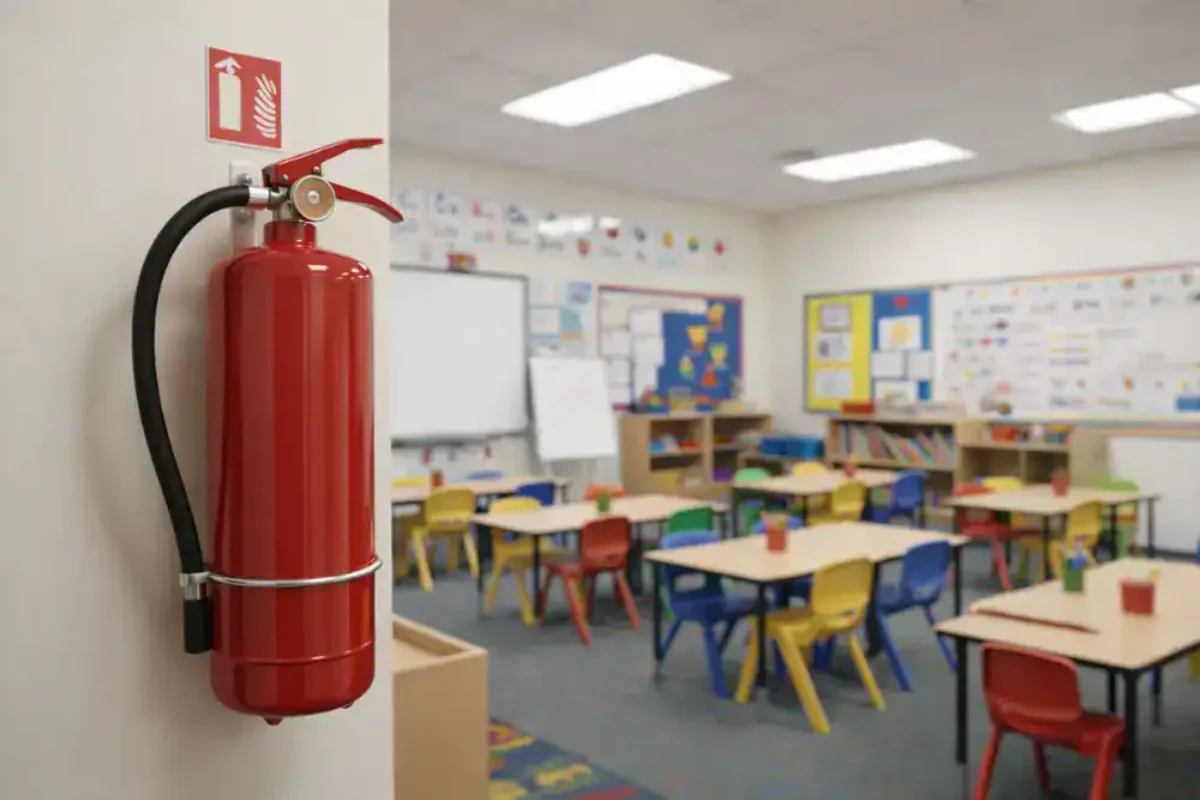
Schools are busy environments where many people share classrooms, laboratories, libraries, offices, cafeterias, sports areas, and sometimes hostels. Because students and staff may be concentrated in one building at the same time, fire safety needs to be planned as a complete system rather than relying on a single extinguisher or alarm.
In Pakistan, the Building Code of Pakistan includes dedicated fire-safety provisions covering evacuation, fire alarms, emergency drills, reporting of fires, and maintenance of fire-protection systems.
What Does School Fire Safety Mean?
School fire safety is the combination of measures used to prevent fires, detect them early, warn people, support safe evacuation, and reduce property damage. It includes physical equipment as well as policies, staff responsibilities, emergency procedures, inspections, and regular training.
A good school fire-safety plan normally considers:
- Fire detection and alarm systems
- Emergency exits and evacuation routes
- Fire extinguishers and other appropriate equipment
- Electrical safety
- Laboratory and kitchen risks
- Emergency lighting and signs
- Communication systems
- Staff responsibilities
- Evacuation drills
- Inspection and maintenance
- Safe assembly areas
The goal is not simply to install equipment. Every part of the system should work together so that people receive an early warning and can leave the building safely.
How Does a School Fire Alarm Work?
A fire alarm system is one of the most important parts of a school’s early-warning strategy. Depending on the design, detectors can identify smoke or excessive heat and send a signal to a control panel. The panel then activates notification devices such as bells, sounders, or visual indicators.
A modern fire alarm system in Pakistan may use conventional, addressable, wireless, or intelligent technology depending on the building’s size, layout, occupancy, and risk profile. Flame Defender, for example, describes systems using smoke detectors, heat sensors, control panels, and different types of alarm technology for properties across Pakistan.
The important point is that an alarm is not designed to replace evacuation procedures. When an alarm activates, the school’s emergency plan should determine what students, teachers, and other occupants do next.
The Building Code of Pakistan states that people should leave a building when a fire alarm system is activated, except in circumstances covered by an approved evacuation plan or routine testing and maintenance.
Why Early Detection Matters in Schools
A small fire can change rapidly. Early detection gives people more time to recognize the emergency and begin evacuation before conditions become more difficult.
This is particularly important in schools because students may be in different parts of a building. A fire in one area could initially be unnoticed by people in another classroom, office, laboratory, or corridor.
A properly designed alarm system helps communicate the emergency throughout the building instead of depending on someone noticing smoke and manually informing everyone.
This is also why simply purchasing detectors is not enough. Their location, compatibility, testing, maintenance, and connection to the overall alarm system all matter.
Fire Risks Commonly Found in Schools
Every school has a different risk profile, but several areas deserve particular attention.
Electrical Equipment
Computers, projectors, printers, laboratory equipment, air conditioners, fans, and other electrical appliances can contribute to fire risk if electrical systems are poorly maintained or overloaded.
Schools should have appropriate electrical inspection and maintenance procedures and should avoid unsafe temporary electrical arrangements.
Science Laboratories
Laboratories may contain equipment and materials that require additional safety controls. Students should follow teacher instructions and established laboratory rules rather than handling potentially hazardous equipment without supervision.
Kitchens and Cafeterias
Schools with kitchens have additional risks associated with cooking equipment, electrical appliances, heat sources, and combustible materials. Appropriate fire-protection arrangements should be selected according to the kitchen’s specific hazards.
Storage Areas
Paper, books, cardboard, furniture, cleaning materials, and other stored items can contribute to fire loading. Storage areas should be organized and kept clear of emergency routes.
Hostels and Dormitories
Schools and universities with residential facilities require particular attention because people may be asleep when an emergency occurs. Detection, alarm notification, clear escape routes, and practiced evacuation procedures become especially important.
Emergency Exits and Evacuation Routes
An alarm only helps if people can actually leave safely.
Emergency routes should be clearly identified and kept unobstructed. The Building Code of Pakistan’s fire-safety provisions address unobstructed means of egress and appropriate indication of exit routes.
Schools should therefore regularly check that:
- Exit routes are not blocked by furniture or stored materials.
- Emergency doors can be used as intended.
- Exit signs remain visible.
- Corridors and stairways are maintained appropriately.
- Students and staff know the designated evacuation routes.
- Alternative routes are considered where the normal route may become unavailable.
Students should never be instructed to return to a building during a fire emergency unless authorized emergency personnel determine that it is safe.
The Role of Teachers and Staff
Teachers have an important role because students normally follow the instructions of adults responsible for their class.
A school emergency plan should clearly assign responsibilities. Depending on the school’s structure, these may include:
- Raising or responding to the alarm
- Directing students toward designated exits
- Taking attendance at the assembly area
- Assisting students who need additional support
- Communicating with school management
- Contacting emergency services according to the school’s emergency plan
- Preventing people from unnecessarily re-entering the building
The exact responsibilities should be established by the school and appropriate authorities rather than improvised during an emergency.
Why Fire Drills Are Important
A written emergency plan is useful, but students and staff also need to understand what to do in practice.
Fire drills provide an opportunity to practice evacuation and identify problems before a real emergency occurs. Pakistan’s Building Code fire-safety provisions include emergency egress and relocation drills, including requirements concerning drill conditions, predetermined relocation areas, and written records.
A school can use drills to identify issues such as:
- Confusing evacuation routes
- Blocked pathways
- Poor communication
- Students who do not hear the alarm
- Congestion near exits
- Difficulty accounting for classes
- Problems with assembly arrangements
Drills should be conducted safely and in cooperation with responsible school personnel and relevant authorities. They should not involve creating real fire or smoke conditions.
The Importance of an Assembly Area
After leaving the building, students and staff need a predetermined location where classes can gather.
An assembly area should be sufficiently separated from the building and should not interfere with emergency responders. The school’s evacuation plan should identify the location in advance.
Teachers can then account for students according to the school’s established procedure. This helps school management identify whether everyone has reached safety and communicate accurate information to emergency personnel.
The Building Code specifically describes relocation to a predetermined location during emergency drills.
Fire Extinguishers in Schools
Fire extinguishers can be an important component of a school’s fire-protection strategy, but their presence does not eliminate the need for evacuation.
Extinguishers should be selected according to the types of fire hazards present and maintained in accordance with applicable requirements. Staff members who may be expected to use them should receive appropriate training.
Students should not be expected to fight a developing fire. Their priority during an alarm should be to follow the school’s evacuation procedure and move to safety.
Fire Alarm Maintenance Is Essential
Installing an alarm is only the beginning. A system that has not been properly inspected or maintained may not provide reliable warning when it is needed.
Dust, humidity, component wear, electrical problems, battery issues, or other faults can affect system performance. Flame Defender notes that regular maintenance, testing, cleaning, and checking of fire alarm components are important for continued reliability.
Schools should maintain appropriate records of inspections, testing, repairs, and other relevant work. If a system develops a fault, responsible management should ensure that the issue is addressed rather than simply assuming the alarm will work.
Communication During an Emergency
A school may have hundreds or thousands of people across multiple buildings. A simple alarm sound may not communicate every necessary instruction.
Public-address systems can support emergency communication by allowing authorized staff to provide clear instructions. Such systems are used in educational institutions and can be integrated with fire-alarm and evacuation planning.
The communication system should complement—not replace—the alarm system and evacuation plan.
Supporting Students Who Need Additional Assistance
A good school fire-safety plan should consider the different needs of students, teachers, visitors, and other occupants.
Some students may require assistance because of mobility, hearing, visual, or other accessibility needs. Their evacuation arrangements should be planned in advance rather than decided during an emergency.
The Building Code recognizes the importance of accessible means of egress and considers the capabilities of building occupants when evaluating fire-safety safeguards.
Fire Safety in Laboratories and Special Areas
Schools should not necessarily use the same fire-safety approach everywhere.
A computer room, science laboratory, kitchen, library, classroom, workshop, and hostel may have different hazards. A professional risk assessment can help determine the appropriate combination of detection, alarm, suppression, emergency communication, and evacuation measures.
Flame Defender describes site surveys and risk assessments as part of designing fire-protection systems for different facilities.
Why Multiple Safety Measures Are Better
Fire safety should never depend entirely on one device.
For example, a school may have:
- Fire prevention procedures
- Smoke or heat detection
- A fire alarm system
- Emergency communication
- Clearly marked exits
- Fire extinguishers
- Emergency lighting where required
- Evacuation procedures
- Trained staff
- Regular drills and maintenance
If one part develops a problem, other safeguards can still contribute to protecting occupants.
This approach is consistent with the Building Code’s principle that fire safety should not depend on a single safeguard.
Creating a School Fire-Safety Culture
Fire safety works best when it becomes part of normal school management rather than an activity performed only before an inspection.
Students should learn basic emergency behavior in age-appropriate ways. Teachers should understand their responsibilities. Maintenance staff should know how to report equipment problems. School management should maintain documentation and arrange appropriate inspections.
The objective is to make the correct response familiar enough that people do not have to invent a plan during an emergency.
Why Professional Assessment Matters
Every school building is different. A small primary school with one floor has different requirements from a large multi-story campus with laboratories, kitchens, hostels, auditoriums, and sports facilities.
Professional assessment can consider the building layout, occupancy, fire hazards, alarm coverage, evacuation routes, equipment, and applicable requirements.
A qualified fire-safety professional can also help determine whether an existing fire alarm system in Pakistan is appropriate for the school’s current needs or whether improvements are necessary.
Maintenance Should Continue After Installation
Fire safety is an ongoing responsibility.
A school should periodically review:
- Alarm functionality
- Detector condition
- Control panels
- Notification devices
- Backup power
- Emergency lighting
- Exit signs
- Fire extinguishers
- Evacuation routes
- Communication systems
- Emergency plans
- Drill records
Building modifications should also trigger a review. Adding classrooms, changing room layouts, installing new equipment, or expanding a campus can change the building’s fire-safety requirements.
The Role of Flame Defender
For schools looking for professional fire-protection support, provides fire alarm installation and related fire-safety services in Pakistan. Its fire alarm services include system design, installation, testing, maintenance, and upgrades, with systems such as conventional and addressable alarms described on its website.
The most suitable system depends on the school’s building, occupancy, risks, and applicable requirements. A professional site assessment is therefore more useful than selecting equipment based only on price or appearance.
Final Thoughts
School fire safety works through a combination of prevention, early detection, warning, evacuation, communication, equipment, training, and maintenance. No single device can provide complete protection.
A reliable alarm can provide an early warning, but that warning must be supported by clear exits, trained staff, regular drills, accessible assembly areas, maintained equipment, and a well-developed emergency plan.
For schools in Pakistan, following applicable building and fire-safety requirements while regularly reviewing the school’s actual risks can help create a safer environment for students, teachers, visitors, and staff. The Building Code of Pakistan provides an important framework for evacuation, drills, alarm activation, and fire-safety management.
FAQs
1. Why is fire safety important in schools?
Fire safety helps protect students, teachers, staff, and visitors by providing early warning, organized evacuation procedures, appropriate equipment, and emergency planning.
2. How does a school fire alarm system work?
Detectors can identify conditions such as smoke or excessive heat and send a signal to a control panel. The system then activates alarms or other notification devices to warn occupants.
3. How often should schools conduct fire drills?
The appropriate frequency depends on the school’s occupancy and applicable requirements. Pakistan’s Building Code specifies emergency drill provisions and requires records of drills where applicable.
4. Should students use fire extinguishers during an emergency?
Students should prioritize evacuation and follow instructions from responsible adults. Fire-extinguisher use should be left to appropriately trained adults when conditions and procedures permit; people should not put themselves at risk trying to fight a fire.
5. Does a school need a fire alarm system in Pakistan?
Fire-alarm requirements depend on the building type, occupancy, size, design, and applicable fire-safety provisions. Schools should have their requirements assessed by qualified professionals and follow the applicable authorities and building codes. Flame Defender provides professional fire-alarm design, installation, testing, and maintenance services across Pakistan.