
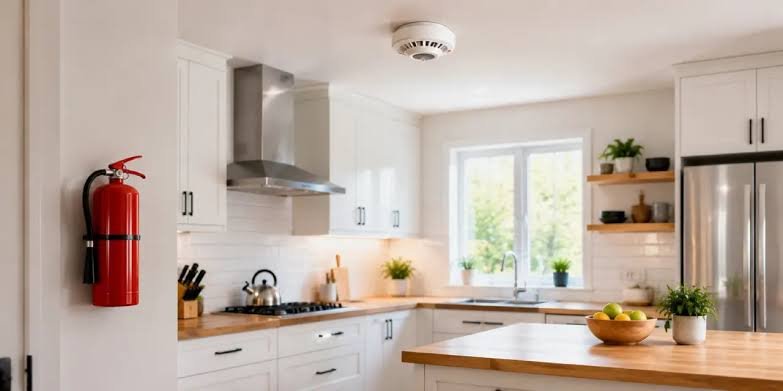
A home kitchen may be much smaller than a restaurant kitchen, but it can still contain several common fire hazards. Cooking appliances, electrical equipment, hot surfaces, cooking oils, gas appliances, and combustible materials can all create risks when they are not managed carefully.
This does not mean that every home needs the same equipment or systems as a commercial restaurant. Instead, homeowners can learn from the basic principles used in professional cooking environments and apply suitable measures to their own homes.
Restaurant kitchens generally place strong emphasis on cooking equipment, ventilation, fire detection, suppression, housekeeping, staff awareness, and regular maintenance. NFPA 96, for example, addresses fire protection and ventilation for commercial cooking operations, including cooking equipment, exhaust hoods, grease-removal devices, and fire-suppression systems.
For homeowners in Pakistan, understanding these principles can help create a safer kitchen without overcomplicating everyday life.
Why Should Homes Learn From Restaurant Fire Safety?
Cooking is one of the most important areas to consider when creating a home fire-safety plan. A kitchen contains heat-producing appliances and materials that can burn or contribute to fire spread.
Commercial kitchens deal with these hazards on a larger scale, so their safety practices can provide useful lessons for homeowners. However, equipment designed for restaurants should not automatically be installed in a house. Fire protection should always match the building, equipment, occupancy, and actual hazards.
The Building Code of Pakistan Fire Safety Provisions 2016 covers fire prevention, life safety, and fire protection and includes provisions concerning the design, installation, maintenance, repair, servicing, and testing of fire-protection systems and equipment.
The basic lesson is straightforward:
Fire safety works best when prevention, early warning, suitable equipment, and safe evacuation are considered together.
1. Start With Kitchen Fire Prevention
The simplest fire-safety measure is preventing a fire from starting.
Cooking should never be treated as something that can be left unattended for long periods. A person responsible for cooking should remain alert and keep the cooking area under control.
Good household habits include:
- Keeping combustible materials away from cooking appliances
- Keeping kitchen surfaces reasonably clean
- Avoiding unnecessary clutter around heat-producing appliances
- Keeping appliance cords in good condition
- Following appliance manufacturer’s instructions
- Keeping children away from active cooking areas
- Making sure household members know how to respond to an alarm
These basic habits may seem simple, but they create an important first layer of protection.
2. Keep Grease and Cooking Areas Clean
Commercial kitchens pay close attention to grease because accumulated grease can increase fire risk. Home kitchens should also avoid allowing grease and food residue to build up around cooking equipment.
Exhaust hoods, filters, cooking surfaces, and nearby areas should be maintained according to the equipment manufacturer’s recommendations.
NFPA 96 specifically addresses commercial cooking ventilation, grease-removal devices, exhaust systems, cooking equipment, and fire protection. Its purpose is to help control fire hazards associated with commercial cooking operations.
A home kitchen may not require a commercial exhaust system, but the principle remains useful: clean equipment is generally easier to maintain and safer to operate than neglected equipment.
3. Install Appropriate Smoke Alarms
Early warning can make a major difference during a home fire.
Smoke alarms are designed to alert occupants when smoke is detected, giving people an opportunity to respond and leave the building safely. They should be installed and maintained according to the manufacturer’s instructions and the requirements applicable to the property.
Homeowners should regularly check their alarms at the user level, keep them free from obvious obstruction, and replace batteries or complete replacement of devices as recommended by the manufacturer.
For more advanced properties, an integrated fire alarm system in Pakistan may provide a broader level of detection and notification. NFPA 72 provides guidance concerning the installation, inspection, testing, and maintenance of fire alarm and signaling systems.
A home alarm should never be treated as decoration. If it produces a fault warning or repeatedly behaves abnormally, the issue should be investigated.
4. Understand That Smoke Alarms and Cooking Protection Are Different
A common misunderstanding is that installing a smoke alarm automatically protects the kitchen from every type of cooking fire.
It does not.
A smoke alarm is primarily a detection and warning device. It does not replace safe cooking practices or specialized fire-protection equipment.
Likewise, a fire extinguisher does not replace an alarm system. Each piece of equipment has a different purpose.
A sensible home fire-safety plan may therefore combine:
- Fire prevention
- Smoke detection
- Suitable fire extinguishers
- Safe electrical practices
- Safe gas-appliance practices
- Clear escape routes
- Family emergency planning
- Professional inspection where necessary
These layers complement each other.
5. Choose Fire Extinguishers Carefully
Not every extinguisher is appropriate for every type of fire.
NFPA 10 establishes requirements for portable fire extinguishers and describes them as a first line of defense against fires of limited size.
The Building Code of Pakistan Fire Safety Provisions 2016 also addresses extinguisher selection based on the hazards present and the types of fires that may occur.
For a home, the correct extinguisher depends on factors such as the cooking equipment, electrical appliances, fuel sources, and other hazards present.
Homeowners should therefore avoid buying an extinguisher simply because it is inexpensive or advertised as suitable for “everything.”
A qualified fire-safety professional can help determine what type of equipment is appropriate.
Technical inspection, recharge, repair, and servicing should be handled by qualified personnel rather than improvised at home.
6. Be Careful Around Cooking Oil
Cooking oils can become extremely hot, and a kitchen fire involving oil requires particular caution.
The most important principle is to avoid panic and never take unnecessary risks. If a fire becomes difficult to control or conditions become unsafe, people should leave the area and call emergency services rather than attempting to fight the fire.
Children should never be expected to deal with a cooking fire.
The safest household approach is prevention, early warning, adult supervision, and a clear evacuation plan.
7. Maintain Kitchen Ventilation
Ventilation is another important lesson from restaurant kitchens.
Commercial cooking operations often use dedicated exhaust systems because large-scale cooking can generate heat, smoke, grease, and vapors. NFPA 96 specifically covers commercial cooking ventilation and fire protection systems.
Homes have different requirements, but kitchen ventilation should still be maintained properly.
If a home uses an exhaust fan or hood, homeowners should follow the manufacturer’s cleaning and maintenance instructions. Poorly maintained equipment can become less effective and may accumulate grease and debris.
Do not modify ventilation or fire-protection equipment without appropriate professional advice.
8. Keep Electrical Appliances in Good Condition
Modern kitchens contain many electrical appliances, including refrigerators, ovens, microwave ovens, blenders, mixers, kettles, and other devices.
Damaged plugs, cables, sockets, or appliances should not be ignored.
Warning signs can include:
- Damaged power cords
- Discolored outlets
- Burning smells
- Unusual heat
- Sparks
- Repeated electrical interruptions
- Appliances behaving unexpectedly
Electrical repairs should be performed by a qualified electrician.
Avoid creating overloaded connections simply because several appliances are being used at the same time. Good electrical maintenance is an important part of kitchen fire prevention.
9. Pay Attention to Gas Appliances
Many homes in Pakistan use gas for cooking, making gas-appliance safety another important consideration.
Gas appliances should be installed and maintained by appropriately qualified professionals. Household members should not attempt technical repairs or modifications themselves.
If someone suspects a gas problem, the priority should be to avoid ignition sources, alert an adult, move away from the suspected danger, and follow the property’s emergency procedures.
Children should never be asked to investigate a suspected gas leak or operate gas equipment during an emergency.
Regular professional attention to gas appliances can help identify problems before they become serious.
10. Keep Children Away From Cooking Hazards
Restaurant kitchens are normally controlled work environments, while home kitchens are also living spaces.
Children may enter a kitchen without understanding the danger presented by hot surfaces, cooking appliances, electrical equipment, or other hazards.
Parents and caregivers should establish simple rules such as:
- Stay away from active cooking areas unless an adult says otherwise.
- Do not touch cooking appliances.
- Never play with matches, lighters, or other ignition sources.
- Tell an adult immediately if they see smoke, flames, or another danger.
- Leave the building when adults instruct them to evacuate.
Fire-safety education should be age-appropriate. Children do not need technical training on fire-protection systems; they need to understand how to recognize danger, alert an adult, and get to safety.
11. Keep Escape Routes Clear
Even the best kitchen equipment cannot compensate for blocked exits.
Every home should have a clear way for occupants to leave during an emergency. Doors, corridors, stairways, and other escape routes should not become storage areas.
The Building Code of Pakistan Fire Safety Provisions 2016 includes requirements concerning means of egress and fire and life safety.
Families should know at least one primary escape route and, where possible, an alternative route.
An outdoor meeting point can also help family members determine whether everyone has reached safety.
12. Don’t Depend on One Safety Device
One of the biggest mistakes homeowners can make is believing that a single device provides complete fire protection.
For example, a smoke alarm can provide warning, but it cannot prevent a fire. An extinguisher may help with a limited fire when appropriate and when a safe response is possible, but it cannot replace evacuation planning.
Similarly, a fire alarm system in Pakistan can be an important part of a property’s protection, but it should work alongside prevention, maintenance, safe exits, and emergency planning.
Fire protection is strongest when several safety measures support one another.
13. Maintain Fire-Safety Equipment
Fire equipment can deteriorate over time.
Dust, physical damage, corrosion, expired components, electrical faults, or neglected servicing can affect reliability.
NFPA guidance for fire alarm systems emphasizes inspection, testing, and maintenance, while NFPA 17A addresses the design, installation, operation, testing, and maintenance of wet-chemical extinguishing systems used for cooking protection.
Homeowners should follow the manufacturer’s instructions for routine user checks and arrange professional servicing when technical maintenance is required.
The same principle applies to more complex systems such as sprinklers, pumps, or fixed suppression systems. NFPA 25 provides inspection, testing, and maintenance guidance for water-based fire-protection systems.
14. Create a Home Kitchen Fire-Safety Checklist
A simple checklist can make fire safety easier to manage.
Kitchen safety checklist
- [ ] Smoke alarms are installed where appropriate.
- [ ] Alarms are tested according to manufacturer instructions.
- [ ] Batteries are replaced when required.
- [ ] Cooking appliances are maintained properly.
- [ ] Electrical cords and plugs are checked for visible damage.
- [ ] Cooking areas are kept reasonably clean.
- [ ] Grease and food residue are not allowed to accumulate unnecessarily.
- [ ] Suitable fire equipment is available where appropriate.
- [ ] Fire equipment is accessible.
- [ ] Gas appliances receive professional attention when needed.
- [ ] Exhaust fans or hoods are maintained according to manufacturer instructions.
- [ ] Escape routes remain clear.
- [ ] Family members know the emergency plan.
- [ ] Children know to alert an adult and leave rather than attempting to fight a fire.
15. Restaurant Standards Are Not Automatically Home Standards
The title of this article asks whether you have “restaurant fire safety” at home, but the answer should not be interpreted as a recommendation to install commercial equipment in every house.
Commercial kitchens have different levels of cooking activity, ventilation, equipment, occupancy, and fire load. They may therefore require specialized systems that are unnecessary or unsuitable for ordinary residential use.
Instead, homeowners should borrow the principles behind professional kitchen safety:
Prevention → Detection → Maintenance → Preparedness → Safe Evacuation
This approach is more practical than trying to turn a residential kitchen into a commercial restaurant kitchen.
Fire Safety in Pakistan: A Practical Approach
Pakistan’s Building Code Fire Safety Provisions provide a national reference for fire prevention, life safety, and fire protection. The provisions cover areas including fire-protection equipment and systems, inspection, maintenance, servicing, testing, and means of egress.
For more specialized fire detection and suppression work, the Pakistan Engineering Council also identifies installation, commissioning, and maintenance of fire detection, alarm, and suppression systems as a defined area of engineering services.
Actual requirements can vary according to the property, building type, local authority, and applicable regulations. For complex systems, homeowners should seek advice from appropriately qualified professionals.
For additional information about fire-safety solutions, you can explore Flame Defender.
Final Thoughts
A home kitchen may not look like a restaurant kitchen, but many of the same fire-safety principles still apply.
Clean and properly maintained equipment, safe cooking habits, reliable smoke detection, appropriate fire extinguishers, electrical awareness, safe gas appliances, clear exits, and family preparedness all contribute to a safer home.
The most important lesson is not to focus on one piece of equipment. A safer kitchen comes from several layers of protection working together.
If you are considering a fire alarm system in Pakistan, start by understanding the actual needs of your home. Choose suitable equipment, follow manufacturer instructions, keep safety systems maintained, and seek professional assistance for technical installation or servicing.
Most importantly, remember that the purpose of fire safety is not to encourage people to fight fires themselves. It is to prevent fires where possible, provide early warning, and help everyone leave safely when an emergency occurs.
FAQs
1. Does my home need restaurant-style fire protection?
Not necessarily. Residential kitchens have different risks and requirements from commercial kitchens. Homeowners should apply appropriate fire-prevention, detection, and evacuation measures rather than installing commercial systems without professional assessment.
2. Is a smoke alarm enough to protect my kitchen?
No. A smoke alarm provides early warning but does not prevent a fire. Kitchen safety should also include safe cooking habits, appropriate equipment, electrical safety, clear exits, and an emergency plan.
3. What type of fire extinguisher should I keep at home?
The appropriate extinguisher depends on the hazards present in your home, including cooking equipment and electrical appliances. A qualified fire-safety professional can help determine suitable equipment for your specific situation.
4. How often should a home fire alarm be checked?
Follow the manufacturer’s instructions for user testing, battery replacement, and device replacement. More complex fire alarm systems require appropriate inspection, testing, and maintenance by qualified personnel.
5. Why is kitchen fire safety important in Pakistan?
Kitchens may contain several potential fire hazards, including cooking appliances, electrical equipment, and gas appliances. Good prevention practices, early warning, suitable equipment, and a clear evacuation plan can help reduce the potential impact of a kitchen fire.