
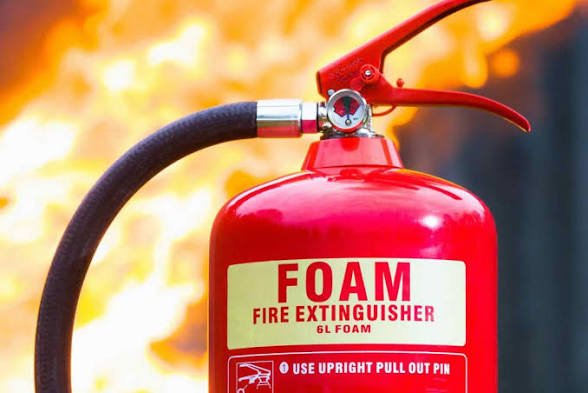
Fire safety is not complete simply because a home or business has a fire extinguisher. The type of extinguisher matters just as much as having one available.
Different fires involve different materials. A fire involving paper or wood is not the same as a fire involving flammable liquids, energized electrical equipment, combustible metals, or cooking oils. Using an unsuitable extinguisher can be ineffective and may create additional danger.
This is why understanding the basic types of fire extinguishers is an important part of fire-safety planning.
The Building Code of Pakistan Fire Safety Provisions 2016 states that portable extinguishers should be selected according to factors including the likely type and size of fire, hazards in the area, nearby energized electrical equipment, and environmental conditions. It also describes portable extinguishers as a first line of defense for fires of limited size.
For homes, offices, shops, factories, warehouses, schools, and other properties in Pakistan, the right choice should be based on the actual hazards present rather than simply buying the most common extinguisher.
A complete fire-safety plan should also include prevention, detection, evacuation, maintenance, and professional assistance where necessary. A fire alarm system in Pakistan can provide an important early-warning layer, while suitable extinguishers can provide another layer of protection.
Why Are There Different Types of Fire Extinguishers?
Fire needs three basic elements to continue: heat, fuel, and oxygen. Different extinguishing agents are designed to address fires involving different fuels and conditions.
For example, ordinary combustible materials such as paper, cloth, and wood require different considerations from flammable liquids or energized electrical equipment.
NFPA identifies five major fire classifications for portable extinguisher selection: Class A, Class B, Class C, Class D, and Class K. Extinguishers are marked with letters and symbols indicating the types of fires for which they are suitable.
This classification system helps people understand that there is no universal extinguisher that should automatically be used for every fire.
Class A Fire Extinguishers
Class A fires involve ordinary combustible materials.
Examples include:
- Wood
- Paper
- Cloth
- Some plastics
- Rubber
- Other ordinary combustible materials
These materials are common in homes, offices, schools, and storage areas.
Class A-rated extinguishers are intended for these types of hazards. NFPA’s fire-extinguisher guidance identifies ordinary combustibles as Class A hazards and includes materials such as wood, cloth, paper, rubber, and many plastics.
A property containing substantial quantities of these materials should be assessed to determine appropriate extinguisher types, ratings, quantity, and placement.
The exact requirements depend on the building and hazard level.
Class B Fire Extinguishers
Class B fires involve flammable liquids.
Examples can include certain:
- Fuels
- Oils
- Paints
- Solvents
- Other flammable liquids
NFPA identifies gasoline, oil, and some paints and solvents as examples associated with Class B hazards.
These hazards may occur in garages, workshops, industrial facilities, maintenance areas, and locations where flammable liquids are stored or used.
A Class B extinguisher should be specifically rated and labeled for the relevant hazard.
Homeowners should not assume that an extinguisher suitable for ordinary household materials is automatically suitable for every flammable-liquid fire.
Class C Fire Extinguishers
Class C relates to fires involving energized electrical equipment.
Electrical equipment can be present almost everywhere, including:
- Homes
- Offices
- Shops
- Computer rooms
- Workshops
- Industrial facilities
- Commercial buildings
NFPA explains that a Class C rating applies to extinguishers suitable for energized electrical equipment and that Class C-rated extinguishers also have an underlying Class A or Class B rating.
This is an important distinction.
The “C” classification does not mean that the extinguisher is suitable for every possible fire. It indicates suitability for the electrical hazard while the extinguisher’s other classifications identify additional fire types it can address.
Electrical fires also highlight why fire prevention is essential. Damaged cables, overloaded circuits, defective equipment, and poor maintenance can create serious hazards.
Technical electrical problems should be addressed by qualified professionals.
Class D Fire Extinguishers
Class D fires involve combustible metals.
These hazards are less common in ordinary homes but can be important in certain industrial and specialist environments.
Examples of combustible metals include:
- Magnesium
- Sodium
- Certain other reactive metals
NFPA identifies combustible metals as Class D hazards.
Because these fires can behave differently from ordinary combustible or liquid fires, specialized extinguishing agents may be necessary.
A Class D extinguisher should therefore be selected based on the specific metal hazard rather than simply purchased as a general-purpose product.
Industrial facilities with metal-processing operations should have their hazards professionally assessed.
Class K Fire Extinguishers
Class K extinguishers are associated with fires involving cooking oils and animal fats, particularly in commercial cooking environments.
NFPA identifies Class K as the classification for hazards involving vegetable oils or animal fats used in commercial cooking equipment.
Commercial kitchens can produce significant quantities of heat and cooking oils, which is why specialized cooking fire protection can be important.
Class K extinguishers are commonly associated with commercial kitchens.
Home kitchens have different requirements, so homeowners should not automatically assume that commercial kitchen equipment is necessary in every residential property. The appropriate protection depends on the cooking equipment, cooking practices, building design, and applicable requirements.
Dry Chemical Extinguishers
Dry chemical extinguishers are widely used because some types can be rated for multiple classes of fire.
For example, an extinguisher may carry an ABC rating, indicating that it is listed for Class A, Class B, and Class C hazards.
However, homeowners should always read the label instead of assuming that every dry chemical extinguisher has the same capabilities.
NFPA emphasizes that portable extinguishers must match the fire being addressed.
The label is therefore an important source of information when selecting equipment.
Water-Based Extinguishers
Water is commonly associated with Class A fires involving ordinary combustibles.
However, water should not be treated as a universal solution.
Different fire types require different approaches, and using an inappropriate agent can increase danger.
For example, energized electrical equipment presents a different hazard from burning paper or wood.
This is why extinguisher selection should always consider the type of fire that is likely to occur.
The Building Code of Pakistan specifically requires extinguisher selection to take account of the type of fire, hazards in the area, and energized electrical equipment.
Carbon Dioxide Extinguishers
Carbon dioxide extinguishers are another type of portable fire extinguisher used for certain hazards.
They can be associated with electrical equipment and some Class B hazards, depending on the specific listed rating.
However, suitability depends on the product’s certification and label.
CO₂ extinguishers are not automatically appropriate for every fire, and their use should be based on the identified hazard and the manufacturer’s instructions.
In enclosed areas, professional fire-safety advice can be particularly important because extinguishing agents can create additional considerations.
Wet Chemical Extinguishing Systems
Wet chemical agents are strongly associated with cooking-fire protection, especially commercial cooking operations.
A wet chemical system can be different from a simple portable extinguisher because it may form part of a fixed cooking fire-suppression arrangement.
Commercial cooking facilities may require integrated protection involving cooking equipment, exhaust hoods, ventilation systems, detection, and suppression.
These systems should be designed and maintained by appropriately qualified professionals.
Homeowners should not attempt to install or modify specialized suppression systems themselves.
Foam Extinguishers
Foam-based extinguishing agents may be suitable for certain Class A and Class B hazards, depending on the specific product and its listing.
They may be used in particular environments where both ordinary combustibles and flammable liquids are concerns.
Again, the extinguisher label is critical.
The safest approach is to select equipment according to the actual hazards identified in a professional fire-risk assessment rather than choosing an agent simply because it is widely advertised.
ABC Extinguishers
ABC extinguishers are often discussed as versatile portable extinguishers because they can be rated for three major categories:
- Class A
- Class B
- Class C
They may therefore be appropriate for a range of common hazards.
However, “ABC” does not mean “every fire.”
They are not automatically suitable for Class D combustible-metal fires or Class K cooking-oil hazards.
The specific product label and applicable requirements should always be checked.
Why Extinguisher Selection Matters in Pakistan
The Building Code of Pakistan Fire Safety Provisions 2016 provides specific requirements concerning portable fire extinguishers.
It states that extinguisher selection should consider the likely fire type and size, hazards present, nearby energized electrical equipment, ambient temperature, and other relevant factors. It also states that extinguishers should be selected for the class or classes of hazards they are intended to protect.
This is important because Pakistani buildings can contain many different types of hazards.
A house may have cooking equipment and electrical appliances. A workshop may contain flammable liquids. A factory may have combustible metals or specialized machinery. A commercial kitchen may have cooking oils and fats.
Each situation requires a different assessment.
Fire Extinguishers Are Only for Limited Fires
A portable extinguisher is not intended to replace firefighters or an evacuation plan.
NFPA 10 describes portable extinguishers as a first line of defense against fires of limited size.
This means people should not assume that having an extinguisher makes it safe to remain in a burning building.
If a fire is spreading rapidly, producing heavy smoke, blocking an exit, or creating conditions that feel unsafe, evacuation should take priority.
Children should never be expected to fight a fire.
Their priority should be to alert an adult, follow the household emergency plan, and get to safety.
Fire Extinguishers and Fire Alarm Systems Work Together
A fire extinguisher and a fire alarm serve different purposes.
An extinguisher is intended to help address a limited fire when the correct equipment is available and a safe response is possible.
A fire alarm system is primarily designed to detect a fire condition and provide warning.
A properly designed fire alarm system in Pakistan can therefore complement portable extinguishers rather than replace them.
A complete fire-safety strategy can include:
- Fire prevention
- Smoke and fire detection
- Alarm notification
- Suitable portable extinguishers
- Clear escape routes
- Emergency planning
- Regular inspection and maintenance
- Professional assistance when required
This layered approach is much stronger than relying on one device.
Where Should Fire Extinguishers Be Located?
Extinguishers should be accessible and located according to the applicable requirements for the building and hazard.
NFPA provides specific placement and travel-distance requirements based on the extinguisher class and hazard level.
The Pakistan fire-safety provisions likewise address extinguisher selection and installation.
Homeowners should avoid hiding an extinguisher behind furniture, boxes, or other objects.
At the same time, equipment should not be positioned where someone would have to move toward a developing fire to reach it.
For commercial and industrial properties, placement should be determined as part of the overall fire-risk assessment.
Maintenance Is Just as Important as Selection
Choosing the right extinguisher is only the beginning.
Equipment can deteriorate through age, physical damage, corrosion, leakage, improper storage, or lack of servicing.
The Building Code of Pakistan states that an extinguisher that can no longer be serviced according to the manufacturer’s maintenance manual is considered obsolete and should be removed from service.
NFPA 10 also addresses inspection, maintenance, testing, and recharging requirements for portable extinguishers.
Homeowners and businesses should therefore maintain appropriate records and arrange professional servicing where required.
Do not attempt technical repairs, pressure-related work, or recharging without the appropriate qualifications and equipment.
Common Fire Extinguisher Mistakes
Several mistakes can reduce the value of otherwise good equipment.
Choosing the cheapest extinguisher
Price should not be the only consideration. Certification, suitability, rating, quality, and maintenance support are also important.
Assuming one extinguisher works everywhere
Different hazards require different classifications.
Blocking access
An extinguisher hidden behind storage may be difficult to reach during an emergency.
Ignoring maintenance
An old or damaged extinguisher may not provide reliable protection.
Forgetting about electrical hazards
Electrical equipment requires appropriate fire protection and safe electrical maintenance.
Treating an extinguisher as a substitute for evacuation
Portable extinguishers are intended for limited fires. They are not a reason to remain in an unsafe building.
How to Choose the Right Type
A sensible selection process starts with identifying the hazards.
Ask:
- What materials are present?
- Is cooking equipment involved?
- Are flammable liquids present?
- Is energized electrical equipment present?
- Are combustible metals involved?
- Is the property residential, commercial, or industrial?
- How large is the area?
- Are there special environmental conditions?
- What do applicable building requirements specify?
The Pakistan Engineering Council’s fire-safety provisions specifically require these kinds of factors to be considered when selecting portable extinguishers.
For more complicated properties, a professional fire-risk assessment can provide a more reliable answer than a general online recommendation.
A Simple Fire Extinguisher Checklist
Before purchasing or reviewing fire extinguishers, consider the following:
- [ ] Identify the likely fire hazards.
- [ ] Select an extinguisher specifically rated for those hazards.
- [ ] Check the manufacturer’s label.
- [ ] Confirm the equipment is approved or listed as required.
- [ ] Make sure the extinguisher is accessible.
- [ ] Keep the surrounding area clear.
- [ ] Check for visible damage or corrosion.
- [ ] Follow inspection and maintenance requirements.
- [ ] Arrange professional servicing when required.
- [ ] Replace obsolete or unserviceable equipment.
- [ ] Maintain clear escape routes.
- [ ] Ensure household or workplace occupants understand the emergency plan.
- [ ] Never treat an extinguisher as a substitute for evacuation.
Fire Safety for Homes in Pakistan
Homes can contain a combination of cooking equipment, electrical appliances, gas appliances, generators, batteries, furniture, fabrics, paper, and other combustible materials.
A practical residential fire-safety plan should therefore consider more than just one extinguisher.
Smoke alarms can provide early warning. A suitable extinguisher can provide an additional layer of protection for a limited fire. Clear exits help people leave safely, while regular maintenance helps keep safety equipment ready.
For properties with a more advanced fire alarm system in Pakistan, professional installation, inspection, testing, and maintenance become increasingly important.
The appropriate level of protection should always reflect the property’s actual hazards and applicable requirements.
For more information about fire-safety equipment and solutions, you can explore Flame Defender.
Final Thoughts
There is no single “best” fire extinguisher for every situation.
Class A extinguishers address ordinary combustible materials. Class B equipment is intended for certain flammable-liquid hazards. Class C relates to energized electrical equipment. Class D is designed for combustible-metal hazards, while Class K addresses specific cooking-oil and fat hazards, particularly in commercial cooking environments.
The right choice depends on the hazards present.
More importantly, extinguishers are only one part of a complete fire-safety strategy. Prevention, early detection, alarms, clear escape routes, emergency planning, and regular maintenance all work together.
For homes and businesses in Pakistan, understanding extinguisher classifications can help people make more informed fire-safety decisions. When the risks are complex, professional assessment is the safest way to determine what equipment is appropriate.
A well-prepared safety plan does not simply ask, “Do we have a fire extinguisher?”
It asks, “Do we have the right equipment for the hazards we actually face, and is that equipment properly maintained?”
FAQs
1. What are the main types of fire extinguishers?
The main fire classifications are Class A, B, C, D, and K. They correspond to different hazards, including ordinary combustibles, flammable liquids, energized electrical equipment, combustible metals, and certain cooking-oil or fat fires.
2. Is an ABC fire extinguisher suitable for every fire?
No. An ABC extinguisher is generally rated for Class A, B, and C hazards, but it is not automatically suitable for Class D combustible-metal fires or Class K cooking-oil hazards. Always check the product’s specific label.
3. Which fire extinguisher is suitable for a home?
The appropriate type depends on the hazards in the home. Many homes have ordinary combustibles and electrical equipment, while kitchens and garages may introduce additional hazards. The equipment should be selected according to the actual risks and applicable requirements.
4. Do fire extinguishers need regular maintenance?
Yes. Fire extinguishers require appropriate inspection and maintenance. Damaged or obsolete equipment should not be relied upon. The Pakistan fire-safety provisions state that extinguishers that can no longer be serviced according to the manufacturer’s maintenance manual should be removed from service.
5. Can a fire extinguisher replace a fire alarm system?
No. The two serve different purposes. A fire alarm system is designed to detect and warn occupants, while a portable extinguisher provides a first line of defense against a limited fire. A complete safety plan should use appropriate layers of protection rather than relying on one device.