Burns can happen suddenly at home, at school, at work, in the kitchen, or during an outdoor activity. A hot drink can spill, a cooking surface can be touched accidentally, or a person can come into contact with fire, steam, electricity, or chemicals. Knowing the correct first-aid response can help prevent further injury while professional medical help is arranged.
Burn first aid does not replace medical treatment. Serious burns can require urgent professional assessment, and even an injury that initially looks small may need medical attention depending on its location, cause, depth, and the age or health of the injured person.
The most important principle is simple: stop the burning process, cool the injury, protect it, and get medical help when needed.
For families and businesses in Pakistan, burn first aid should also be part of a wider fire-safety plan. Fire prevention, smoke detection, emergency exits, fire alarms, and staff or family education all help reduce the consequences of a fire emergency.
What Is a Burn?
A burn is an injury to the skin or deeper tissues caused by heat or another damaging source.
Common causes include:
- Fire and flames
- Hot liquids
- Steam
- Hot surfaces
- Electrical sources
- Chemicals
- Certain forms of radiation
A scald is a burn caused by hot liquid or steam. Hot water, tea, coffee, cooking liquids, and steam can all cause scald injuries.
Burns can vary greatly in severity. Some affect only the outer layer of skin, while deeper burns can damage several layers of tissue.
Because severity is not always easy to judge, people should not rely only on how painful an injury feels. A serious burn can sometimes cause less pain because deeper damage may affect nerves.
The First Rule: Stop the Burning Process
The first priority after a burn is to stop further exposure to the source of heat or danger.
If it is safe to do so, the injured person should be moved away from the source.
However, people helping should not put themselves in danger. Trying to rescue someone from an unsafe environment without proper protection can result in additional injuries.
Once the person is away from the source, the burn can be cooled.
Cool the Burn With Running Water
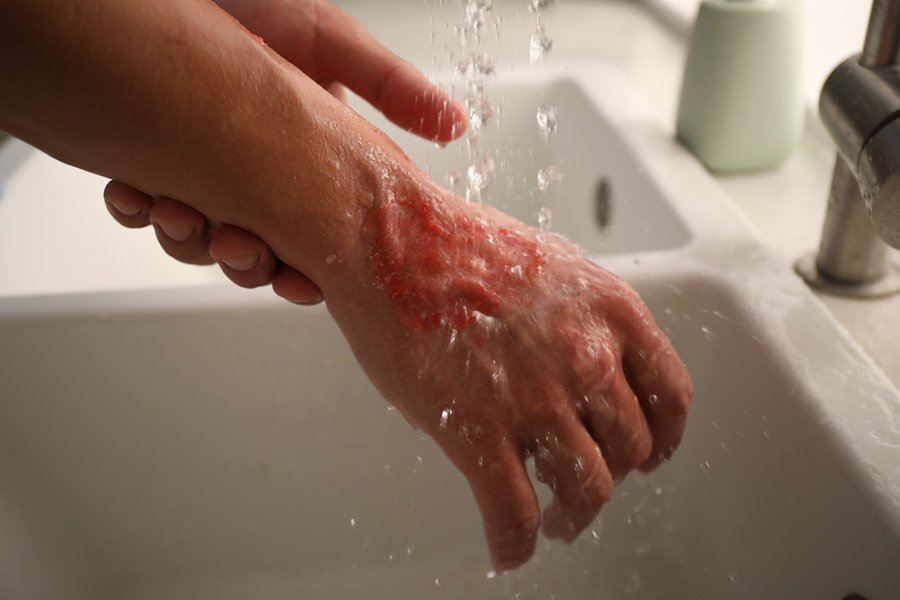
For a typical thermal burn or scald, first-aid guidance recommends cooling the affected area under cool running water for around 20 minutes. Cooling should begin as soon as possible.
The water should be cool rather than extremely cold.
Cooling helps remove heat from the affected tissue and can limit further damage.
If running water is not immediately available, some first-aid guidance recommends using another safe source of cool water until proper cooling can be provided.
The rest of the person’s body should be kept comfortably warm while the injured area is being cooled, particularly when the injured person is a child.
Why You Should Not Use Ice
One of the most common burn first-aid mistakes is applying ice directly to the injury.
Ice or extremely cold water can cause additional tissue damage. Established first-aid guidance therefore recommends cool running water instead.
A simple rule to remember is:
Cool water — not ice.
This is especially important when teaching children about burn safety.
Remove Nearby Clothing and Jewelry Carefully
Clothing, watches, rings, bracelets, or other items close to a burn may become difficult to remove if swelling develops.
If clothing or jewelry is near the injured area and can be removed easily, it may be removed while taking care not to disturb the damaged skin.
However, anything stuck to the burn should not be pulled away. Removing material that has become attached to burned skin can cause additional damage.
When in doubt, leave stuck material alone and seek professional medical assistance.
Do Not Put Household Remedies on a Burn
Many traditional or commonly repeated home remedies are not appropriate first aid.
Do not automatically apply:
- Toothpaste
- Butter
- Cooking oil
- Grease
- Creams
- Ointments
- Household pastes
- Ice
NHS guidance specifically advises against applying ice, butter, toothpaste, creams, gels, oils, or ointments to burns and scalds.
These substances can interfere with proper assessment and may make subsequent medical treatment more difficult.
The safer initial approach for a thermal burn is proper cooling with cool running water.
Do Not Burst Blisters
Some burns can produce blisters.
A blister provides a natural protective layer over the underlying skin. It should not be deliberately punctured or popped.
Breaking a blister unnecessarily can increase the risk of infection.
If a blister is large, damaged, or associated with a significant burn, professional medical advice should be obtained.
Cover the Burn After Cooling
Once the burn has been cooled, it can be protected with an appropriate clean covering.
Some established first-aid guidance recommends loosely covering a cooled burn with cling film or a clean, non-fluffy covering while medical assessment is being arranged. Cling film should be laid over the injury rather than wrapped tightly around a limb.
Do not use materials that are likely to stick to the injured skin.
The purpose of temporary covering is to protect the area from contamination and reduce discomfort while the person receives appropriate care.
When Should You Seek Medical Help?
Not every burn requires the same level of medical treatment.
Professional medical assessment is particularly important when a burn is:
- Large or extensive
- Deep
- On the face
- Around the eyes
- On the hands
- On the feet
- Around major joints
- Around the genitals
- Caused by electricity
- Caused by chemicals
- Associated with breathing difficulties
- Associated with significant swelling or other concerning symptoms
Children, older adults, and people with certain medical conditions may also need additional consideration.
If you are unsure about the seriousness of a burn, contacting a qualified healthcare professional is safer than relying on home treatment alone.
Chemical Burns Are Different
Chemical burns require particular caution.
A chemical may continue damaging tissue as long as it remains in contact with the skin. The priority is to stop further exposure and obtain urgent professional advice.
Contaminated clothing may need to be removed carefully if it can be done without spreading the chemical to other areas.
The affected area generally needs extensive flushing with clean water, but the exact response can depend on the substance involved. Emergency medical guidance should be sought for significant chemical exposure.
People should avoid experimenting with household neutralizing substances unless specifically instructed by an appropriate medical or emergency professional.
Electrical Burns Need Medical Attention
Electrical injuries should not be treated like ordinary minor thermal burns.
Electricity can cause internal injuries that are not immediately visible on the skin.
If someone receives an electrical injury, the electrical source must be made safe before anyone touches the injured person. Do not put yourself at risk.
Electrical burns should receive appropriate medical assessment, particularly when the electrical exposure was significant or the person has other symptoms.
Burns to the Face and Eyes
Burns involving the face or eyes require particular care.
The face is an important area of the body, and injuries around the eyes can potentially affect vision.
If a chemical or other harmful substance enters the eye, prompt flushing with clean water and urgent medical advice are important.
Do not rub an injured eye.
For significant facial or eye burns, professional medical evaluation should be obtained promptly.
Burn First Aid for Children
Children are particularly vulnerable to burns and scalds.
Common childhood risks include:
- Hot drinks
- Hot cooking liquids
- Bath water
- Steam
- Heaters
- Irons
- Cooking equipment
- Electrical appliances
- Fire
- Fireworks
Parents and caregivers can reduce risk by keeping hot liquids away from children’s reach and teaching children never to touch hot equipment.
If a child suffers a burn, an adult should take responsibility for first aid and decide whether medical assessment is necessary.
Children should be taught a simple message:
Move away, tell an adult, and never try to treat a serious burn alone.
Kitchen Burn Prevention
The kitchen is one of the most important places for burn prevention.
Hot pans, boiling liquids, steam, ovens, and cooking appliances can all cause injuries.
Some practical prevention measures include:
- Keep hot drinks away from table edges.
- Keep children away from active cooking areas.
- Avoid leaving cooking equipment unattended.
- Keep appliance cords away from hot surfaces.
- Use safe areas for placing hot cookware.
- Keep flammable materials away from cooking flames and heat.
- Store matches and lighters away from children.
Prevention is always preferable to treating an injury after it happens.
Teaching Children What to Do During a Fire
Burn first aid should be connected to broader fire-safety education.
Children should know that a fire alarm means they need to leave the building and follow adult instructions.
They should not stop to collect toys, school bags, phones, or other possessions during an emergency.
Families can also teach children where they should meet after leaving the building.
A short and memorable message can be:
Hear the alarm. Leave safely. Tell an adult.
The Role of Fire Alarm Systems
First aid helps after an injury has occurred, but fire prevention and early warning can reduce the chance of people becoming trapped in the first place.
Pakistan’s Building Code of Pakistan Fire Safety Provisions 2016 states that fire alarm systems should be provided where necessary to warn occupants when the building’s size, arrangement, or occupancy means that the fire itself may not provide adequate warning. It also addresses clear means of egress and emergency illumination.
This makes fire detection an important part of broader fire and life-safety planning.
A properly designed fire alarm system in Pakistan can help provide early warning when smoke or heat is detected. Flame Defender describes systems incorporating smoke detectors, heat sensors, control panels, and notification equipment for residential, commercial, and industrial properties.
A fire alarm does not replace evacuation planning or other safety measures. It works as one part of a complete fire-protection strategy.
Fire Alarm Maintenance Matters
Installing an alarm system is only the beginning.
Fire alarm systems need appropriate inspection, testing, maintenance, and servicing to help ensure that detectors, control panels, batteries, sounders, and notification devices remain operational.
Regular maintenance can also help identify faults before an emergency occurs.
For businesses, schools, offices, shopping centers, factories, and other occupied buildings, fire-safety equipment should be maintained according to applicable requirements and the manufacturer’s recommendations.
Emergency Exits Should Remain Clear
A fire alarm can warn people about danger, but occupants still need a safe way out.
Emergency exits and escape routes should not be blocked by:
- Furniture
- Boxes
- Decorations
- Equipment
- Stored materials
- Temporary structures
The Pakistan Engineering Council’s Fire Safety Provisions include requirements concerning means of egress and clear indication of routes to a place of safety.
Families should also know how to leave their homes safely, while businesses and public buildings should have appropriate emergency procedures.
What Not to Do After a Burn
Knowing what not to do can be just as important as knowing what to do.
Avoid:
- Applying ice directly to the injury
- Applying toothpaste
- Applying butter or oil
- Applying unapproved creams or household remedies
- Pulling material stuck to burned skin
- Popping blisters
- Ignoring a serious or worsening injury
- Putting yourself in danger while trying to rescue someone
These simple precautions can prevent additional harm.
Burn First Aid at Schools and Workplaces
Schools and workplaces should have clear emergency procedures.
Teachers, supervisors, and designated staff should know where first-aid supplies are located and how to summon professional assistance.
Students and employees should also understand basic prevention rules.
Fire drills can be useful for teaching evacuation behavior, while first-aid education can help people respond appropriately to common injuries.
The goal is not to make students or employees responsible for serious medical treatment. Instead, it is to ensure that they know how to report an emergency and follow trained staff instructions.
Create a Family Fire-Safety Plan
Every household can benefit from a simple fire-safety plan.
It can include:
- Identify the main exit.
- Identify an alternative exit.
- Choose an outdoor meeting point.
- Make sure smoke or fire alarms can be heard.
- Teach children how to respond to an alarm.
- Keep emergency routes clear.
- Keep matches and lighters away from children.
- Discuss kitchen and electrical safety.
- Practice leaving the home without stopping for belongings.
A plan does not need to be complicated. What matters is that everyone understands it.
Why Prevention Is Better Than First Aid
Burn first aid is valuable, but prevention remains the strongest protection.
A complete fire-safety approach combines safe behavior with appropriate building systems.
For example, a commercial property may need suitable fire detection, alarm systems, emergency lighting, fire-protection equipment, evacuation procedures, and regular maintenance.
A home may need smoke alarms, safe cooking practices, electrical safety, safe heating practices, and an emergency escape plan.
The exact requirements depend on the type of property, its occupancy, design, and applicable regulations.
Choosing Fire Safety Systems in Pakistan
For businesses and other buildings, choosing an appropriate fire alarm system in Pakistan requires consideration of the property’s size, layout, occupancy, risk profile, and applicable requirements.
Flame Defender describes fire alarm installation services that include site assessment, system design, equipment supply, installation, programming, commissioning, testing, user training, and maintenance.
Property owners should make sure that fire-safety systems are designed and maintained appropriately rather than selecting equipment based only on price.
More information about fire alarm and fire-protection solutions is available from Flame Defender.
Conclusion
Burn first aid is easier to understand when it is explained in simple steps.
First, stop further exposure to the heat or danger. Then cool a thermal burn with cool running water for around 20 minutes. Avoid ice and household remedies such as toothpaste or butter. Do not pull away material stuck to the skin, and protect the cooled injury while arranging appropriate medical care.
Serious, extensive, deep, electrical, chemical, facial, or otherwise concerning burns require professional medical assessment.
At the same time, families and organizations should focus on preventing fires and reducing the chance of serious injuries. Fire alarms, clear escape routes, safe electrical systems, kitchen safety, emergency planning, and regular maintenance all contribute to a safer environment.
For buildings in Pakistan, a properly planned fire alarm system in Pakistan can provide an important early-warning layer as part of a wider fire-safety strategy. The Building Code of Pakistan Fire Safety Provisions 2016 also emphasizes occupant notification and safe means of egress where applicable.
The best fire-safety plan is one that combines prevention, early warning, sensible first aid, and professional help when it is needed.
FAQs
1. What is the first thing to do after a burn?
Move the person away from the source of heat if it is safe to do so, then cool the affected area under cool running water for around 20 minutes.
2. Should ice be used on a burn?
No. Ice and extremely cold water should not be applied directly to a burn because they can cause additional tissue damage. Cool running water is recommended instead.
3. Can toothpaste or butter be applied to a burn?
No. Toothpaste, butter, oil, creams, and similar household substances should not be used as initial burn treatment. Cool running water is the recommended first step for thermal burns.
4. When should a burn receive medical attention?
Medical assessment is particularly important for large, deep, or serious burns and burns involving areas such as the face, eyes, hands, feet, or major joints. Electrical and chemical burns also require appropriate professional assessment.
5. How does a fire alarm system help with fire safety?
A properly designed fire alarm system can provide early warning when smoke or heat is detected, giving occupants more time to respond and evacuate. Pakistan’s Fire Safety Provisions include requirements for occupant notification through fire alarm systems where necessary.