
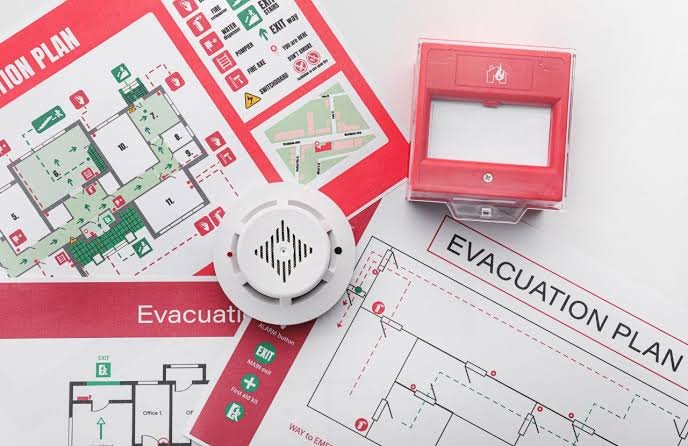
A fire can turn an ordinary business day into an emergency within minutes. Employees may become confused, customers may not know where to go, and smoke can make familiar corridors difficult to navigate. In such situations, having a fire escape plan can provide clear instructions about how people should respond and where they should go.
Fire safety is not limited to installing extinguishers or alarms. A business also needs suitable evacuation routes, emergency exits, warning systems, designated assembly areas, trained personnel, and procedures that are regularly reviewed.
In Pakistan, fire-safety planning is particularly relevant to commercial buildings, factories, offices, schools, high-rise properties, and other occupied premises. Punjab Civil Defence lists fire detection and alarm systems, fire-safety plans, emergency fire control rooms, and emergency exit and evacuation plans among the fire-safety measures it inspects in industries, commercial premises, and high-rise buildings.
The Building Code of Pakistan – Fire Safety Provisions 2016 also addresses means of egress, occupant notification, emergency lighting, and fire-protection systems. The Pakistan Engineering Council continues to list the Fire Safety Provisions 2016 among Pakistan’s building codes and standards.
What Is a Fire Escape Plan?
A fire escape plan is a documented procedure showing how people should leave a building safely during a fire or similar emergency.
A typical plan may identify:
- Emergency exits
- Primary and alternative evacuation routes
- Stairways and corridors
- Fire alarm activation points
- Fire extinguishers and other firefighting equipment
- Emergency contact procedures
- Designated assembly areas
- Responsibilities of employees or emergency coordinators
- Procedures for assisting people who require additional support
The plan should be appropriate to the actual building. A small office may need a relatively simple arrangement, while a factory, hotel, hospital, shopping centre, or multi-storey office building may require a much more detailed plan.
An effective plan should also be understandable to people who are unfamiliar with the premises.
Why Fire Escape Plans Matter
A fire escape plan gives people a predetermined response to an emergency instead of requiring them to make decisions from scratch when a fire occurs.
During an emergency, people may not remember instructions they have never practiced. A clear plan, visible evacuation maps, training, and drills can make the expected response more familiar.
The purpose is not to predict exactly where a fire will start. Instead, the objective is to establish practical procedures that can be adapted to different emergency situations.
Punjab Civil Defence describes evacuation drills as a way to practice effective performance during a real emergency and uses drills in industries, institutions, and buildings.
1. Fire Escape Plans Help Employees Know What to Do
Employees may spend most of their working day focused on their normal responsibilities. They cannot be expected to automatically know the safest response to every emergency.
A fire escape plan provides basic information such as:
- Where the nearest exit is
- Which alternative exit can be used
- Where to assemble
- How the alarm will be communicated
- Who is responsible for specific emergency tasks
- What to do after leaving the building
This is particularly important for new employees.
Businesses should include fire-safety information as part of workplace orientation where appropriate, so employees become familiar with emergency arrangements before an incident occurs.
2. Plans Help Visitors and Customers
Employees are not the only people inside a business.
Customers, contractors, delivery personnel, guests, and other visitors may have little or no knowledge of the building’s layout.
A clear emergency plan, combined with visible exit signs and suitable alarm notification, can help guide people who are unfamiliar with the premises.
Businesses that regularly receive members of the public should consider how their evacuation procedures will work for people who have never seen the building before.
3. Fire Escape Plans Work With Alarm Systems
A fire alarm and an evacuation plan perform different functions.
A suitable fire alarm system in Pakistan can provide occupants with a warning when a fire or other monitored emergency condition is detected. Depending on the system, this may involve smoke or heat detection, manual call points, alarm notification appliances, control equipment, and other components.
The escape plan tells occupants what to do after receiving that warning.
The Building Code of Pakistan states that fire alarm systems should be provided where necessary in buildings or structures where the fire itself would not provide adequate warning to occupants. It also requires means of egress to be clearly indicated and illuminated.
This illustrates why businesses should think about detection, notification, and evacuation as connected elements of their overall safety arrangements.
An alarm without an understood evacuation procedure may leave people uncertain about what to do next. Conversely, an evacuation plan without an effective means of warning may not reach occupants quickly enough.
4. They Help Identify Alternative Escape Routes
A business should not assume that its main entrance will always be available during an emergency.
A fire could occur near a reception area, kitchen, electrical room, storage space, production area, or another location that affects the normal route out of the building.
An effective fire escape plan identifies alternative routes where required and shows occupants how to reach them.
The Building Code addresses means of egress as a continuous route toward a place of safety and includes requirements concerning the arrangement and marking of these routes.
Businesses should regularly check whether their planned routes remain usable after changes to office layouts, machinery, storage arrangements, partitions, or building use.
5. Plans Can Reduce Confusion During an Emergency
People may react differently when confronted with a fire.
Some may immediately leave. Others may look for colleagues, attempt to collect belongings, or initially move toward a familiar entrance.
A well-communicated evacuation procedure establishes a common response.
For example, employees can be instructed to:
- Respond immediately when the alarm is activated.
- Stop work safely where possible.
- Follow the nearest safe evacuation route.
- Avoid unnecessary delays.
- Assist others according to the established procedure.
- Go to the designated assembly area.
- Follow instructions from emergency personnel.
- Avoid re-entering the building until authorized.
The precise procedure should reflect the building’s design and applicable emergency requirements.
6. They Support Emergency Drills
A plan is much more useful when people have practiced it.
Fire drills provide an opportunity to determine whether employees understand the evacuation procedure and whether the physical arrangements work as expected.
A drill may reveal:
- Blocked exits
- Confusing signs
- Slow evacuation routes
- Problems with alarm audibility
- Difficult-to-open doors
- Inadequate emergency lighting
- Unclear assembly procedures
- Employees unfamiliar with alternative exits
Punjab Civil Defence reports conducting evacuation drills and mock exercises as part of emergency preparedness and training. Its training programs also include fire safety, firefighting, rescue, and evacuation drills.
Businesses can use lessons from drills to update their plans and correct problems.
7. They Help Protect People With Different Needs
A good evacuation plan should consider everyone who may be inside the workplace.
Some people may have mobility limitations, hearing or visual impairments, temporary injuries, or other circumstances that affect how they respond to an emergency.
A business should identify appropriate procedures for assisting people who may require additional support.
Depending on the premises, this can involve:
- Accessible routes
- Visual alarm notification
- Assistance arrangements
- Designated staff responsibilities
- Clear communication procedures
- Suitable evacuation equipment where required
The Building Code of Pakistan addresses accessibility of means of egress for occupants with impaired mobility.
Planning for these needs in advance is preferable to trying to develop a procedure during an emergency.
8. They Encourage Better Workplace Fire Safety
Creating a fire escape plan requires a business to examine its premises.
During this process, management may identify hazards or weaknesses that were previously overlooked.
For example, the planning process may reveal:
- Storage blocking an exit route
- Missing directional signage
- Poor emergency lighting
- Inaccessible stairways
- Inadequate alarm coverage
- Unclear assembly areas
- Fire doors that require attention
- Employees who have not received emergency training
In this way, an escape plan can become part of a broader workplace safety review.
9. They Are Important for Commercial Buildings in Pakistan
Fire-safety requirements depend on the type, size, occupancy, design, and location of a building.
In Punjab, Civil Defence states that it inspects fire-safety measures in industrial and commercial premises and high-rise buildings. Its listed safety measures include fire detection and alarm systems, firefighting arrangements, fire-safety plans, emergency fire control rooms, and emergency exit and evacuation plans.
This means businesses should not treat an evacuation plan simply as an optional document.
Owners and facility managers should determine which national and local requirements apply to their particular premises and consult the relevant authority or qualified fire-safety professional where necessary.
What Should a Business Fire Escape Plan Include?
Although every building is different, a useful plan can include several basic elements.
Emergency Exit Locations
Clearly identify all required exits and make sure employees understand their locations.
Primary and Alternative Routes
Show the normal evacuation route and alternatives where required.
Assembly Point
Identify a safe location outside the building where employees and visitors can gather.
Alarm Procedures
Explain how occupants will be notified and what they should do when the alarm activates.
Emergency Contacts
Provide relevant emergency contact information according to the organization’s emergency procedures.
Employee Responsibilities
Assign appropriate responsibilities to trained staff, such as assisting with evacuation procedures or accounting for employees at the assembly point.
Assistance Procedures
Include arrangements for people who may need additional help during evacuation.
Floor Plans
For larger buildings, evacuation maps can show exits, stairs, alarm points, firefighting equipment, and the “You Are Here” location.
How to Create a Business Fire Escape Plan
Step 1: Assess the Building
Start by reviewing the building layout.
Identify rooms, corridors, stairways, exits, fire doors, alarm equipment, firefighting equipment, and potential hazards.
Step 2: Identify Escape Routes
Determine the safest practical routes from occupied areas toward appropriate exits.
Routes should remain unobstructed.
The Building Code requires means of egress to be maintained without obstructions or impediments to immediate use during an emergency.
Step 3: Identify Alternative Routes
Where required, identify alternatives if the primary route becomes unsafe.
Avoid assuming that everyone should use the same exit.
Step 4: Mark the Assembly Area
Choose an appropriate assembly point away from immediate hazards and where occupants can be accounted for.
Step 5: Install Appropriate Signs and Lighting
Exit routes should be clearly identified.
The Building Code addresses illumination and clear indication of means of egress.
Step 6: Explain the Alarm Procedure
Employees should understand what the alarm means and what action they are expected to take.
Step 7: Train Employees
Explain the evacuation plan during appropriate workplace training.
New employees should receive relevant information, while existing employees should receive refresher training as appropriate.
Step 8: Conduct Drills
Use evacuation drills to test the plan.
After a drill, review what worked and what needs improvement.
Step 9: Review the Plan
The plan should be updated when the building layout, occupancy, staffing, equipment, or operations change.
Common Mistakes Businesses Should Avoid
Blocking Emergency Exits
Boxes, furniture, equipment, or merchandise should not obstruct evacuation routes.
Locking Exit Doors Improperly
Security arrangements should not prevent occupants from escaping in an emergency.
Ignoring Alarm Faults
A fire alarm system should be inspected, tested, and maintained according to applicable requirements and manufacturer instructions.
Relying Only on the Main Entrance
The main entrance may not always be a safe evacuation route.
Failing to Train Employees
A written document is not enough if employees do not understand it.
Forgetting Visitors
Emergency procedures should account for customers, contractors, and other visitors.
Failing to Update the Plan
A plan can become outdated when offices are renovated, equipment is moved, departments change, or building use changes.
Fire Alarm Systems and Evacuation Planning
Fire alarm equipment should be viewed as one part of a larger safety strategy.
A business may use detection devices to identify signs of fire and notification equipment to warn occupants. The evacuation plan then provides instructions about how people should respond.
The Pakistan Engineering Council identifies installation, commissioning, and maintenance of fire detection, alarm, and suppression systems as a recognized engineering specialization, reflecting the technical nature of these systems.
Businesses should therefore avoid treating fire alarm equipment as a simple standalone purchase. System design, installation, commissioning, testing, and maintenance should be handled according to applicable requirements and by appropriately qualified professionals.
Regular Maintenance Is Essential
A fire escape plan cannot compensate for physical safety equipment that is unavailable or defective.
Businesses should establish appropriate inspection and maintenance procedures for:
- Fire alarms
- Smoke and heat detectors
- Manual call points
- Emergency lighting
- Exit signs
- Fire doors
- Fire extinguishers
- Fire hydrants
- Sprinkler systems where installed
- Emergency power systems
- Escape routes
The Building Code includes provisions concerning maintenance, inspection, and testing of fire-protection systems and safeguards.
Maintenance records should be retained where required and problems should be addressed promptly.
What Employees Should Remember
Employees do not need to memorize every technical detail of a fire-protection system.
They should understand the essentials:
- Know where the nearest exit is.
- Know at least one alternative route where applicable.
- Know what the fire alarm sounds or looks like.
- Leave promptly when instructed.
- Do not block exits.
- Do not return for personal belongings.
- Go to the designated assembly area.
- Follow emergency personnel’s instructions.
- Do not re-enter until authorized.
These simple principles can make an evacuation procedure easier to follow.
Conclusion
Every business needs a practical fire escape plan because fire emergencies can develop quickly and create conditions that are difficult to manage without preparation.
A good plan gives employees and visitors clear information about evacuation routes, emergency exits, assembly areas, alarm procedures, and responsibilities. It also encourages businesses to inspect their premises, identify weaknesses, conduct drills, and keep safety equipment maintained.
For businesses in Pakistan, evacuation planning should be considered alongside applicable building and fire-safety requirements. Pakistan’s Building Code addresses means of egress, occupant notification, illumination, and other fire-safety measures, while Punjab Civil Defence specifically identifies emergency exit and evacuation plans among the fire-safety measures relevant to commercial and industrial premises.
A properly maintained fire alarm system in Pakistan can provide an important warning function, but an alarm alone is not an evacuation strategy. People also need clear routes, functioning exits, appropriate signage, emergency lighting, training, and a practiced plan.
Fire safety is therefore an ongoing process rather than a one-time task. Businesses should review their plans regularly, conduct appropriate drills, maintain their equipment, and update procedures whenever their premises or operations change.
Preparing before an emergency occurs gives everyone a clearer understanding of what to do when every second matters.
Frequently Asked Questions
1. Why does every business need a fire escape plan?
A fire escape plan provides employees and visitors with clear instructions for leaving the building during a fire or other emergency. It identifies evacuation routes, exits, assembly areas, and relevant emergency procedures.
2. What should a business fire escape plan include?
A plan should generally identify emergency exits, primary and alternative evacuation routes, alarm procedures, assembly areas, emergency contacts, responsibilities, and arrangements for people who may need additional assistance.
3. How does a fire alarm system support an evacuation plan?
A fire alarm system provides occupants with a warning that a fire or monitored emergency condition may exist. The evacuation plan then tells occupants how to respond, including which routes to use and where to assemble.
4. How often should businesses conduct fire evacuation drills?
The appropriate frequency depends on the building, occupancy, applicable requirements, and organizational procedures. Businesses should conduct appropriate drills and use the results to identify and correct weaknesses in their evacuation arrangements. Punjab Civil Defence recognizes evacuation drills as part of emergency preparedness and training.
5. Should a fire escape plan be updated?
Yes. Businesses should review their plans whenever there are significant changes to the building layout, occupancy, staffing, equipment, operations, or emergency procedures. Regular reviews also help identify blocked routes, outdated information, and other issues that could affect evacuation.