
Fire extinguishers are one of those things people forget about until they actually need one. It sits quietly in the corner of an office, kitchen, warehouse, or hallway for months, sometimes years, and nobody thinks twice about it. But here’s the problem: an extinguisher that hasn’t been checked or serviced properly can fail exactly when you need it most. That’s why regular servicing isn’t just a legal formality in Pakistan it’s a genuine safety requirement for homes, offices, factories, and commercial buildings.
If you’ve never had a technician come out for a service visit, the whole process can feel a bit mysterious. What do they actually do? How long does it take? Do they take the extinguisher away or work on-site? This guide walks you through exactly what happens during a professional fire extinguisher service visit, so you know what to expect and why it matters.
Why Regular Fire Extinguisher Servicing Matters
Extinguishers aren’t “install and forget” devices. Over time, the pressure inside the cylinder can drop, the extinguishing agent can settle or clump, seals can degrade, and hoses can crack. None of this is visible from the outside, which is exactly why professional inspection is necessary rather than just a quick glance.
In Pakistan, fire safety regulations for commercial properties offices, factories, malls, restaurants, and residential complexes — typically require extinguishers to be inspected and serviced on a scheduled basis. Insurance companies also often ask for proof of servicing before approving claims related to fire damage. Beyond compliance, though, the real reason to keep up with servicing is simple: you want the extinguisher to actually work if there’s ever a fire.
Step 1: Initial Visual Inspection
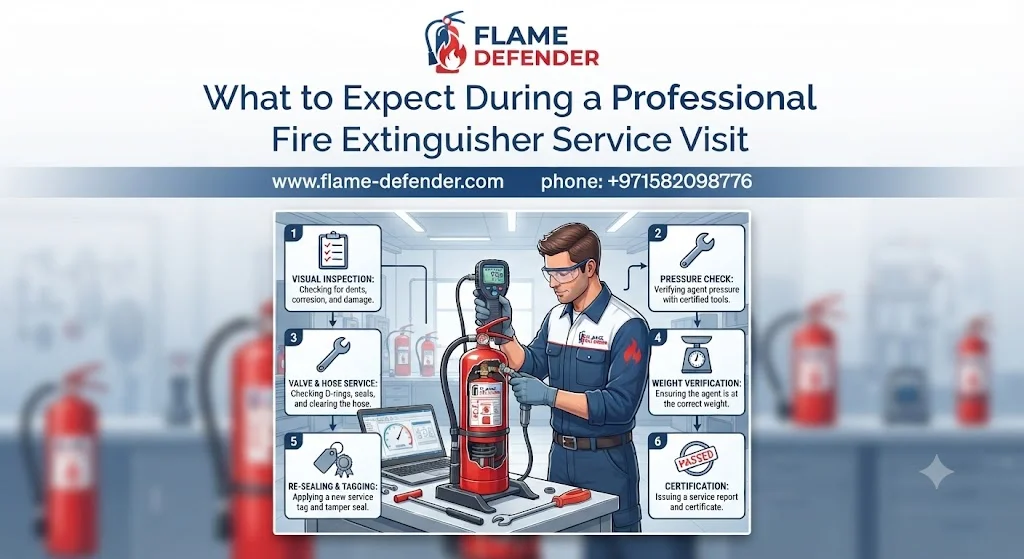
When a technician arrives for a service visit, the first thing they do is a visual check of the extinguisher itself. This includes:
- Checking the pressure gauge to see if it’s in the correct operating range
- Looking for visible dents, rust, or corrosion on the cylinder
- Inspecting the hose and nozzle for cracks or blockages
- Checking the pin and tamper seal to confirm the extinguisher hasn’t been used or tampered with
- Verifying the mounting bracket or stand is secure and the extinguisher is accessible
This step usually takes just a few minutes per unit, but it’s an important first filter. If something looks obviously wrong like a badly dented cylinder or a broken gauge the technician will flag it immediately.
Step 2: Weighing the Extinguisher
For most extinguisher types, especially dry chemical powder and CO2 units, weight is one of the clearest indicators of whether the unit is still properly charged. Every extinguisher has a specified full weight printed or stamped on it. The technician weighs the unit and compares it against this specification.
If the weight has dropped below the acceptable range, it usually means the extinguisher has lost pressure or some of its extinguishing agent, and it will need a refill.
Step 3: Checking the Extinguishing Agent
This is where things get more technical, and it depends on the type of extinguisher:
Dry Chemical Powder Extinguishers — The technician checks whether the powder inside has caked or clumped together. Powder can settle over time due to humidity or vibration, and if it’s clumped, it won’t discharge properly even if the pressure is fine.
CO2 Extinguishers — Since CO2 units don’t use a gauge in the same way, weighing is the primary method of checking the charge level.
Foam and Water-Based Extinguishers — These are checked for agent quality, expiry, and any signs of contamination or leakage.
If the agent has degraded or the pressure has dropped, this is when a refill becomes necessary rather than a simple top-up.
Step 4: Fire Extinguisher Refilling (When Needed)
This is the core service most people are actually looking for, and it’s a specialized job that shouldn’t be handled casually. Fire extinguisher refilling in Pakistan typically involves:
- Fully discharging any remaining pressure and agent from the cylinder
- Cleaning the inside of the cylinder to remove old powder residue or moisture
- Inspecting the cylinder body for internal corrosion or damage
- Refilling with the correct type and quantity of extinguishing agent
- Repressurizing the cylinder to the manufacturer’s specified level
- Fitting a new seal and safety pin
Refilling isn’t something that should be done with mismatched agents or guessed pressure levels — using the wrong type of powder or gas can actually make the extinguisher less effective or unsafe. A professional service provider follows the manufacturer’s specifications for each cylinder type, whether it’s a 1kg unit for a small office or a 50kg trolley-mounted unit for an industrial facility.
If you’re comparing providers, it’s worth checking how the company handles this specific step, since it directly affects how reliable your extinguisher will be during an actual emergency. You can see how this process is handled at Flame Defender’s fire extinguisher refilling service, which covers refilling for various extinguisher types across Pakistan.
Step 5: Hydrostatic Testing (Periodically)
Extinguisher cylinders don’t last forever. Every few years — the exact interval depends on the cylinder type and local regulations cylinders need a hydrostatic test. This involves pressurizing the empty cylinder with water to well above its normal operating pressure to check for structural weaknesses, leaks, or metal fatigue.
This isn’t done at every single service visit, but a good technician will know when a cylinder is due for this test and will flag it, since using an extinguisher past its safe testing window is a real risk.
Step 6: Reassembly and Final Checks
Once refilling (if needed) is complete, the technician reassembles the extinguisher:
- Fits a new tamper seal and pin
- Rechecks the pressure gauge reading
- Wipes down and cleans the exterior of the cylinder
- Attaches a service tag noting the date of service and the next due date
- Reinstalls it on its mounting bracket or stand
That service tag is actually important — it’s often what building inspectors, auditors, or insurance assessors check first to confirm the extinguisher is within its valid service period.
Step 7: Documentation and Certification
For commercial and industrial clients, the visit usually ends with paperwork. A proper service provider will issue:
- A service report listing each unit checked, its condition, and any action taken
- A certificate confirming compliance with fire safety standards
- Recommendations for units that need replacement rather than refilling
This documentation matters if your building is ever inspected by fire safety authorities, or if you need to show proof of maintenance for insurance purposes.
How Long Does a Service Visit Take?
For a small office with five or six extinguishers, a routine inspection and service visit usually takes under an hour. For larger sites — factories, warehouses, or multi-floor buildings with dozens of units — it can take several hours or even span a full day, especially if multiple units need refilling or hydrostatic testing.
How Often Should You Get Extinguishers Serviced?
As a general guideline followed across Pakistan:
- Monthly: A quick visual self-check by staff (pressure gauge, accessibility, obvious damage)
- Annually: A full professional service visit, including weighing and detailed inspection
- Every 5 years (varies by type): Hydrostatic testing of the cylinder
Buildings with higher fire risk — like commercial kitchens, warehouses storing flammable materials, or factories — often benefit from more frequent checks than the minimum standard.
Choosing a Fire Extinguisher Service Provider in Pakistan
Not all providers offer the same level of thoroughness. When choosing a company for servicing or refilling, it’s worth looking for:
- Technicians trained specifically in extinguisher maintenance, not general handymen
- Use of correct, agent-specific refill materials matched to your extinguisher type
- Transparent service reports and tagging after every visit
- Coverage for both residential and commercial/industrial clients
- On-site service so you’re not left without fire protection while units are away
Getting this right isn’t about ticking a compliance box it’s about knowing that if something goes wrong, the equipment on your wall will actually respond the way it’s supposed to.
Frequently Asked Questions
1. How often should a fire extinguisher be serviced in Pakistan? Most extinguishers should get a full professional service at least once a year, with monthly visual checks done in between by building staff.
2. How do I know if my fire extinguisher needs a refill? Signs include a pressure gauge reading outside the normal range, a weight below the specified full weight, clumped powder, or a missing/broken tamper seal.
3. Can any technician refill a fire extinguisher, or does it need to be a specialist? It should always be handled by a trained technician. Using the wrong agent type or incorrect pressure levels can make the extinguisher unreliable or unsafe.
4. Is fire extinguisher refilling different from replacement? Yes. Refilling reuses the existing cylinder after cleaning, testing, and recharging it, while replacement means installing a brand-new unit — usually necessary if the cylinder is damaged or has failed a hydrostatic test.
5. How long does a fire extinguisher last before it needs refilling? This depends on usage and storage conditions, but most units need refilling or a full check within 1 to 5 years, even if never used, due to natural pressure loss over time.
6. What happens if an expired or unserviced extinguisher is used during a fire? It may fail to discharge properly, run out of agent too quickly, or not build enough pressure all of which can leave a fire unchecked at a critical moment.
7. Do CO2 and dry powder extinguishers require different servicing methods? Yes. CO2 units are checked mainly by weight since they lack a traditional pressure gauge, while dry powder units are checked for both pressure and whether the powder has clumped.
8. Is fire extinguisher servicing mandatory for offices and businesses in Pakistan? Most commercial buildings are required to maintain serviced, compliant fire extinguishers under local fire safety regulations, and insurance providers often request proof of servicing as well.
9. How much does fire extinguisher refilling cost in Pakistan? Cost varies based on extinguisher size and type (dry powder, CO2, foam), but professional refilling is generally affordable compared to the cost of replacing a full unit.
10. Can fire extinguisher refilling be done on-site, or do units need to be taken away? Many providers, including Flame Defender, offer on-site refilling and servicing so your property isn’t left without fire protection during the process.
Keeping your fire extinguishers properly serviced is one of the simplest ways to protect your property and the people in it. Whether you’re managing a single office or an entire industrial facility, scheduling regular checks and getting timely fire extinguisher refilling in Pakistan ensures your equipment is ready the moment it’s actually needed.