
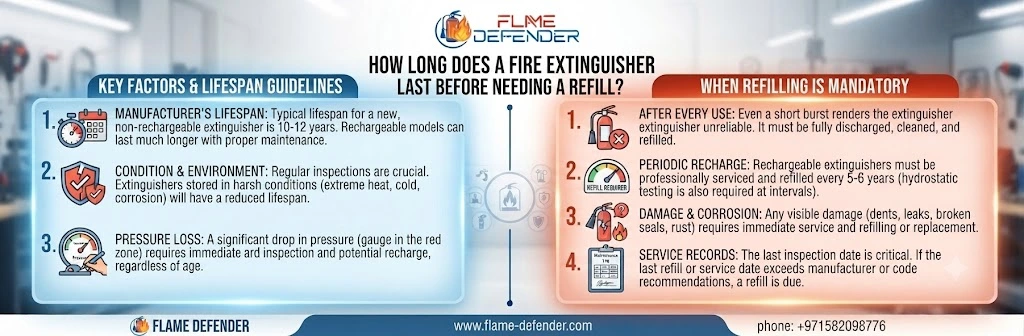
A fire extinguisher sitting quietly in the corner of your kitchen, office, or warehouse can feel like a “set it and forget it” item. You mount it on the wall, and years go by without a second thought. But here’s the uncomfortable truth: a fire extinguisher that hasn’t been checked in years may not work at all when you actually need it. Pressure drops, powder settles, seals weaken and none of this is visible from a glance.
If you’re in Pakistan and searching for fire extinguisher refilling in Pakistan, this guide will walk you through exactly how long an extinguisher lasts, when it needs a refill, and how to know your equipment will actually protect you during an emergency.
Do Fire Extinguishers Really Expire?
Yes, but not in the way food or medicine expires. A fire extinguisher doesn’t suddenly become useless on a specific calendar date. Instead, it gradually loses reliability as its internal pressure drops, its extinguishing agent settles or clumps, and its seals, hoses, and valves age. Even a unit that has never been used can become ineffective simply from sitting unused for too long.
This is exactly why fire safety authorities recommend scheduled inspection and servicing rather than waiting for a visible problem to appear. By the time you notice something is wrong — a stuck lever, a hissing sound, a needle stuck in the red zone — it’s often too late to help you in an actual fire.
Average Lifespan of a Fire Extinguisher
The lifespan depends heavily on the type of extinguisher you own:
- Disposable (non-rechargeable) extinguishers — These are common in small households and shops. They typically last around 10 to 12 years from the manufacture date. Once they reach that age, or once they’re used even briefly, they must be replaced entirely rather than refilled.
- Rechargeable extinguishers — These are the standard for offices, factories, and commercial buildings. They can remain in service well beyond 12 years, but only if they’re professionally emptied, inspected, and recharged roughly every 6 years, with a full pressure (hydrostatic) test around the 10 to 12-year mark.
- Dry Chemical Powder (DCP) extinguishers — The most widely used type in Pakistan. The powder inside can settle or clump over time due to humidity, so these need more frequent shaking and inspection even between formal refills.
- CO2 extinguishers — These don’t have an agent that spoils, but the pressurized gas can slowly leak out of the cylinder, so periodic weight checks and hydrostatic testing are essential.
- Foam and water-based extinguishers — These generally need agent replacement every few years since the liquid contents can degrade or become contaminated over time.
Signs Your Fire Extinguisher Needs a Refill
You don’t have to wait for an annual inspection to catch a problem. Watch for these warning signs:
- The pressure gauge needle is not in the green zone. If it’s pointing to red — whether too low or too high — the extinguisher isn’t ready for use.
- The safety pin or tamper seal is broken or missing. This usually means the unit has been triggered, tampered with, or bumped hard enough to compromise it.
- You hear no movement when you gently tilt a DCP extinguisher. Powder that has caked together won’t discharge properly, even if the gauge looks fine.
- Visible rust, dents, or corrosion on the cylinder. Physical damage can weaken the metal and make the extinguisher unsafe to use, refill, or even keep nearby.
- The unit has been discharged, even partially. Any use — even a two-second test spray — means it needs to be refilled and re-pressurized before going back into service.
- The service tag is missing, faded, or outdated. No record of maintenance is a red flag on its own, especially for commercial properties that need to prove compliance.
Why Refilling Matters More in Pakistan’s Climate
Pakistan’s mix of high humidity in coastal cities like Karachi, dusty conditions in Punjab, and temperature swings across the country can accelerate wear on fire extinguishers faster than in more temperate climates. Moisture speeds up powder clumping, heat affects seal integrity, and dust can clog valves and nozzles. This makes routine inspection — not just periodic refilling — especially important for homes and businesses operating here.
For commercial properties, staying current with fire safety maintenance isn’t optional. Building authorities, civil defence regulations, and insurance providers commonly require documented proof that fire extinguishers are inspected and serviced on schedule. An expired or unpressurized unit found during an audit can mean fines, failed inspections, or complications with an insurance claim after an incident.
How Often Should You Get a Refill?
As a general rule for both homes and businesses across Pakistan:
- Monthly: A quick visual check — gauge reading, seal intact, no visible damage, extinguisher accessible and unobstructed.
- Annually: A professional inspection by a certified technician, who will test pressure, check components, and top up or refill the agent if needed.
- Every 6 years (rechargeable units): A full internal service — emptying, inspecting, and recharging the cylinder with fresh agent.
- Immediately after any use: Even a brief discharge requires a full refill before the extinguisher can be trusted again.
Can You Refill a Fire Extinguisher Yourself?
No — and this isn’t just a formality. Refilling involves discharging residual pressure safely, cleaning the cylinder interior, selecting the correct extinguishing agent for the extinguisher’s class, re-pressurizing to an exact specification, and running a leak/pressure test afterward. Getting any of this wrong can turn the extinguisher into a safety hazard itself — either failing to work in a fire or, in rare cases, rupturing under improper pressure. This job needs trained technicians with the right equipment, not a DIY approach.
Choosing a Reliable Refilling Service in Pakistan
When picking a provider for fire extinguisher refilling in Pakistan, look for a few essentials: certified technicians, use of proper extinguishing agents matched to your equipment, a documented pressure and leak test after every refill, and a service tag showing the refill date, technician details, and next due date. This paperwork isn’t just bureaucracy — it’s your proof of compliance and your quickest way to track when the next service is due.
If you’d rather not track all of this yourself, providers like Flame Defender’s fire extinguisher refilling service handle the full process on-site — from inspection and cylinder cleaning to refilling, pressure testing, and certification for homes, offices, factories, and other commercial properties across the country.
Final Thoughts
A fire extinguisher is only as good as its last inspection. Whether you own a small DCP unit for your kitchen or manage dozens of CO2 and foam extinguishers across a factory floor, the underlying rule is the same: check it monthly, service it annually, and never assume “it’s fine because it’s never been used.” Fires don’t wait for convenient timing, and neither should your fire safety maintenance schedule.
Frequently Asked Questions
1. How long does a fire extinguisher last before it needs to be refilled? Most fire extinguishers need a professional refill or recharge within 5 to 6 years of installation, even if they’ve never been used, since internal pressure and the extinguishing agent naturally degrade over time.
2. Do fire extinguishers really expire? Yes. While they don’t have a strict expiration date like food, they lose reliability over time due to pressure loss, agent degradation, and wear on seals and valves — which is why regular servicing is necessary.
3. How do I know if my fire extinguisher needs a refill? Check the pressure gauge (it should sit in the green zone), inspect the safety pin and seal for damage, and look for rust, dents, or an outdated service tag. Any of these signs means it’s time for professional servicing.
4. Can I refill a fire extinguisher myself at home? No. Refilling requires specialized equipment, the correct extinguishing agent, and pressure testing that only trained technicians can perform safely. A DIY refill can leave the extinguisher unsafe or non-functional.
5. How often should a fire extinguisher be inspected in Pakistan? A monthly visual check is recommended for all extinguishers, along with a full professional inspection at least once a year, and a complete internal recharge roughly every 6 years for rechargeable units.
6. Does a fire extinguisher need a refill after every use? Yes. Even a brief or partial discharge lowers internal pressure. It reduces the amount of extinguishing agent inside, so the unit must be refilled and pressure-tested before it’s placed back into service.
7. What is the difference between a disposable and a rechargeable fire extinguisher? Disposable extinguishers are meant to be replaced entirely once they reach the end of their service life or are used. In contrast, rechargeable extinguishers can be professionally emptied, inspected, and refilled multiple times over their working life.
8. What happens if I use an expired fire extinguisher? An expired or poorly maintained extinguisher may fail to discharge, spray with insufficient pressure, or not work at all — leaving you without protection exactly when you need it most.
9. How much does fire extinguisher refilling cost in Pakistan? Cost varies depending on the extinguisher’s type (DCP, CO2, foam, water, or clean agent) and its capacity, so it’s best to get a direct quote from a certified fire safety provider based on your specific equipment.
10. Where can I get my fire extinguisher refilled in Pakistan? Certified fire safety companies offer on-site refilling for homes, offices, and commercial buildings across major Pakistani cities. For example, Flame Defender provides inspection, refilling, and certified maintenance services nationwide.