
Office fire safety is an important responsibility for every business owner, manager, employee, and building operator in Pakistan. Offices contain electrical equipment, computers, printers, cables, kitchen appliances, paper, furniture, batteries, and other materials that can contribute to a fire if they are not managed properly.
A safe office is not created simply by placing a few fire extinguishers on the walls. Effective protection requires prevention, early detection, clear escape routes, suitable firefighting equipment, employee awareness, emergency planning, and regular maintenance.
Pakistan’s Building Code of Pakistan Fire Safety Provisions 2016 places responsibilities on owners, operators, lessees, and occupants and emphasizes the maintenance and operation of buildings to provide a reasonable level of life safety and property protection. It also calls for records of relevant inspections, testing, maintenance, emergency plans, and drills where required.
This guide explains the right approach to office fire safety and how businesses can build a stronger protection plan.
Why Office Fire Safety Matters
An office may appear to be a low-risk environment compared with a factory or warehouse, but fires can still develop quickly.
Electrical faults, overloaded outlets, damaged cables, heating equipment, kitchen appliances, batteries, and combustible office materials can all contribute to fire risk. A small problem can become more serious when employees do not know how to respond or when protective equipment has not been maintained.
The goal of office fire safety is therefore not only to stop fires from starting. It is also to detect a fire early, alert people, provide a safe way out, and support an organized emergency response.
A layered approach is much stronger than relying on one piece of equipment.
Start With Fire Risk Assessment
The first step is to understand the specific risks inside the office.
Every office has a different layout and different equipment. A small administrative office may have computers, printers, a kitchenette, and storage cabinets, while a large corporate building may include server rooms, electrical rooms, meeting spaces, kitchens, archives, workshops, and multiple floors.
A basic assessment should consider:
- Electrical equipment and wiring
- Extension cords and power strips
- Server and communication rooms
- Kitchen and cooking equipment
- Heating or cooling equipment
- Batteries and charging areas
- Paper and packaging storage
- Flammable materials, where present
- Emergency exits and stairways
- Fire alarm coverage
- Fire extinguishers
- Emergency lighting and signage
- Employee evacuation arrangements
The assessment should also be reviewed when the office layout, occupancy, equipment, or use changes.
Use Electrical Equipment Responsibly
Electrical equipment is an important consideration in office fire prevention.
Computers, monitors, printers, photocopiers, chargers, air conditioners, refrigerators, water dispensers, and other appliances should be kept in good condition. Damaged plugs, loose connections, visibly damaged cables, unusual overheating, or repeated electrical problems should not be ignored.
Pakistan’s fire-safety provisions include requirements related to electrical systems and equipment, while the general principle is that buildings and equipment should be maintained to provide appropriate protection against fire hazards.
Avoid treating extension cords as a permanent replacement for properly designed electrical wiring. Office electrical requirements should be assessed by a suitably qualified professional, especially where equipment loads are significant.
Keep Combustible Materials Organized
Paper, cardboard, packaging, files, furniture, and other combustible materials can add fuel to a fire.
Good housekeeping can reduce unnecessary fire risk. Offices should avoid allowing boxes, paper waste, or other combustible materials to accumulate near electrical equipment, heating sources, escape routes, or electrical panels.
Storage areas should remain organized, and unnecessary combustible materials should be removed rather than allowed to build up over time.
Keeping corridors and stairways free from storage is equally important. An escape route is useful only when people can actually use it during an emergency.
Install a Suitable Fire Alarm System
Early warning is one of the most important parts of office fire safety.
A properly designed fire alarm system in Pakistan can detect signs of fire and provide an alert so occupants can begin an emergency response. Depending on the building and system design, detection may involve smoke detectors, heat detectors, manual call points, control panels, sounders, visual notification devices, and other components.
NFPA 72 is a widely recognized reference for fire alarm and signaling systems and covers areas including installation, inspection, testing, and maintenance.
The correct system depends on factors such as:
- Office size
- Number of floors
- Building layout
- Occupancy
- Fire hazards
- Ceiling arrangement
- Equipment rooms
- Applicable requirements
- Required detection coverage
There is no single alarm arrangement that is suitable for every office.
Choose the Right Type of Detection
Different areas may require different types of detection.
Smoke detection is commonly important in ordinary office areas, while heat detection may be more appropriate in locations where environmental conditions could make smoke detection unsuitable.
Specialized areas may require additional consideration. For example, a server room, electrical room, kitchen, storage area, or workshop can have different hazards from a normal office.
Detection should therefore be selected as part of a complete system design rather than simply installing devices wherever convenient.
Flame Defender describes fire alarm solutions for offices and other commercial properties, including conventional, addressable, wireless, smoke, heat, and intelligent detection options.
Do Not Block Fire Alarm Equipment
Fire alarm equipment must remain accessible and visible.
Furniture, decorations, storage materials, partitions, or temporary office arrangements should not interfere with detectors, manual call points, alarm sounders, control panels, or other safety equipment.
During office renovations, changes in ceilings, walls, partitions, room layouts, or equipment may affect the performance or coverage of the alarm system. Any major modification should therefore be reviewed by an appropriately qualified fire-safety professional.
Maintain Fire Extinguishers
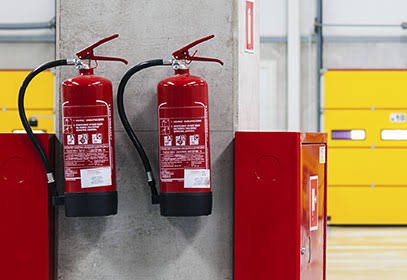
Fire extinguishers can provide an important first response to a small fire when conditions are safe and trained people are available to respond.
The Pakistan Building Code identifies portable fire extinguishers as part of fire protection and states that extinguisher selection should consider the type and size of the expected fire and other relevant conditions.
Offices should make sure extinguishers are:
- Suitable for the expected hazard
- Easy to access
- Clearly identified
- Not blocked by furniture
- Properly maintained
- Appropriate for their location
- Inspected according to applicable requirements
Employees should not be expected to fight a fire if doing so would put them at risk. Evacuation and calling for emergency assistance should remain the priority.
Keep Emergency Exits Clear
A fire alarm can warn people about danger, but employees still need a safe way to leave.
Emergency exits, corridors, stairways, and other escape routes should remain clear. Office furniture, cartons, files, equipment, or temporary storage should never turn an escape route into a storage area.
Exit signs should be visible, and employees should know where the designated exits are located.
For larger offices, evacuation arrangements should also consider visitors, contractors, and people who may need additional assistance.
Create an Office Fire Escape Plan
Every office should have a clear emergency plan.
The plan should explain:
- How employees are alerted.
- Which exits should be used.
- Where people should assemble.
- Who is responsible for emergency communication.
- How visitors will be accounted for.
- How assistance will be provided to people who need it.
- How emergency responders will be contacted.
- Who is responsible for checking or reporting safety problems.
Employees should not depend on memory alone. Emergency procedures should be communicated clearly and practiced where appropriate.
The Building Code of Pakistan Fire Safety Provisions 2016 also recognizes emergency evacuation and relocation drills and requires relevant records to be maintained where applicable.
Train Employees Properly
Equipment cannot replace employee awareness.
Workers should understand the meaning of the fire alarm, know the available exits, recognize assembly arrangements, and understand that they should leave promptly when an evacuation is required.
Training should also explain basic prevention practices, such as reporting damaged electrical equipment, keeping exits clear, and avoiding unsafe storage.
New employees should receive basic fire-safety information as part of workplace orientation. Refresher training can help maintain awareness over time.
Inspect and Maintain the Fire Alarm System
Installing a fire alarm is only the beginning.
Dust, physical damage, electrical problems, ageing components, battery issues, building modifications, or other faults can affect system performance. Regular inspection, testing, and maintenance help identify problems before an emergency occurs.
NFPA guidance emphasizes inspection, testing, and maintenance as important parts of keeping fire protection systems operational. NFPA 72 specifically addresses these activities for fire alarm systems.
Maintenance should follow the applicable requirements and equipment manufacturer’s instructions. Records should also be retained where required.
Maintain Emergency Power Where Required
Some fire-protection systems depend on standby or emergency power arrangements.
An alarm system that loses its required power during an emergency may not provide the expected protection. Backup power arrangements should therefore be considered as part of the overall system design and maintained according to applicable requirements.
Office managers should not assume that a system is reliable simply because the control panel appears normal. Professional inspection and testing can identify problems that are not obvious during a normal working day.
Pay Attention to Server and Electrical Rooms
Modern offices often contain rooms with concentrated electrical and electronic equipment.
Server rooms, communication rooms, UPS areas, and electrical rooms may require special fire-protection consideration because the equipment and operating conditions can differ from ordinary office spaces.
These areas should be kept clean, appropriately organized, and protected according to their specific hazards. The choice of detection or suppression technology should be based on professional assessment rather than a one-size-fits-all approach.
Control Kitchen and Pantry Risks
Many offices have kitchens, tea stations, or small pantry areas.
Microwave ovens, electric kettles, refrigerators, cooking equipment, and other appliances should be maintained properly. Combustible materials should not be stored close to heat-producing equipment.
Employees should also know what to do if a kitchen-related fire or other emergency occurs. The appropriate response depends on the type of fire and the circumstances, so staff should follow workplace emergency procedures rather than attempting risky actions.
Avoid Unsafe Charging Practices
Offices increasingly contain laptops, phones, tablets, power banks, rechargeable tools, and other battery-powered equipment.
Charging areas should be organized and free from unnecessary combustible materials. Damaged batteries or equipment showing signs of a fault should be taken out of service according to the manufacturer’s safety guidance.
Large quantities of batteries or specialized charging equipment may require additional risk assessment.
Maintain Fire Doors and Fire Separation
Fire doors and other building features can help limit the movement of fire and smoke when properly designed and maintained.
Doors that are intended to provide fire protection should not be casually removed, damaged, wedged open, or altered. Any modification should be assessed appropriately.
NFPA notes that fire and smoke protection components need inspection and maintenance so they can perform their intended function when required.
Keep Fire Safety Records
Good documentation helps an office understand whether its safety program is actually being maintained.
Useful records can include:
- Fire alarm inspection reports
- Testing and maintenance records
- Extinguisher inspection records
- Emergency drills
- Employee training
- Repairs and corrective actions
- Emergency plans
- Equipment servicing
- Building safety assessments
Pakistan’s Building Code of Pakistan Fire Safety Provisions 2016 specifically addresses maintaining records of inspections, testing, maintenance, fire alarm systems, emergency plans, evacuation drills, and related safety measures where required.
Review Fire Safety After Office Changes
Office environments change frequently.
A company may add more employees, move desks, install new equipment, create meeting rooms, add partitions, expand a server room, or renovate a kitchen.
These changes can affect fire risk and evacuation arrangements. They can also affect the coverage or placement of detection devices.
Whenever there is a significant change to the building or its use, fire-safety arrangements should be reviewed.
Build a Complete Office Fire-Safety Checklist
A practical checklist can help managers identify problems before they become serious.
Daily or Routine Checks
- Keep exits and corridors clear.
- Remove unnecessary combustible waste.
- Report damaged electrical equipment.
- Keep fire equipment accessible.
- Avoid unsafe storage.
- Check that emergency routes remain usable.
Periodic Checks
- Inspect fire alarm equipment.
- Maintain detectors and notification devices.
- Check fire extinguishers.
- Review emergency lighting where applicable.
- Review emergency procedures.
- Provide employee training.
- Conduct evacuation drills where appropriate.
- Update fire-safety records.
After Building Changes
- Review fire risks.
- Check escape routes.
- Review alarm coverage.
- Assess new electrical loads.
- Reconsider storage arrangements.
- Update emergency plans.
Why Professional Fire Safety Support Matters
Office fire safety involves more than buying equipment.
A professional assessment can help determine what type of detection, alarm, extinguishing equipment, emergency planning, and maintenance arrangements are appropriate for a particular building.
For offices in Pakistan, the design should consider the building’s occupancy, layout, hazards, applicable requirements, and manufacturer’s instructions. The Pakistan Building Code also places responsibility on building owners, operators, lessees, and occupants for compliance with its applicable provisions.
Businesses looking for professional fire alarm planning, installation, testing, or maintenance can explore the services offered by Flame Defender.
Final Thoughts
Office fire safety should be treated as an ongoing process rather than a one-time project.
A safer office combines prevention, suitable detection, reliable alarms, accessible extinguishers, clear escape routes, employee training, emergency planning, and regular maintenance.
A properly selected fire alarm system in Pakistan can form an important part of this layered approach by providing early warning when a fire-related condition is detected. However, an alarm cannot replace evacuation planning, safe electrical practices, appropriate fire protection equipment, or employee awareness.
The best office fire-safety strategy is one that is planned before an emergency happens and maintained throughout the life of the building.
Frequently Asked Questions
1. Why is fire safety important in an office?
Fire safety helps protect employees, visitors, property, equipment, and business operations. Offices can contain electrical equipment, combustible materials, kitchens, batteries, and other potential hazards.
2. What should an office fire safety plan include?
It should cover fire prevention, alarm procedures, emergency exits, evacuation routes, assembly arrangements, communication, employee responsibilities, emergency contacts, training, and appropriate fire-protection equipment.
3. Does every office need a fire alarm system?
The exact requirements depend on factors such as building type, occupancy, size, layout, applicable regulations, and fire risk. A qualified professional or relevant authority can determine the appropriate requirements for a specific property.
4. How often should an office fire alarm system be maintained?
Fire alarm systems should be inspected, tested, and maintained according to applicable requirements, the system design, and the manufacturer’s instructions. NFPA 72 provides recognized guidance for fire alarm inspection, testing, and maintenance.
5. What is the most important office fire-safety rule?
The most important principle is to prepare before an emergency. Keep ignition hazards under control, maintain fire-protection equipment, keep exits clear, train employees, and make sure everyone understands what to do when an alarm sounds.