
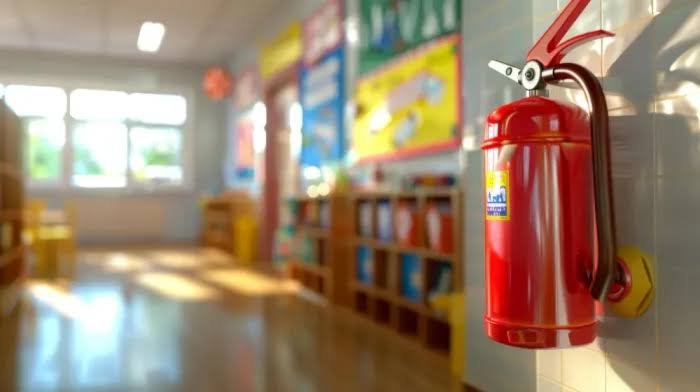
Schools are places where large numbers of children, teachers, staff members, and visitors gather every day. Because students may be unfamiliar with emergency procedures and may need guidance during an evacuation, fire safety should be an important part of every school’s daily management.
A school fire-safety program is not limited to installing extinguishers or a fire alarm. It involves prevention, early warning, clear escape routes, emergency lighting, staff training, evacuation planning, equipment maintenance, and regular review of safety procedures.
In Pakistan, schools should consider the applicable building and fire-safety requirements for their location and type of building. The Pakistan Engineering Council’s Building Code of Pakistan Fire Safety Provisions 2016 addresses fire prevention, life safety, fire protection, and related matters. Pakistan’s later building-code material also references these fire-safety provisions for matters involving fire hazards and changes to fire-protection and alarm systems.
This guide explains practical principles that schools can use to develop and maintain a safer environment for students and staff.
Why School Fire Safety Is Important
A school may contain classrooms, laboratories, libraries, kitchens, offices, electrical rooms, storage areas, workshops, computer rooms, generators, and other spaces with different fire risks.
Students also create a special consideration. They may not know the building layout, may become frightened by an alarm, or may need teachers and staff to guide them to a safe location.
For this reason, schools need a coordinated approach.
Important elements include:
- Fire prevention
- Reliable fire detection
- Alarm and notification systems
- Accessible fire extinguishers
- Clear emergency exits
- Emergency lighting
- Fire doors where required
- Staff training
- Student awareness
- Evacuation drills
- Emergency communication
- Regular inspection and maintenance
The goal is to make the right response familiar before an actual emergency occurs.
1. Identify Fire Hazards Around the School
The first step is understanding where fire hazards may exist.
A school management team should review different parts of the property rather than treating the entire building as having identical risks.
Potential areas for attention include:
- Science laboratories
- Computer rooms
- Kitchens
- Electrical rooms
- Generator areas
- Libraries
- Storage rooms
- Workshops
- Maintenance areas
- Staff rooms
- Parking areas
The risks will depend on the school’s activities, building design, equipment, and materials.
A documented fire-risk assessment can help management identify problems and assign responsibility for corrective action.
2. Maintain a Reliable Fire Alarm System
Early warning is an important part of school fire safety.
A Fire alarm system in Pakistan may include smoke detectors, heat detectors, manual call points, sounders, visual notification devices, control panels, and other components depending on the building and system design.
NFPA 72 is a recognized reference for fire alarm and signaling systems and covers areas including installation, inspection, testing, and maintenance.
Schools should ensure that their alarm system is appropriate for the building and is maintained according to applicable requirements and manufacturer instructions.
Staff should also understand what the alarm means and what action is expected when it activates.
An alarm should never be treated as an ordinary bell or ignored because it happens to be inconvenient.
3. Investigate Alarm Faults Promptly
A fire alarm panel may display a fault or trouble condition when there is a problem with part of the system.
The appropriate response is to report the issue and arrange technical assessment rather than repeatedly silencing the indication.
Potential issues can involve:
- Detectors
- Wiring
- Power supplies
- Batteries
- Notification devices
- Control equipment
- Communication connections
The Pakistan Engineering Council’s professional registration information includes installation, commissioning and maintenance of fire detection, alarm and suppression systems and allied equipment as a recognized professional specialization.
Schools should therefore use appropriately qualified professionals for specialized fire-alarm installation, testing, commissioning, and maintenance.
4. Keep Smoke and Heat Detectors Clear
Detectors need to remain accessible and unobstructed so they can perform their intended function.
Schools should check detectors after:
- Classroom renovations
- Ceiling work
- Painting
- Construction
- Changes to room layouts
- Installation of new equipment
Dust and construction activity can also affect fire-detection equipment.
Staff should not cover or interfere with detectors. If a detector appears damaged or has been affected by building work, it should be reported to the responsible maintenance team.
5. Keep Fire Extinguishers Accessible
Portable fire extinguishers can provide an important first line of defense against limited fires. NFPA 10 establishes requirements intended to ensure portable extinguishers work as intended for fires of limited size.
Schools should make sure extinguishers are:
- Appropriate for the hazards
- Clearly identifiable
- Accessible
- Properly mounted or positioned
- Free from obvious damage
- Maintained according to applicable requirements
Boxes, desks, sports equipment, files, and other items should not be placed in front of fire extinguishers.
Students should not be encouraged to handle extinguishers or attempt to fight fires. Fire response procedures should prioritize getting people to safety and following trained adult or emergency-responder instructions.
6. Keep Emergency Exits Clear
An emergency exit is useful only when people can reach it.
School corridors, stairways, doors, and escape routes should be checked regularly for obstructions.
Common problems can include:
- Desks placed in corridors
- Sports equipment blocking routes
- Boxes near exits
- Furniture restricting doors
- Decorations covering signs
- Stored materials in stairways
Schools should establish clear rules against using escape routes as storage areas.
Any changes to the building layout should trigger a review of evacuation routes.
7. Make Exit Signs Easy to See
Students may not know where every emergency exit is located.
Clear exit signs can help occupants identify appropriate routes during an emergency.
Schools should check that signs:
- Are visible
- Are not covered by decorations
- Remain understandable
- Are correctly positioned
- Are illuminated where required
- Match the current building layout
If a school changes rooms or corridors, signage should be reviewed to make sure it still directs people appropriately.
8. Maintain Emergency Lighting
A fire or electrical problem can affect normal lighting.
Emergency lighting can help occupants identify escape routes when normal lighting is unavailable.
Maintenance personnel should periodically review emergency lights and related backup arrangements for problems such as:
- Failed fixtures
- Damaged units
- Battery problems
- Poor visibility
- Obstructions
The exact inspection and testing requirements depend on the installed system and applicable standards.
9. Teach Teachers What to Do
Teachers have an important role during a school emergency.
They are often responsible for groups of students and need to understand the school’s emergency procedures before an alarm occurs.
Teacher training can cover:
- Alarm response
- Evacuation routes
- Classroom responsibilities
- Assembly locations
- Student accountability
- Communication procedures
- Visitors and unfamiliar students
- Assistance for students who need additional support
The school should clearly define responsibilities instead of expecting teachers to make up procedures during an emergency.
10. Teach Students Age-Appropriate Fire Safety
Students should receive fire-safety education appropriate to their age.
Younger children may need simple explanations about:
- Recognizing the school alarm
- Listening to teachers
- Walking calmly during evacuation
- Staying with their group
- Never returning to the building without permission
Older students can receive more detailed information about fire prevention, evacuation, emergency communication, and responsible behavior.
Fire-safety education should focus on safe actions rather than encouraging students to experiment with fire or firefighting equipment.
11. Conduct Evacuation Drills
Practice can help students and staff become familiar with emergency procedures.
School evacuation drills should be planned and managed responsibly, taking into account the school’s age groups, building design, and local requirements.
A drill can reveal problems such as:
- Confusing evacuation routes
- Slow movement
- Blocked exits
- Poor communication
- Inadequate assembly arrangements
- Students unsure about where to go
- Difficulties accounting for groups
After a drill, school management should review what happened and make improvements where necessary.
NFPA educational-occupancy fire-safety material recognizes occupant emergency programs and evacuation/relocation drills as components that can be considered when evaluating educational-occupancy safety.
12. Establish Safe Assembly Areas
Students and staff need a known location where they can gather after leaving the building.
The school should identify appropriate assembly arrangements as part of its emergency plan.
Teachers can then account for their students according to the school’s procedures.
The assembly process should also consider:
- Visitors
- Contractors
- Administrative staff
- Students arriving or leaving during the emergency
- Students who require additional assistance
People should remain at the assembly area until school management or emergency responders provide further instructions.
13. Pay Special Attention to Laboratories
Science laboratories may have different fire hazards from ordinary classrooms.
Laboratories can contain equipment, electrical devices, chemicals, heating equipment, and other materials that require controlled handling.
Fire-safety procedures should therefore be coordinated with the school’s laboratory-management rules.
Laboratory staff should know:
- Emergency procedures
- Locations of relevant safety equipment
- Emergency communication arrangements
- Evacuation routes
- Procedures for reporting hazards
The school should not assume that the same fire-safety arrangements used for an ordinary classroom automatically address laboratory risks.
14. Manage School Kitchens Carefully
Schools with cafeterias, kitchens, or food-preparation areas need additional attention.
Cooking areas may contain heat-producing equipment, electrical appliances, oils, and combustible materials.
Good housekeeping should include appropriate cleaning and maintenance of cooking equipment and ventilation systems.
Kitchen equipment should be maintained according to manufacturer instructions and applicable requirements.
Fire-protection equipment serving the kitchen should also be inspected and maintained appropriately.
15. Inspect Electrical Systems
Schools rely heavily on electricity for lighting, computers, fans, air-conditioning, laboratory equipment, communication systems, and other devices.
Electrical safety should therefore be part of the school’s regular maintenance program.
Staff should report:
- Damaged cables
- Broken sockets
- Unusual heat
- Burning smells
- Sparks
- Repeated electrical interruptions
- Damaged electrical appliances
Electrical inspection and repair should be carried out by appropriately qualified personnel.
The current NFPA 70 edition is the 2026 National Electrical Code, which provides a major reference for electrical installation and safety in its applicable context. Local requirements and the authority having jurisdiction remain important when evaluating a school in Pakistan.
16. Control Combustible Storage
Schools can accumulate large amounts of paper, cardboard, books, decorations, furniture, sports equipment, and other materials.
Storage should be organized so combustible materials do not unnecessarily increase fire hazards or obstruct emergency routes.
Particular attention should be given to:
- Storerooms
- Libraries
- Archives
- Maintenance areas
- Stage or event-storage areas
- Classrooms
Unnecessary materials should be removed rather than allowed to accumulate indefinitely.
17. Keep Fire Doors in Good Condition
Where fire doors are provided as part of a building’s fire-safety design, they should be maintained appropriately.
Staff should avoid damaging doors, hardware, or other fire-protection features.
Doors should not be unnecessarily blocked, and any visible damage should be reported.
Renovations should also be reviewed to make sure fire doors and other fire-separation features remain appropriate for the building’s current arrangement.
18. Manage Generators and Backup Power
Many schools may use generators or other backup-power arrangements.
These systems should receive appropriate maintenance and should be managed according to their design and applicable safety requirements.
Generator areas should be kept orderly, with suitable access for maintenance and emergency response.
Fuel and electrical arrangements should be managed by trained personnel.
Backup power can also be relevant to fire alarms, emergency lighting, communication equipment, and other important systems, so schools should understand which safety systems depend on emergency power.
19. Include Visitors and Contractors
A school’s emergency plan should account for everyone on the premises.
Visitors may not know:
- Which exit to use
- Where the assembly point is
- What the alarm sounds like
- How the school organizes evacuation
Reception and security staff can help ensure visitors understand the basic emergency arrangements.
Contractors working on construction, electrical, maintenance, or renovation projects should also follow the school’s safety procedures.
20. Manage Fire Safety During Construction
Construction and renovation can temporarily change a school’s fire risk.
Temporary electrical arrangements, construction materials, altered corridors, dust, blocked access, and changes to fire-protection systems can all require additional management.
Pakistan’s building-code material specifically addresses fire hazards associated with construction, extension, repair, alteration, and changes involving fire suppression, sprinkler, and alarm systems.
If a fire-protection system must be temporarily impaired, school management should use an appropriate impairment-management process and obtain qualified advice about suitable precautions.
21. Keep Fire-Safety Records
Documentation helps school management understand whether required maintenance and training activities are actually being completed.
Records may include:
- Fire alarm inspections
- Equipment servicing
- Emergency-light checks
- Fire-drill results
- Staff training
- Electrical inspections
- Identified hazards
- Corrective actions
- Renovation-related reviews
Records are particularly useful when a school operates across multiple buildings or campuses.
22. Review Fire Safety Regularly
Fire safety should change when the school changes.
A review may be appropriate after:
- Building extensions
- New classrooms
- New laboratories
- Major renovations
- Changes in student capacity
- New equipment
- Changes to emergency exits
- Installation or modification of alarm systems
The Pakistan Engineering Council’s building-code material states that fire-safety provisions can apply to matters involving occupancy, construction, extension, repair, alteration, and changes to fire-protection and alarm systems, subject to the applicable authority and legal framework.
A Simple School Fire-Safety Checklist
School management can use this as a starting point:
- [ ] Identify fire hazards throughout the campus.
- [ ] Keep fire alarm equipment maintained.
- [ ] Investigate alarm faults promptly.
- [ ] Keep smoke and heat detectors unobstructed.
- [ ] Maintain fire extinguishers.
- [ ] Keep emergency exits clear.
- [ ] Check exit signs.
- [ ] Maintain emergency lighting.
- [ ] Inspect fire doors where applicable.
- [ ] Check electrical equipment and installations.
- [ ] Review laboratory safety.
- [ ] Maintain kitchen fire-safety arrangements.
- [ ] Keep storage areas organized.
- [ ] Maintain generators and backup systems.
- [ ] Train teachers and staff.
- [ ] Provide age-appropriate student awareness.
- [ ] Conduct appropriate evacuation drills.
- [ ] Establish assembly arrangements.
- [ ] Include visitors and contractors.
- [ ] Keep inspection and training records.
- [ ] Review fire safety after renovations or major changes.
The Role of a Fire Alarm System in Pakistan
A properly designed and maintained Fire alarm system in Pakistan can provide an important early-warning layer for schools.
However, an alarm system should not be viewed as a complete fire-safety solution by itself. Detection needs to work together with evacuation procedures, clear exits, emergency communication, staff training, equipment maintenance, and appropriate building protection.
Schools should also avoid assuming that one alarm design is suitable for every campus. A small school, multi-story school, boarding facility, laboratory-focused institution, and large educational campus can have very different requirements.
Professional assessment can help determine what protection is appropriate for a particular building.
For organizations seeking fire-safety solutions in Pakistan, Flame Defender can be considered as part of the process of evaluating fire-protection needs.
Building a Culture of Fire Safety
The strongest school fire-safety programs are not based only on equipment.
They are supported by a culture in which teachers report hazards, students take alarms seriously, management maintains equipment, contractors follow safety procedures, and everyone understands the basic emergency plan.
A blocked exit should be reported. A damaged electrical cable should not be ignored. A recurring alarm fault should be investigated. A fire drill should lead to improvements rather than simply being treated as a formality.
These everyday decisions can make a significant difference to preparedness.
Conclusion
School fire safety is a shared responsibility involving management, teachers, students, maintenance personnel, security staff, contractors, parents, and emergency services.
A safe school needs more than fire extinguishers and alarms. It needs hazard identification, reliable detection, clear evacuation routes, emergency lighting, appropriate fire-protection equipment, staff training, student awareness, drills, maintenance, and regular review.
For schools in Pakistan, fire-safety arrangements should be developed according to the building’s characteristics, occupancy, installed systems, applicable requirements, and guidance from qualified professionals.
A well-maintained Fire alarm system in Pakistan can provide valuable early warning, but it should operate as one component of a broader fire and life-safety strategy.
Most importantly, school fire safety should be treated as an ongoing responsibility. When prevention, preparation, maintenance, and education become part of everyday school operations, students and staff are better prepared to respond appropriately if an emergency occurs.
For professional fire-safety information and solutions, visit Flame Defender.
Frequently Asked Questions
1. Why is fire safety important in schools?
Schools contain large numbers of students and staff, along with classrooms, laboratories, kitchens, electrical equipment, storage areas, and other potential hazards. Children may also need adult guidance during an evacuation, making planning and training especially important.
2. What is the purpose of a fire alarm system in a school?
A fire alarm system is intended to provide early warning so occupants can follow the school’s emergency procedures. Its effectiveness depends on suitable design, installation, inspection, testing, maintenance, and prompt correction of faults.
3. How often should schools conduct fire drills?
The appropriate frequency depends on the school’s circumstances, applicable requirements, building type, and emergency plan. Drills should be planned responsibly and reviewed afterward so that identified weaknesses can be corrected.
4. Should students use fire extinguishers during a school fire?
Students should not be encouraged to fight fires. Their priority should be following the school’s emergency procedure, listening to teachers and responsible adults, and moving to a safe location. Firefighting should be left to trained personnel and emergency responders.
5. What should a school do if its fire alarm system develops a fault?
The fault should be reported promptly and assessed by appropriately qualified personnel. Schools should not simply ignore or repeatedly silence fault indications. If a critical protection system is impaired, management should follow an appropriate impairment procedure and consider professional advice about temporary precautions.