
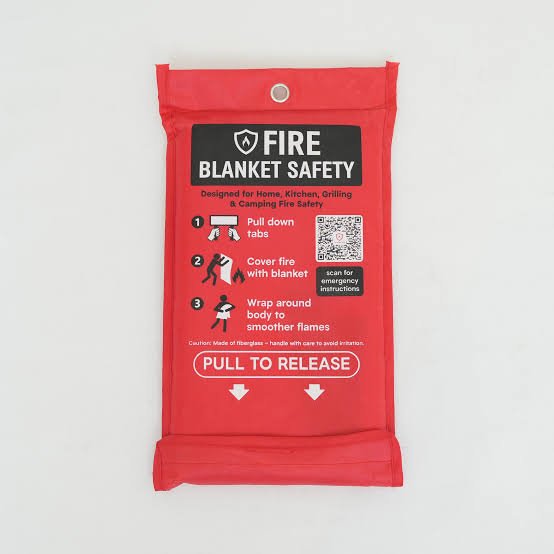
A fire safety plan is often built around detection, alarms, extinguishers, emergency exits, and evacuation procedures. These are all important, but one simple piece of equipment is sometimes overlooked: the fire blanket.
A fire blanket is designed to smother certain small fires by cutting off their oxygen supply. It can be particularly useful in kitchens, laboratories, workshops, and other areas where a small, contained fire can develop quickly. Pakistan’s safety guidance also recognizes the importance of keeping fire blankets readily available in relevant workplaces, while some local building regulations specify their provision alongside extinguishers and other fire-safety measures.
This does not mean a fire blanket should replace an extinguisher, sprinkler system, or properly designed fire alarm system in Pakistan. Rather, each element has a different role. Detection systems provide early warning, suppression equipment helps control a fire, and evacuation procedures help people reach safety.
For businesses and property owners, the goal should therefore be to create a layered approach to fire protection rather than relying on one device.
Understanding the Role of a Fire Blanket
A fire blanket is a sheet made from fire-resistant material that can be placed over a suitable small fire to restrict its oxygen supply. The basic principle is straightforward: when the flames are covered safely and completely, oxygen availability is reduced and the fire can be smothered.
Fire blankets are particularly associated with small fires involving cooking equipment, such as a pan containing burning cooking oil. They can also be useful when a person’s clothing catches fire, provided they are appropriate for the situation and used correctly.
Their usefulness comes partly from their simplicity. Unlike an extinguisher, a blanket does not require a pressurized cylinder or discharge mechanism. It can be stored in a clearly marked location and pulled out quickly when needed.
However, a fire blanket has limitations. It is intended for appropriate, manageable fires—not for a fire that is spreading rapidly or producing dangerous amounts of smoke and heat. Anyone who encounters a fire should prioritize personal safety and evacuation. If there is doubt about whether a fire can be safely controlled, leaving the area and contacting emergency services should take priority.
Why Fire Blankets Belong in a Broader Safety Plan
Fire protection works best when several measures support one another.
Imagine a commercial kitchen. A cooking fire starts while employees are working nearby. A properly installed detection system can identify smoke or heat and initiate an alarm. The alarm warns occupants that an emergency exists. Trained personnel may then use suitable firefighting equipment if the fire is small and conditions permit. Meanwhile, clearly marked exits and an established evacuation plan provide a route to safety.
A fire blanket can be one part of this sequence.
The Building Code of Pakistan’s Fire Safety Provisions addresses detection, alarm, communications, and other fire-safety functions. Where fire alarm systems or automatic detectors are required, the code states that they should be installed in accordance with applicable requirements including NFPA 70 and NFPA 72 or an approved equivalent.
This illustrates an important point: fire protection is not simply about purchasing equipment. It involves detection, warning, suppression, evacuation, maintenance, training, and planning.
Fire Alarm Systems and Fire Blankets Serve Different Purposes
A common mistake is to view different fire-safety products as interchangeable. They are not.
A fire alarm system is primarily concerned with detection and notification. Depending on the system design, detectors can identify conditions such as smoke or excessive heat and communicate the alarm through control panels and notification appliances.
A fire blanket, by comparison, is a manual fire-suppression tool intended for specific small-fire situations.
The Building Code of Pakistan describes protected-premises fire alarm systems as potentially incorporating functions such as manual alarm initiation, automatic fire alarm and supervisory signal initiation, monitoring of suppression systems, activation of emergency control functions, and fire alarm notification.
In practical terms:
- Smoke and heat detectors help identify a developing fire.
- Alarm notification appliances alert occupants.
- Fire blankets can help suppress certain small, contained fires.
- Fire extinguishers provide another method of first-response fire suppression for appropriate fire types.
- Sprinkler and other suppression systems can provide automatic fire control where required.
- Emergency exits and evacuation procedures help people leave safely.
A complete safety strategy considers how these components work together.
Where Fire Blankets Can Be Especially Useful
The appropriate location depends on the building, hazards, occupancy, and applicable requirements. Generally, fire blankets are particularly relevant in areas where small fires may occur and where immediate access can make a difference.
1. Commercial Kitchens
Cooking areas can involve hot oils, fats, gas appliances, electrical equipment, and other heat sources. A fire blanket may provide an additional response option for a suitable small cooking fire.
It should be located where staff can reach it without moving toward the fire unnecessarily.
2. Restaurants and Cafeterias
Restaurants combine cooking equipment with significant numbers of occupants. Fire-safety planning should therefore consider both employee response and customer evacuation.
Local requirements can vary according to the building and occupancy. For example, DHA Karachi’s building regulations specify fire blankets on each floor corridor/staircase for certain commercial and amenity plots up to 400 square yards, alongside other fire-safety provisions.
3. Laboratories and Workshops
Laboratories and workshops may contain heat sources, chemicals, electrical equipment, and combustible materials. The appropriate firefighting equipment should be determined through a hazard assessment rather than a one-size-fits-all approach.
4. Educational Facilities
Schools, colleges, technical institutions, and training facilities need fire protection measures that account for students, teachers, visitors, and staff. Training employees to understand emergency procedures is particularly important because a fire emergency may require rapid evacuation.
5. Residential Properties
A fire blanket can also be useful in a home, particularly in or near a kitchen. However, households should not assume that a blanket alone provides adequate protection. Smoke alarms, appropriate extinguishers, safe electrical installations, and a family evacuation plan remain important.
Choosing and Positioning a Fire Blanket
Simply owning a fire blanket does not guarantee that it will be useful during an emergency.
It should be:
- Made from suitable fire-resistant material.
- Appropriate for its intended application.
- Easy to identify.
- Easily accessible without requiring someone to approach a fire closely.
- Stored according to the manufacturer’s instructions.
- Kept in a condition suitable for emergency use.
- Accompanied by clear instructions where appropriate.
The mounting location deserves particular attention. A blanket should not be placed directly beside a hazard if retrieving it would require someone to move through flames or heavy smoke.
Accessibility also matters. Equipment hidden behind boxes, stored inside locked cabinets, or placed in an obscure location may be effectively unavailable during an emergency.
Training Is Just as Important as Equipment
A fire blanket is only useful if people know what it is for and understand when not to use it.
Employees should receive basic fire-safety training appropriate to their responsibilities. This can include:
- Recognizing the fire alarm.
- Knowing the building’s evacuation routes.
- Understanding the location of emergency equipment.
- Knowing the difference between a manageable incipient fire and a dangerous fire.
- Understanding when to evacuate immediately.
- Knowing how to report an emergency.
- Participating in appropriate fire drills.
Pakistan’s vocational safety guidance emphasizes both the availability of fire blankets and training and testing associated with firefighting equipment.
Training should never encourage untrained personnel to take unnecessary risks. The priority during a fire is life safety.
Don’t Forget Fire Alarm Maintenance
Installing a sophisticated alarm system is only the beginning. It needs to remain operational.
The Building Code of Pakistan states that fire alarm components should be installed, tested, inspected, and maintained according to the manufacturer’s instructions and applicable provisions. It also addresses restoring systems to normal operating condition after testing or abnormal conditions.
A maintenance program should therefore consider:
- Detector condition.
- Alarm notification devices.
- Control-panel status.
- Backup power.
- Manual call points.
- Wiring and connections.
- Fault and trouble indications.
- System records.
- Testing and inspection schedules.
The exact maintenance frequency and procedures should follow applicable regulations, manufacturer requirements, and the system’s design.
Professional providers such as describe installation and maintenance services for conventional and addressable fire alarm systems in Pakistan and the UAE.
Fire Blankets Should Not Replace Fire Extinguishers
It is tempting to think that one type of firefighting equipment can cover every situation. It cannot.
A fire blanket may be suitable for certain small fires, while an extinguisher may be designed for a different fire class. Electrical equipment, cooking oils, ordinary combustibles, and flammable liquids can present different hazards.
The correct equipment should therefore be selected according to the risks present at the property.
For larger commercial or industrial premises, a fire-safety assessment can help determine the appropriate combination of detection, alarm, extinguishing, suppression, emergency lighting, signage, and evacuation systems.
Evacuation Should Always Remain a Priority
Firefighting equipment should never become a reason for someone to remain in an unsafe building.
If smoke is spreading, flames are growing, escape routes are becoming compromised, or conditions are otherwise unsafe, occupants should evacuate rather than attempt to fight the fire.
Emergency plans should identify:
- Primary and alternative escape routes.
- Emergency exits.
- Assembly points.
- Responsibilities of designated personnel.
- Procedures for visitors.
- Procedures for assisting people who may need additional support.
- Emergency communication arrangements.
- Methods for accounting for occupants after evacuation.
Training material from Pakistan’s NAVTTC also emphasizes leaving the building during a fire, avoiding lifts, proceeding to an assembly location, and following emergency instructions.
A Layered Approach to Fire Safety
The strongest safety plans do not depend on one piece of equipment.
Instead, they create several layers:
Prevention → Detection → Notification → Initial Response → Evacuation → Emergency Response
Prevention reduces the likelihood of a fire.
Detection identifies dangerous conditions as early as possible.
Notification alerts people inside the building.
Initial-response equipment, such as appropriate extinguishers or fire blankets, can potentially help address a small fire when conditions are safe.
Evacuation provides a way for occupants to reach safety.
Emergency responders then handle incidents beyond the capabilities of occupants and onsite equipment.
This layered approach is especially relevant to commercial properties, where a fire can affect employees, customers, equipment, inventory, and neighboring areas.
Building a Practical Fire Safety Checklist
Property managers and business owners can periodically review their arrangements using questions such as:
- Are fire hazards identified?
- Are smoke and heat detectors installed where required?
- Is the fire alarm system operational?
- Are manual alarm points accessible?
- Are alarms audible and/or visible to occupants as required?
- Are suitable fire extinguishers available?
- Are fire blankets provided where appropriate?
- Can occupants reach emergency exits without obstruction?
- Are exit signs visible?
- Are emergency lights operational?
- Are staff trained in emergency procedures?
- Are fire drills conducted as appropriate?
- Are inspection and maintenance records maintained?
- Are changes to the building reflected in the fire-safety plan?
- Is emergency contact information readily available?
The Building Code of Pakistan provides requirements for fire alarm systems and related fire-safety functions, while specific local authorities may impose additional requirements depending on the property and occupancy.
Final Thoughts
A fire blanket is a relatively simple piece of equipment, but its value comes from being part of a broader, properly planned safety system.
For properties in Pakistan, fire protection should be approached as a complete system rather than as a collection of unrelated products. A properly designed fire alarm system in Pakistan can provide early warning, while suitable suppression equipment, fire blankets, emergency exits, training, drills, and maintenance provide additional layers of protection.
Most importantly, fire blankets should be used only for appropriate situations and should never encourage people to take unnecessary risks. When a fire is beyond safe initial control, evacuation and emergency assistance should take priority.
A complete fire safety plan is ultimately about giving people the earliest possible warning, providing appropriate tools for limited initial response, and creating a clear path to safety when an emergency occurs.
FAQs
1. What is a fire blanket used for?
A fire blanket is designed to smother certain small, contained fires by restricting their oxygen supply. It is commonly associated with suitable cooking fires and can also be used in appropriate circumstances when clothing catches fire.
2. Can a fire blanket replace a fire extinguisher?
No. Fire blankets and extinguishers have different applications. A property should use firefighting equipment appropriate to its identified hazards, and a blanket should be considered an additional safety measure rather than a universal replacement for extinguishers.
3. Where should a fire blanket be kept?
It should be placed somewhere clearly identified and readily accessible, particularly near areas where an appropriate small-fire hazard exists. It should not be positioned so close to a potential fire that someone would have to move through flames to retrieve it.
4. Does every building in Pakistan require a fire blanket?
Requirements depend on the building, occupancy, location, applicable regulations, and authority having jurisdiction. Some local building regulations specifically require fire blankets for certain types of commercial properties, while the broader Building Code of Pakistan establishes requirements for fire and life-safety systems based on building characteristics.
5. How does a fire alarm system complement a fire blanket?
They address different stages of fire safety. A fire alarm system is designed to detect and communicate a fire or related emergency, while a fire blanket can provide manual suppression for certain small fires. Together with extinguishers, evacuation routes, training, and other measures, they can form part of a layered fire-safety strategy.