Fire safety equipment is designed to protect people and property during an emergency, but simply installing equipment does not guarantee that it will work when needed. Fire extinguishers can lose pressure, alarm components can develop faults, batteries can weaken, and suppression systems can require inspection or servicing.
Regular maintenance helps identify these problems before an emergency occurs. The Building Code of Pakistan Fire Safety Provisions 2016 includes requirements related to the maintenance, inspection, and testing of fire-safety equipment and systems. The Pakistan Engineering Council lists these provisions among Pakistan’s building-code resources.
Maintenance should therefore be treated as an ongoing part of fire safety rather than a one-time activity.
What Fire Equipment Maintenance Includes
Fire equipment maintenance can involve several different systems. The exact requirements depend on the building, its occupancy, the equipment installed, and applicable standards.
Common areas include:
- Fire extinguishers
- Fire alarm and detection systems
- Smoke and heat detectors
- Manual call points
- Alarm notification devices
- Emergency lighting
- Fire suppression systems
- Fire pumps and related equipment
- Hydrant and hose systems
- Fire doors and other protective features
- Safety signs
- Emergency communication systems
Each type of equipment has its own inspection and maintenance requirements. A maintenance program should therefore be based on the equipment actually installed rather than using the same checklist for every building.
Fire Extinguishers Need Regular Attention
Fire extinguishers are among the most visible pieces of fire-safety equipment, but they can easily be overlooked after installation.
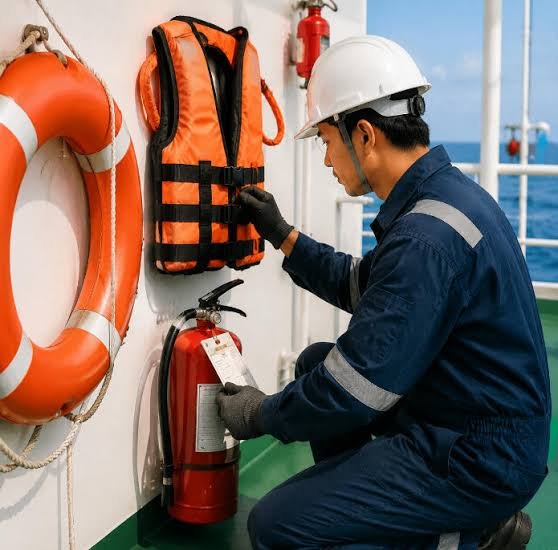
A basic inspection should consider whether the extinguisher remains in its designated location, is accessible, appears undamaged, and has appropriate pressure where a pressure indicator is provided. The cylinder should also be checked for signs of corrosion or other physical damage.
Professional maintenance is more comprehensive than a simple visual check. Depending on the extinguisher type and applicable requirements, servicing may include examination, recharging, parts inspection, and pressure testing.
The Building Code of Pakistan Fire Safety Provisions refers to NFPA 10 or another approved code or standard for hydrostatic testing of portable fire extinguishers. It also specifies that an extinguisher cylinder that fails the required examination or pressure test should be condemned rather than returned to service.
Keep Extinguishers Accessible
An extinguisher cannot provide useful protection if people cannot reach it when necessary.
Equipment should not be hidden behind stored goods, furniture, boxes, or other obstructions. Its location should also remain clearly identifiable.
During routine maintenance, businesses should check whether changes to the building have affected access. A storage area that was empty when an extinguisher was installed may later become crowded, making the equipment difficult to reach.
Maintaining clear access is a simple but important part of fire safety.
Maintain the Fire Alarm System
A fire alarm system provides early warning, which can be especially important when people are sleeping, working in different areas, or unfamiliar with a particular building.
A professional maintenance program may include inspection and testing of detectors, control panels, alarm notification devices, manual call points, backup power, and other system components.
Pakistan’s fire-safety provisions address building fire alarm and automatic detection systems and specify that systems required by the provisions should be installed according to NFPA 70, NFPA 72, or another approved code or standard.
For buildings that rely on a fire alarm system in Pakistan, routine inspection is important because a system that appears normal may still contain a fault that is not immediately obvious.
Why Fire Alarm Maintenance Is Important
Over time, dust, humidity, environmental conditions, component aging, and general wear can affect fire detection equipment.
For example, a detector may become contaminated, a backup battery may lose capacity, or a control panel may display a fault. Regular maintenance can help identify these conditions before they become more serious.
Flame Defender notes that scheduled maintenance can involve cleaning, testing, and checking fire alarm systems, while older or underperforming systems may require upgrades.
This is why installing an alarm system should be considered the beginning of a maintenance program, not the end.
Check Smoke and Heat Detectors
Smoke and heat detectors are important parts of many fire detection systems.
Maintenance should verify that detectors are present where required, are not visibly damaged or obstructed, and are appropriately maintained according to the manufacturer’s instructions and applicable standards.
Environmental conditions also matter. Areas with dust, humidity, steam, or other conditions that can affect detection should receive appropriate technical attention.
The goal is to maintain reliable detection while also minimizing unnecessary nuisance alarms.
Inspect Alarm Control Panels
The control panel acts as an important part of many fire alarm systems. It receives information from connected devices and communicates system conditions.
During maintenance, technicians may check:
- Panel condition
- Power supply
- Backup batteries
- Fault indicators
- System connections
- Alarm signals
- Supervisory conditions
- Event or fault history where applicable
The Building Code of Pakistan Fire Safety Provisions also addresses fire alarm equipment that requires resetting or rewinding after testing or an alarm, stating that such equipment should be returned to normal operation promptly.
Maintain Backup Power
A fire alarm system may depend on backup batteries or another secondary power source so that essential functions remain available when normal electrical power is interrupted.
Battery condition should therefore form part of appropriate system maintenance.
Weak or aging batteries can create system faults or reduce reliability. Maintenance records should document relevant battery inspections, testing, and replacement when required.
Because electrical systems can be technically complex, testing and servicing should be performed by appropriately trained personnel.
Do Not Ignore Fire Suppression Systems
Fire suppression systems can include different technologies depending on the protected area and the type of hazard.
Examples include:
- Water-based systems
- Clean-agent systems
- Foam systems
- Carbon-dioxide systems
- Dry-chemical systems
- Specialized kitchen suppression systems
The correct system depends on the building and the hazard being protected.
Maintenance can involve inspecting detection devices, control equipment, piping, valves, cylinders, nozzles, alarms, and other components. Flame Defender describes inspection, testing, preventive maintenance, and annual servicing as part of its fire suppression services.
Specialized suppression equipment should always be maintained by qualified professionals because incorrect servicing can compromise system reliability.
Inspect Hydrant and Water-Based Systems
Larger buildings may use hydrants, hose systems, pumps, tanks, sprinklers, or other water-based fire-protection equipment.
Maintenance programs should consider the condition and accessibility of relevant equipment and whether required inspection and testing have been completed.
Water-based systems can contain numerous components, meaning maintenance should be systematic rather than limited to a single visual inspection.
Any deficiencies should be documented and addressed through an appropriate professional service process.
Check Emergency Lighting and Signage
Fire equipment is only one part of emergency preparedness.
During a power interruption or emergency, occupants may need clear information about where to go. Emergency lighting and exit signs can therefore support evacuation by helping people identify routes and exits.
Maintenance should check whether signs remain visible and whether emergency lighting equipment is functional according to its intended design and applicable requirements.
Changes to walls, partitions, furniture, storage areas, or building layouts can also affect visibility and escape routes.
Keep Fire Doors in Good Condition
Fire doors can play an important role in limiting the spread of fire and smoke between designated areas.
Maintenance should look for obvious damage, unsuitable alterations, blocked doors, or other conditions that could affect their intended function.
Doors and their associated hardware should be maintained according to the applicable building requirements and manufacturer’s specifications.
Fire doors should not be treated as ordinary doors because their safety role depends on their proper installation and condition.
Create a Maintenance Schedule
A written maintenance schedule makes fire-safety responsibilities easier to manage.
A building can maintain a simple record showing:
| Equipment | Maintenance Activity | Date | Findings | Next Action |
|---|---|---|---|---|
| Fire extinguishers | Inspection/service | Recorded date | Condition noted | Follow-up if required |
| Fire alarm | Inspection/testing | Recorded date | System status | Repair if required |
| Emergency lighting | Functional check | Recorded date | Condition noted | Replace/repair if needed |
| Suppression system | Professional inspection | Recorded date | Test results | Correct deficiencies |
| Fire doors | Condition inspection | Recorded date | Observations | Maintenance if needed |
The exact frequency should be determined according to the equipment, manufacturer instructions, applicable standards, building requirements, and recommendations from qualified professionals.
Keep Proper Maintenance Records
Documentation is an important part of a fire-safety program.
Records can help building managers understand when equipment was last inspected, what problems were found, and which corrective actions were completed.
Useful records may include:
- Inspection reports
- Testing results
- Service certificates
- Repair records
- Replacement records
- Fire alarm fault reports
- Extinguisher service records
- Suppression-system reports
- Training records
- Fire-drill records
Good documentation can also help identify recurring problems.
For example, if the same alarm fault appears repeatedly, maintenance records can help technicians investigate whether a larger issue needs attention.
Train Responsible Staff
Maintenance is not only a technical responsibility.
Staff members who are responsible for a building should know how to recognize obvious equipment problems and report them through the appropriate safety process.
They should also understand what the building’s fire alarm means and know the established evacuation procedure.
Training should never encourage untrained people to approach a dangerous fire. The priority during a serious emergency is to follow the building’s emergency plan, evacuate, and allow emergency professionals to handle the incident.
Watch for Environmental Conditions
Pakistan includes a wide range of environmental conditions, from hot and dusty areas to humid coastal environments.
Fire equipment can be affected by the environment in which it is installed. Dust, moisture, heat, corrosion, and physical exposure can all create maintenance concerns depending on the equipment.
This makes regular inspection particularly useful.
A maintenance plan should consider the conditions in which the equipment operates rather than assuming that every component will age in the same way.
Maintenance After a Fire Alarm or Other Event
Equipment should not simply be assumed to be ready after it has activated.
After a fire alarm, system fault, discharge, or other significant event, appropriate equipment should be inspected and returned to normal operating condition by qualified personnel.
The Building Code of Pakistan Fire Safety Provisions specifically addresses returning equipment that requires resetting after testing or an alarm to normal operation promptly.
Any equipment that has been used or damaged should be assessed before being relied upon again.
Know When Equipment Needs Replacement
Maintenance can extend the useful life of equipment, but it cannot make every old or damaged component safe indefinitely.
Replacement may become appropriate when equipment:
- Has significant physical damage
- Repeatedly develops faults
- Fails required testing
- Is obsolete or unsupported
- Cannot be properly serviced
- No longer suits the building’s needs
- Has reached a condition where continued use is inappropriate
The decision should be based on professional assessment and applicable requirements rather than simply on age.
Choose Qualified Maintenance Professionals
Fire equipment should be serviced by people with appropriate technical knowledge and experience.
The Pakistan Engineering Council identifies installation, commissioning, and maintenance of fire detection, alarm, and suppression systems as a specific engineering category.
When selecting a service provider, consider:
- Relevant technical experience
- Trained personnel
- Clear maintenance procedures
- Appropriate testing equipment
- Detailed documentation
- Familiarity with applicable standards
- Ability to service the specific equipment installed
A maintenance company should be able to explain what it inspected, what it found, and what action is recommended.
Maintenance Is Better Than Waiting for a Problem
Waiting until equipment fails can create unnecessary risk.
Preventive maintenance aims to identify problems before an emergency requires the equipment to perform. This approach applies to fire extinguishers, alarms, detection systems, suppression systems, emergency lighting, and other safety equipment.
Regular maintenance also helps building owners understand the condition of their fire-protection systems and plan repairs or replacements instead of dealing with unexpected failures.
Final Thoughts
Fire equipment maintenance is one of the basic foundations of a reliable fire-safety program. Extinguishers, alarms, detectors, suppression systems, emergency lighting, and other equipment all require appropriate inspection and care.
For buildings using a fire alarm system in Pakistan, regular professional testing and maintenance can help identify faults, maintain system reliability, and support compliance with applicable fire-safety requirements. The Building Code of Pakistan Fire Safety Provisions 2016 provides an important national reference for fire-safety practices.
Organizations such as Flame Defender provide fire alarm, suppression, extinguisher, inspection, testing, and maintenance services for different types of properties.
Ultimately, maintenance is not about having paperwork that says equipment was checked. It is about ensuring that the systems people depend on during an emergency are kept in an appropriate working condition.
FAQs
1. Why is fire equipment maintenance important?
Maintenance helps identify faults, damage, aging components, and other problems before an emergency occurs. It helps keep fire-safety equipment reliable and ready for its intended purpose.
2. How often should fire equipment be maintained?
The frequency depends on the type of equipment, manufacturer instructions, applicable standards, building requirements, and environmental conditions. Some equipment needs routine checks, while professional servicing and testing may be required at specific intervals.
3. Does a fire alarm system need regular maintenance?
Yes. Fire alarm systems should be appropriately inspected, tested, and maintained. Detectors, control panels, batteries, notification devices, and other components can develop faults over time.
4. What should be checked during fire extinguisher maintenance?
Depending on the extinguisher type and applicable requirements, maintenance may include checking its physical condition, accessibility, pressure, components, extinguishing agent, recharge requirements, and applicable pressure-testing requirements.
5. Who should maintain fire safety equipment?
Fire safety equipment should be maintained by appropriately trained and qualified professionals, particularly for technical systems such as fire alarms and suppression systems. Professional servicing helps ensure that inspection, testing, repairs, and documentation are handled correctly.